Maharashtra Clears Plan to Mitigate Human-Wildlife Conflict
Source:Indian Express ↗
Why It Matters
Provides a strong case study of a state-level, technology-driven approach (AI alerts, rapid rescue teams, sterilization centers) to manage the escalating challenge of man-animal conflict, crop depredation, and wildlife conservation on forest fringes.
Summary
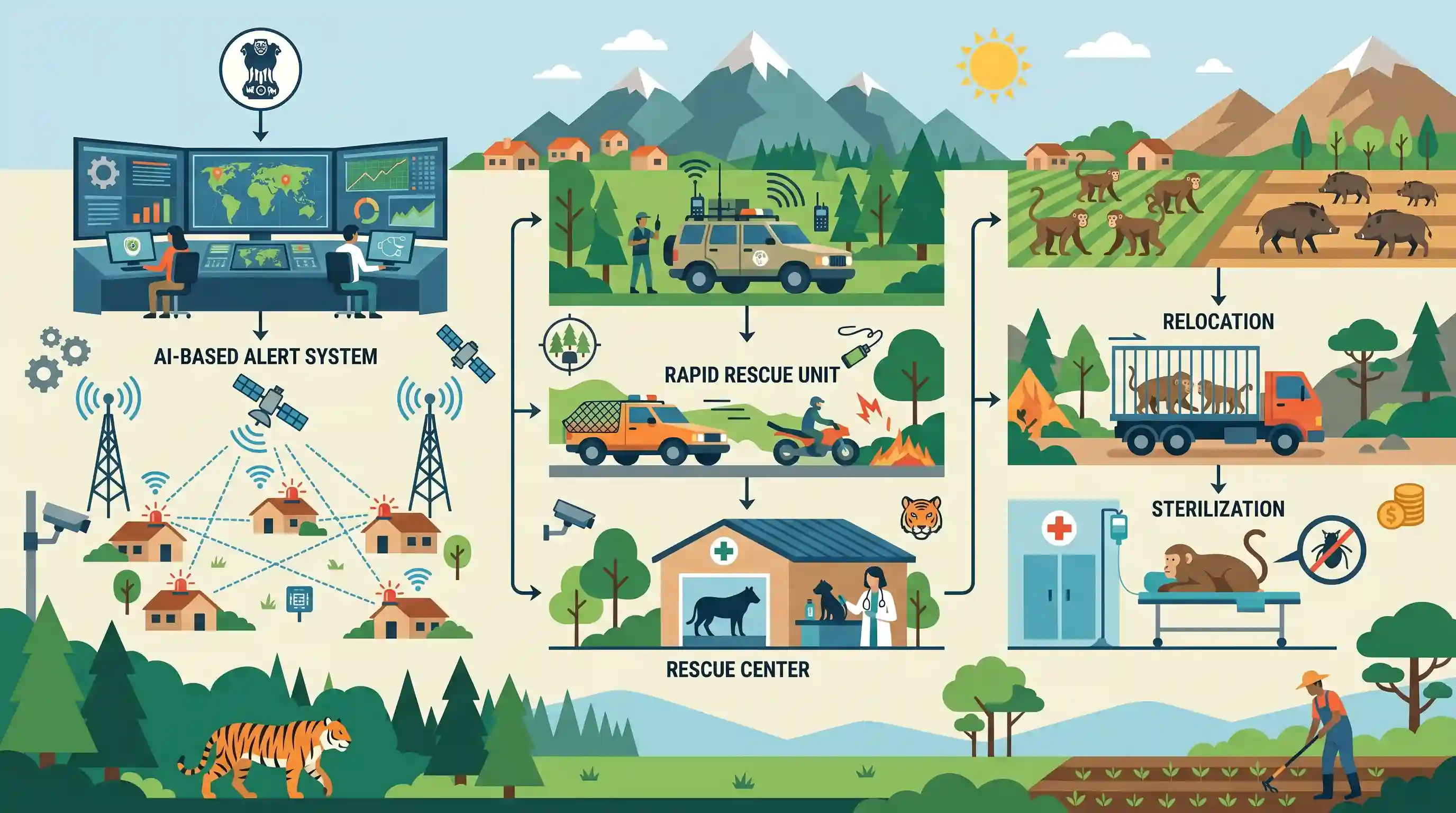
In response to escalating human-wildlife conflicts, highlighted by recent fatal tiger attacks in Chandrapur, the Maharashtra State Wildlife Board has sanctioned a Rs 260 crore mitigation plan. The strategy combines advanced technology, such as an AI-based alert system for 1,000 villages and high-tech control rooms, with extensive ground infrastructure including rescue centers, primary response teams, and rapid rescue units. Additionally, the plan introduces specialized measures to address crop damage by relocating and sterilizing problem species like monkeys and wild boars.
Key Points
- The Maharashtra Wildlife Board approved a Rs 260 crore comprehensive action plan to mitigate human-wildlife conflict after fatal tiger attacks in Chandrapur.
- The state will deploy an AI-based early warning system across 1,000 forest-fringe villages to alert locals about wild animals outside protected areas.
- Infrastructure upgrades include the establishment of 10 high-tech control rooms, rescue centers, 10 transit treatment facilities, and 20 rapid rescue teams.
- To combat crop depredation, dedicated mobile squads will safely capture and relocate species like monkeys and wild boars, while sterilization centers will help control their population.
Important Terms
State Board for Wildlife (SBWL)

A statutory body constituted under Section 6 of the Wildlife (Protection) Act, 1972, chaired by the Chief Minister, to advise the state government on wildlife conservation and protected area management.
UPSC context
GS Paper III: Environment & Biodiversity. Important for understanding statutory frameworks for wildlife protection and center-state cooperation in conservation.
Primary Response Teams (PRTs)
Community-led groups of local villagers trained to provide the first level of response and early warning during human-wildlife encounters, assisting the Forest Department in conflict mitigation.
UPSC context
GS Paper III: Environment. Tests concepts of community-based conservation and the role of local stakeholders in disaster/conflict management.
Rapid Rescue Units (RRUs)
Specialized, mobile squads equipped with advanced tools (like tranquilizers and rescue vans) for the immediate capture, treatment, and relocation of wild animals involved in emergencies or crop damage.
UPSC context
GS Paper III: Disaster Management/Environment. Focuses on institutional mechanisms and infrastructure for mitigating biological disasters and human-animal conflict.
AI-based Wildlife Alert System
A technology-driven early warning mechanism that uses sensors and artificial intelligence to track wildlife movement near human settlements, sending real-time alerts to villagers to prevent fatal encounters.
UPSC context
GS Paper III: Science & Technology and Environment. Tests the application of emerging technologies (AI/IoT) in solving environmental and social challenges.
Critical Wildlife Habitat (CWH)
Areas within National Parks and Sanctuaries that must be kept 'inviolate' for wildlife conservation, as defined under the Forest Rights Act, 2006, requiring scientific evidence and community consent.
UPSC context
GS Paper III: Environment and GS Paper II: Governance. Crucial for questions on tribal rights versus wildlife conservation and the Forest Rights Act.
Prelims Trap
"State Wildlife Boards can independently declare crop-raiding species as 'Vermin' under Schedule V of the WPA."
Only the Central Government can declare species as vermin. Furthermore, the Wildlife (Protection) Amendment Act 2022 completely abolished the dedicated 'Vermin' schedule (formerly Schedule V).
Static Concepts Connected
What is the statutory basis and composition of State Boards for Wildlife (SBWL)?
- Statutory backing: Mandated under Section 6 of the Wildlife (Protection) Act, 1972, to advise state governments on wildlife policy and protected areas.
- Chairperson: The SBWL is chaired by the Chief Minister of the State/UT, not the Environment or Forest Minister (unlike the NBWL, which is chaired by the PM).
How do ecological concepts like 'Carrying Capacity' and 'Edge Effect' relate to this conflict?
- Carrying Capacity: The maximum population size a habitat can sustainably support. When tiger populations in reserves like Tadoba exceed this, territorial disputes push sub-adults into human-dominated landscapes.
- Edge Effect: Changes in species structures at the boundary of two habitats (e.g., forest and agriculture). Buffer zones experience high edge effect, leading to frequent inter-species conflict.
Cross-Topic Patterns
AI alerts as Disaster Management
Using AI to track tiger movement treats human-wildlife conflict as a predictable disaster (similar to railways' Gajraj system), shifting policy from post-facto compensation to proactive mitigation.
NTFP collection vs. Wildlife Conservation
Socio-economic reliance on Minor Forest Produce like Tendu leaves under the Forest Rights Act forces rural communities into buffer zones, acting as a major driver of fatal human-carnivore encounters.

A 2026 prelims question will likely link WPA 2022 schedule changes regarding population control with the powers of State Wildlife Boards.
Linked PYQs · 1
Linked PYQs · 1
- 2022PrelimsGS1
With reference to Indian laws about wildlife protection, consider the following statements : 1. Wild animals are the sole property of the government. 2. When a wild animal is declared protected, such animal is entitled for equal protection whether it is found in protected areas or outside. 3. Apprehension of a protected wild animal becoming a danger to human life is sufficient ground for its capture or killing. Which of the statements given above is/are correct?
