Rupee Depreciation Impacts Macroeconomic Stability And Growth Targets
Source:The Hindu ↗
Why It Matters
Currency depreciation and its impact on the macroeconomic fundamentals (inflation, exports/imports, capital flight) is a core component of the GS3 syllabus and frequently tested in Prelims. Understanding both the negative impacts (LRS outflows, imported inflation) and potential buffers (Forex reserves, bond yields) is essential for holistic economic analysis.
Summary
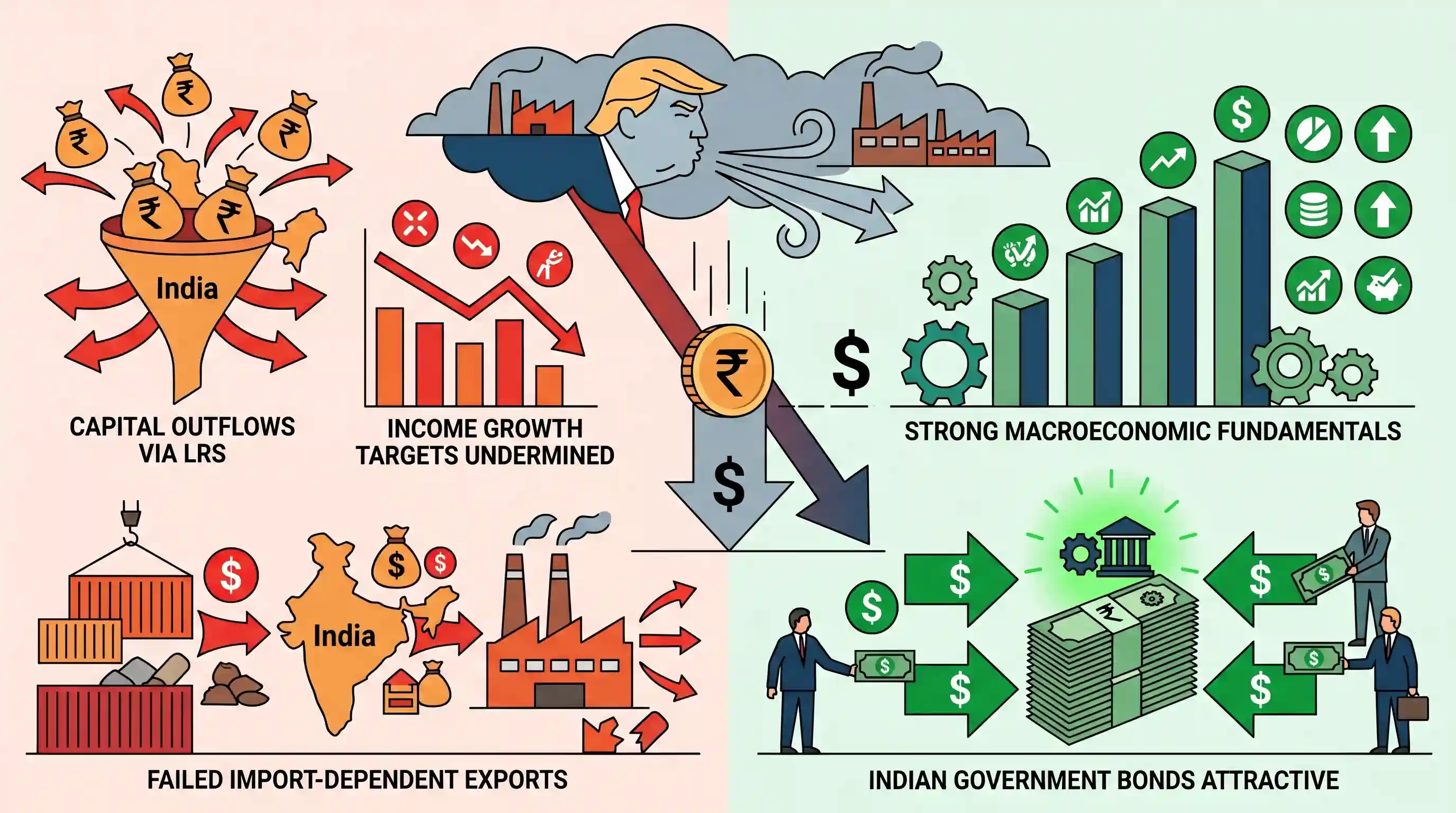
The recent depreciation of the Indian Rupee past the ₹91 mark against the US Dollar has divided economic experts. While some argue it undermines India's income growth targets by spurring capital outflows via the Liberalised Remittance Scheme (LRS) and failing to aid import-dependent exports, others believe India's macroeconomic fundamentals remain strong. The decline, partly triggered by the threat of US tariffs under the incoming Trump administration, could also make Indian Government Bonds more attractive to foreign investors, although it underscores concerns about India's structural reliance on foreign capital.
Key Points
- The Indian Rupee recently breached the ₹91 mark against the US Dollar, sparking debate over its impact on achieving income growth targets.
- Experts warn that continuous depreciation increases the cost of capital and fails to boost export competitiveness, as Indian exports often rely heavily on imported components and lack strong pricing power.
- A weakening rupee encourages domestic wealth to flow out into dollar-denominated assets via the Liberalised Remittance Scheme (LRS) or physical gold, tightening domestic liquidity.
- Conversely, some fund managers view the depreciation as a short-term aberration driven by external volatility and proposed US tariffs, asserting that India's robust forex reserves and GDP growth keep macroeconomic fundamentals intact.
- The depreciated rupee is seen by some as an opportunity to attract foreign investment into Indian Government Bonds (IGBs), which have become comparatively cheaper.
Important Terms
Liberalised Remittance Scheme (LRS)

An RBI policy allowing resident individuals to remit up to USD 250,000 per financial year for permissible current or capital account transactions, such as education, travel, or foreign asset investments.
UPSC context
GS III (Indian Economy): Essential for topics on the external sector, capital account convertibility, and FEMA regulations.
Rupee Depreciation
The fall in the value of the Indian Rupee against foreign currencies (like the US Dollar) driven by market forces such as high dollar demand, trade deficits, or capital flight.
UPSC context
GS III (External Sector): Tests understanding of exchange rate dynamics and their impact on inflation and trade balance.
Indian Government Bonds (IGBs)
Marketable debt instruments issued by the central or state governments to fund fiscal requirements, recently made more accessible to foreign investors through inclusion in global bond indices.
UPSC context
GS III (Investment/Resources): Relevant for debt market reforms, sovereign debt management, and Foreign Portfolio Investment (FPI) trends.
Capital Outflow
The movement of financial assets and money out of a country, typically occurring when foreign investors withdraw capital or residents move savings abroad during periods of economic uncertainty.
UPSC context
GS III (Balance of Payments): Key to understanding currency volatility and the vulnerability of the capital account to global shocks.
Macroeconomic Fundamentals
The core indicators of an economy’s health, including GDP growth, inflation, fiscal deficit, and current account balance, which determine its resilience against external market volatility.
UPSC context
GS III (Growth/Development): Fundamental for assessing long-term economic stability and policy effectiveness in UPSC Mains.
Import-Dependent Exports
An export structure where finished products (like jewelry or electronics) require significant imported inputs, meaning currency depreciation fails to provide a major competitive advantage due to rising input costs.
UPSC context
GS III (Trade): Tests structural knowledge of India’s trade basket and the nuances of the export-import value chain.
Prelims Trap
Rupee depreciation automatically makes all Indian exports more competitive globally.
UPSC often traps aspirants with absolute statements. Depreciation fails to aid export competitiveness in sectors highly dependent on imported raw materials (e.g., electronics, gems) due to rising input costs.
Static Concepts Connected
What are the key features of the Liberalised Remittance Scheme (LRS)?
- Eligibility: Only resident individuals (including minors) can remit; corporates, partnership firms, Hindu Undivided Families (HUFs), and trusts are strictly excluded.
- Annual Limit: Individuals can freely remit up to $250,000 per financial year for permissible current or capital account transactions.
- Prohibitions: Cannot be used for trading in foreign exchange abroad, margin calls, or purchasing lottery tickets.
How does continuous currency depreciation impact macroeconomic stability?
- Corporate Debt: It significantly increases the rupee-equivalent debt servicing burden for domestic firms holding unhedged dollar-denominated External Commercial Borrowings (ECBs).
- Imported Inflation: It raises the domestic cost of inelastic imported essentials like crude oil and edible oils, directly stoking retail inflation.
- Capital Flight: A weakening currency can trigger a feedback loop where domestic wealth flees into dollar-denominated assets or physical gold, tightening local liquidity.
Cross-Topic Patterns
Bond Indices & Currency Valuations
A depreciating rupee makes Indian Government Bonds cheaper in dollar terms, potentially accelerating FPI inflows under the Fully Accessible Route following India's JP Morgan index inclusion.
LRS Outflows vs. Forex Intervention
Surging capital flight through LRS tightens domestic liquidity, directly testing the RBI's willingness to deploy its forex reserves to smooth out rupee volatility against US protectionist tariffs.

Expect a multi-statement question linking rupee depreciation impacts on LRS limits, unhedged ECBs, and bond index FPI inflows in 2026.
Linked PYQs · 3
Linked PYQs · 3
- 2021PrelimsGS1
Consider the following statements : The effect of devaluation of a currency is that it necessarily 1. improves the competitiveness of the domestic exports in the foreign markets 2. increases the foreign value of domestic currency 3. improves the trade balance Which of the above statements is/are correct?
- 2022PrelimsGS1
Consider the following statements: 1. Tight monetary policy of US Federal Reserve could lead to capital flight. 2. Capital flight may increase the interest cost of firms with existing External Commercial Borrowings (ECBs). 3. Devaluation of domestic currency decreases the currency risk associated with ECBs. Which of the statements given above are correct?
- 2018MainsGS3
How would the recent phenomena of protectionism and currency manipulations in world trade affect macroeconomic stability of India?
