Victim Centric Paradigm Shift in Sex Trafficking Legal Framework
Source:The Hindu ↗
આ શા માટે મહત્વનું છે
Understanding the legal and human rights nuances of human trafficking is critical for UPSC aspirants. It overlaps with constitutional fundamental rights (Article 23), social justice (rehabilitation of vulnerable women and children), and internal security (organized crime).
સારાંશ
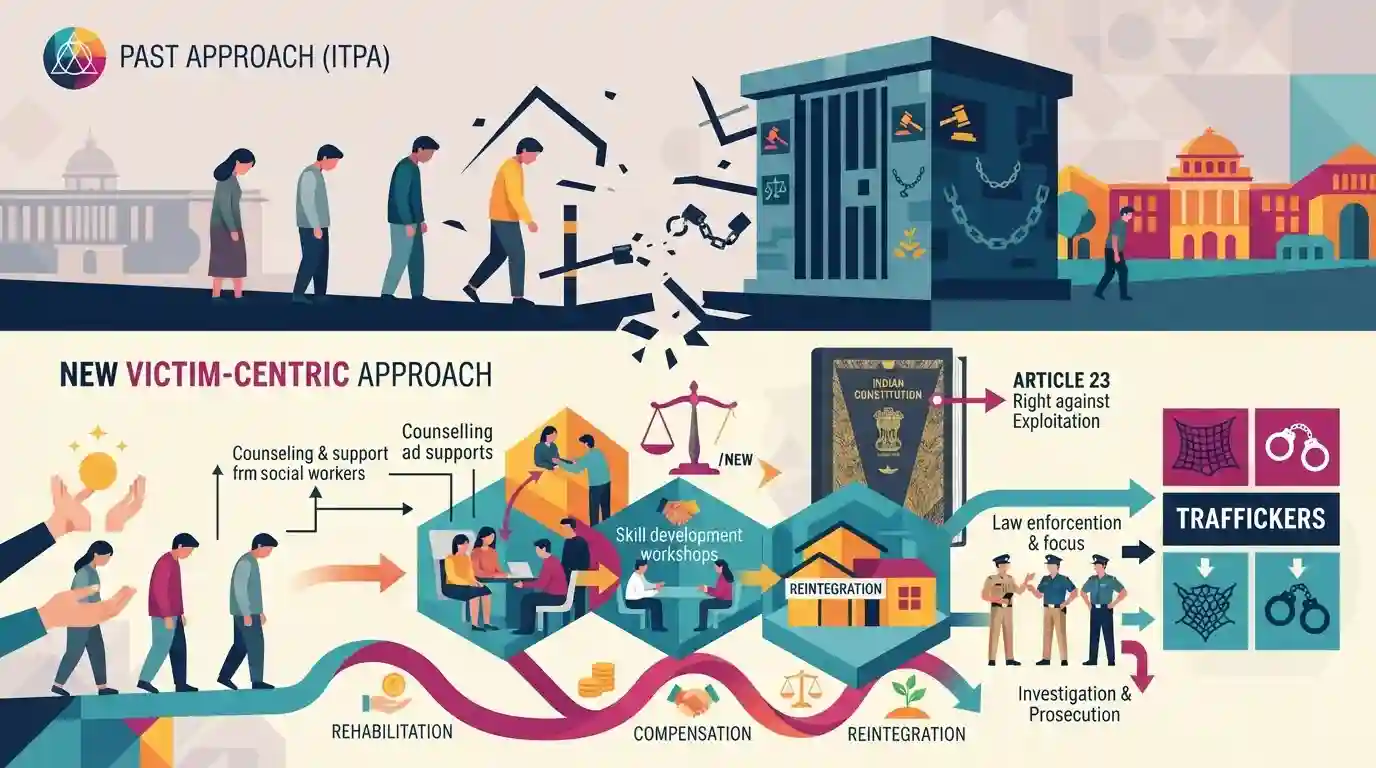
The article highlights a necessary paradigm shift in India's legal and law enforcement approach to sex trafficking, advocating for a strictly 'victim-centric' model. Historically, individuals trapped in sex trafficking have often faced criminalization and stigma under the Immoral Traffic (Prevention) Act (ITPA). The proposed shift emphasizes recognizing them as victims of organized crime and exploitation. It calls for upholding their fundamental rights, anchored in Article 23 of the Constitution, by prioritizing the prosecution of traffickers and ensuring holistic rehabilitation, compensation, and reintegration for survivors rather than revictimizing them within the criminal justice system.
મુખ્ય મુદ્દા
- A paradigm shift in the criminal justice system is needed to treat individuals caught in sex trafficking as victims rather than criminals.
- The application of the Immoral Traffic (Prevention) Act (ITPA) must prioritize the prosecution of organized traffickers and syndicate operators over penalizing the trafficked.
- Article 23 of the Constitution provides a strong fundamental right against human trafficking, mandating active state protection and intervention.
- Judicial guidelines emphasize the critical need for holistic rehabilitation, including compensation, psychological support, and vocational training, to prevent re-trafficking.
મહત્વપૂર્ણ શબ્દો
Immoral Traffic (Prevention) Act (ITPA)

India's primary law preventing human trafficking for commercial sexual exploitation. It penalizes brothel-keeping and pimping but historically penalized victims, driving the need for a restorative, victim-centric overhaul in recent times.
UPSC context
GS Paper 2 (Vulnerable Sections). Crucial for evaluating legislative mechanisms for women's protection and the ongoing debate over decriminalizing trafficking victims.
Article 23 of the Indian Constitution
A Fundamental Right guaranteeing the Right Against Exploitation. It explicitly prohibits human trafficking, begar (unpaid forced labor), and other similar forms of forced labor, making their contravention a legally punishable offense.
UPSC context
GS Paper 2 (Indian Constitution). Foundational for understanding constitutional safeguards against human trafficking, forced labor, and evaluating rights-based judicial interventions.
Victim-centric Approach
A law enforcement and judicial model prioritizing the trauma, rights, and rehabilitation of survivors. It emphasizes identifying and supporting trafficked individuals as victims of organized crime rather than prosecuting them as offenders.
UPSC context
GS Paper 2 & 4 (Social Justice & Ethics). Relevant for analyzing the evolution of India's criminal justice system from punitive to restorative justice frameworks.
National Human Rights Commission (NHRC)
A statutory watchdog established under the Protection of Human Rights Act, 1993. It monitors rights violations, takes suo motu cognizance of trafficking cases, and issues guidelines to protect exploited populations.
UPSC context
GS Paper 2 (Statutory Bodies). Tests knowledge of institutional frameworks for human rights protection, their mandates, and effectiveness in addressing organized exploitation.
પ્રિલિમ્સ ટ્રેપ
"The Ujjawala scheme is a flagship government initiative for clean cooking fuel distribution."
UPSC frequently exploits naming similarities. 'Ujjawala' (Ministry of WCD) focuses on rescuing and rehabilitating trafficking victims, whereas 'PM Ujjwala Yojana' (PMUY) provides LPG connections.
સંલગ્ન સ્થિર ખ્યાલો
What is the constitutional framework against exploitation under Article 23?
- Prohibition: Article 23(1) prohibits traffic in human beings, begar, and other similar forms of forced labour.
- Universal Protection: The right is available to both citizens and non-citizens, protecting them against both the State and private individuals.
- Exception: Article 23(2) allows the State to impose compulsory service for public purposes, provided there is no discrimination based on religion, race, caste, or class.
What is the UN Palermo Protocol?
- Parent Treaty: It is a 2000 protocol supplementing the UN Convention against Transnational Organized Crime (UNTOC), specifically targeting trafficking in persons.
- 3P Paradigm: It established the first global framework based on the 3P paradigm: Prevention of trafficking, Protection of victims, and Prosecution of traffickers.
- India's Status: India ratified the UNTOC and the Palermo Protocol in 2011, aligning its domestic framework with global anti-trafficking standards.
આંતર-વિષય પેટર્ન
Internal Security + Dark Web
Sex trafficking syndicates increasingly utilize the dark web and cryptocurrencies for anonymity, bridging GS-2 welfare for vulnerable sections with GS-3 cyber security and money laundering threats.
Federalism + Law Enforcement
Since 'Police' is a State subject, dismantling inter-state trafficking networks requires cooperative federal mechanisms and central agency (e.g., NIA) interventions, linking organized crime to federalism.

Expect a multi-statement Prelims question testing the scope of Article 23 alongside the UN Palermo Protocol and India's ITPA provisions.
સંલગ્ન PYQ · 3
સંલગ્ન PYQ · 3
- 2023MainsGS2
Explain the constitutional perspectives of Gender Justice with the help of relevant Constitutional Provisions and case laws.
- 2018MainsGS3
India's proximity to two of the world's biggest illicit opium-growing states has enhanced her internal security concerns. Explain the linkages between drug trafficking and other illicit activities such as gunrunning, money laundering and human trafficking. What counter-measures should be taken to prevent the same?
- 2021MainsGS2
Though the Human Rights Commissions have contributed immensely to the protection of human rights in India, yet they have failed to assert themselves against the mighty and powerful. Analyzing their structural and practical limitations, suggest remedial measures.
