Global Nuclear Deterrence Architecture and Strategic Stability
Source:The Hindu ↗
Why It Matters
The collapse of global arms control treaties and the modernization of nuclear arsenals by major powers directly impact global stability. For UPSC aspirants, understanding these shifts is crucial for analyzing India's evolving nuclear doctrine, its foreign policy calculations, and the broader geopolitical implications for GS-II (International Relations) and GS-III (Security).
Summary
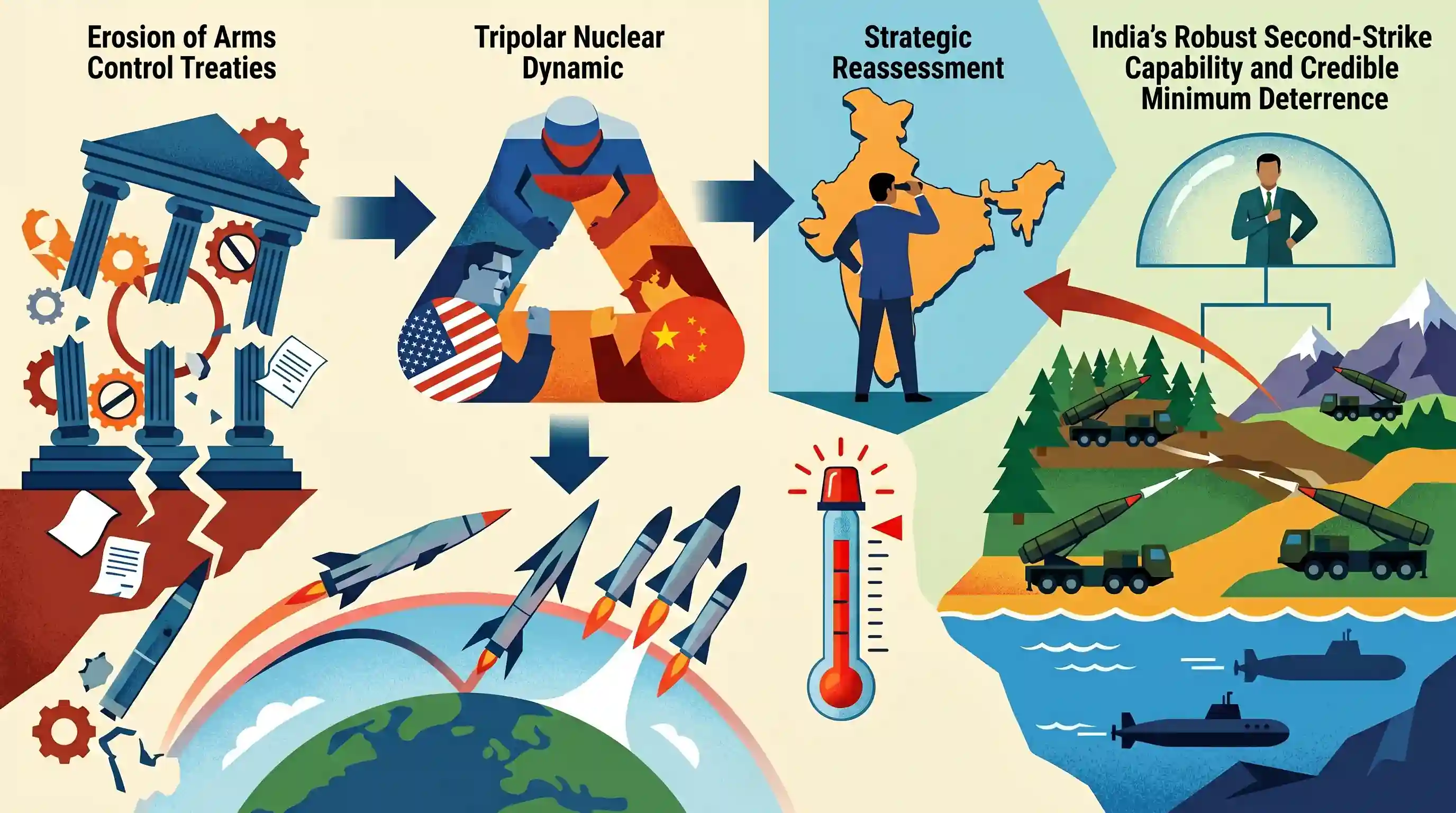
The article examines the profound transformation in global nuclear deterrence driven by the erosion of traditional arms control treaties, the emergence of a tripolar nuclear dynamic involving the US, Russia, and China, and the advent of disruptive delivery technologies. As frameworks like New START unravel and powers modernize their arsenals with hypersonics and MIRVs, the threshold for nuclear escalation is lowering. This evolving security paradigm forces non-proliferation advocates and nations like India to reassess their strategic deterrence postures, emphasizing the need for robust second-strike capabilities to maintain the viability of credible minimum deterrence.
Key Points
- The global nuclear deterrence architecture is shifting from a Cold War-era bipolar model (US-Russia) to a more complex tripolar dynamic involving China's expanding arsenal.
- The suspension and erosion of pivotal arms control frameworks, such as the New START and INF treaties, risk initiating a new, unchecked global arms race.
- Emerging technologies, including hypersonic missiles, Multiple Independently targetable Reentry Vehicles (MIRVs), and AI integration, are compressing decision times and threatening second-strike survivability.
- For India, the shifting landscape necessitates continuous modernization of its nuclear triad to ensure the credibility of its 'Credible Minimum Deterrence' and 'No First Use' doctrine against dual threats from China and Pakistan.
Prelims Trap
India's 'No First Use' doctrine strictly prohibits nuclear retaliation against non-nuclear attacks.
India's 2003 nuclear doctrine explicitly retains the option of nuclear retaliation in the event of a major attack against India, or Indian forces anywhere, using biological or chemical weapons.
Static Concepts Connected
What are the key pillars of India's 2003 Nuclear Doctrine?
- No First Use: Nuclear weapons will only be used in retaliation against a nuclear attack on Indian territory or forces anywhere.
- Minimum Deterrence: Maintaining a survivable arsenal sufficient to inflict unacceptable damage, actively avoiding a quantitative arms race.
- Civilian Control: Retaliatory attacks can only be authorized by the civilian political leadership through the Nuclear Command Authority.
How do MIRVs and Hypersonic glide vehicles alter strategic deterrence?
- MIRV Technology: Allows a single ballistic missile to deliver multiple warheads to distinct targets, easily overwhelming standard anti-ballistic missile defense shields.
- Hypersonic Missiles: Travel over Mach 5 with unpredictable, maneuverable trajectories in the upper atmosphere, bypassing traditional early-warning radar systems and compressing response times.
Cross-Topic Patterns
Second-Strike & Project ATV (SSBNs)
India's pursuit of credible minimum deterrence relies heavily on SSBNs (INS Arihant, Arighat), linking static nuclear doctrine to indigenous naval modernization (Project ATV) and maritime security in GS3.
Hypersonics, MIRVs and FOBS weaponization
The erosion of bilateral treaties (New START) often parallels China's testing of Fractional Orbital Bombardment Systems (FOBS), connecting nuclear deterrence directly to the Outer Space Treaty and space weaponization.

Expect a multi-statement question interlinking MIRV/Agni-V tech with India's NFU caveats and the lapse of US-Russia arms treaties.
Linked PYQs · 3
Linked PYQs · 3
- 2011PrelimsGS1
The "New START" treaty was in the news. What is this treaty?
- 2015PrelimsGS1
Consider the following countries: 1. China 2. France 3. India 4. Israel 5. Pakistan Which among the above are Nuclear Weapons States as recognized by the Treaty on the Non-Proliferation of Nuclear Weapons, commonly known as Nuclear Non-Proliferation Treaty (NPT)?
- 2018PrelimsGS1
What is/are the consequence/consequences of a country becoming the member of the 'Nuclear Suppliers Group'? 1. It will have access to the latest and most efficient nuclear technologies. 2. It automatically becomes a member of "The Treaty on the Non-Proliferation of Nuclear Weapons (NPT)". Which of the statements given above is/are correct?
