India Free Trade Agreements and Industrial Competitiveness
Source:The Hindu ↗
কেন এটি গুরুত্বপূর্ণ
The debate between domestic protectionism and open trade (via FTAs) is central to India's economic strategy. Understanding this dichotomy is essential for tackling Mains questions on industrial competitiveness, the success of 'Make in India', and India's evolving stance on global trade governance.
সারসংক্ষেপ
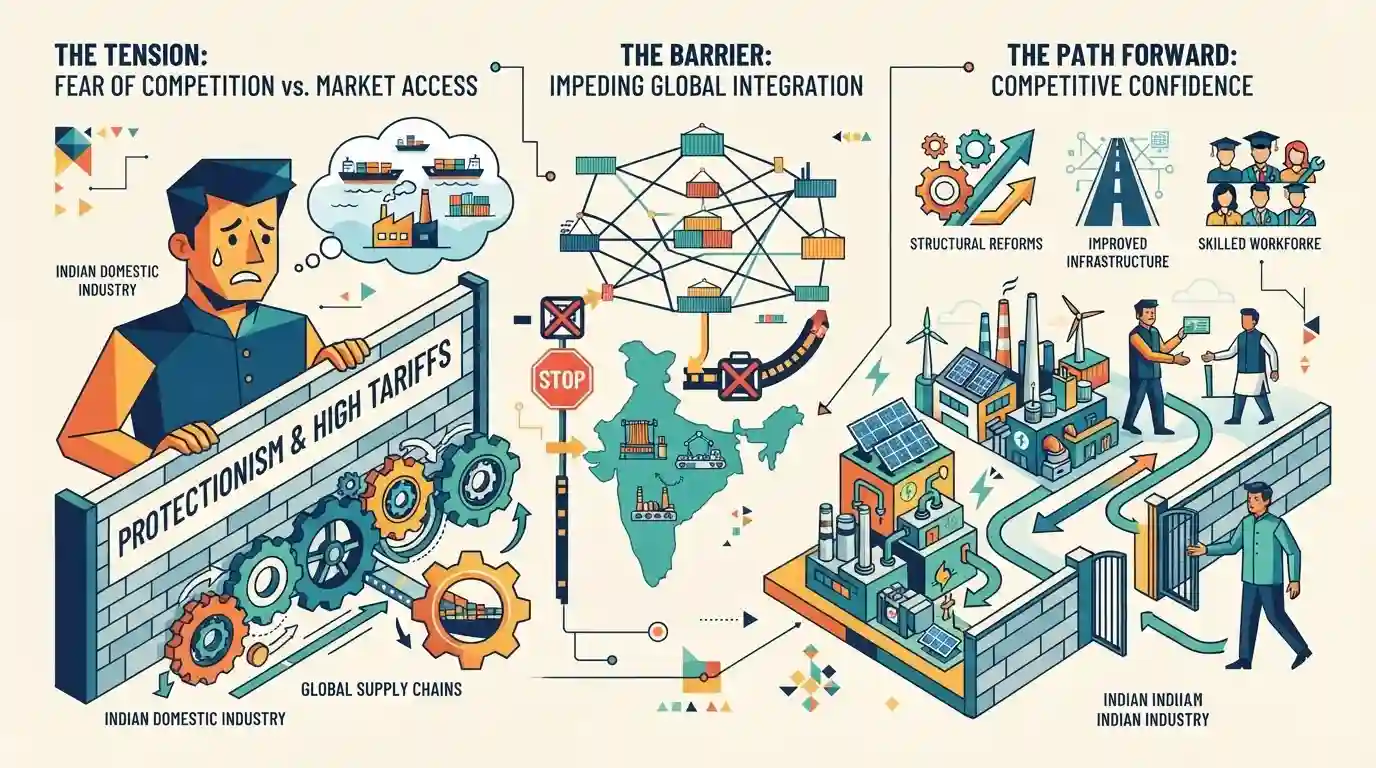
The article critically assesses India’s approach to ongoing Free Trade Agreement (FTA) negotiations, highlighting a persistent tension between securing global market access and the domestic industry's fear of competition. It argues that while protectionist policies and high tariffs offer short-term cover for local manufacturers, they severely impede India's ability to integrate into Global Value Chains (GVCs). To truly benefit from bilateral and regional trade deals, the article emphasizes that India must demonstrate 'competitive confidence.' This requires transitioning away from protectionism towards embracing open markets, supported by structural reforms, improved infrastructure, and a modernized industrial base capable of competing with global peers.
মূল বিষয়
- Evaluates India’s defensive negotiating stance in current FTAs, which is largely driven by domestic industries' apprehension toward foreign competition.
- Highlights that prolonged reliance on high import tariffs and protectionist measures limits India's export potential and hinders seamless integration into Global Value Chains (GVCs).
- Argues that for initiatives like 'Make in India' to be globally successful, Indian enterprises must build 'competitive confidence' by facing open market conditions rather than relying on state protection.
- Recommends that India balance its defensive interests in sensitive sectors with proactive structural reforms to enhance the ease of doing business and overall industrial competitiveness.
গুরুত্বপূর্ণ শব্দ
Free Trade Agreements (FTAs)

Formal treaties between two or more countries to reduce or eliminate tariffs, quotas, and barriers on goods and services, facilitating open, cross-border economic integration and trade.
UPSC context
GS Paper 3 (Liberalization & Trade Policy) and GS Paper 2 (Bilateral Groupings), testing strategic trade diplomacy and regional integration.
Comprehensive Economic Partnership Agreement (CEPA)
An advanced trade agreement that goes beyond traditional FTAs by integrating tariff reductions on goods with commitments in services, investment, intellectual property, and regulatory cooperation.
UPSC context
GS Paper 3 (Economy) and GS Paper 2 (Bilateral Agreements), testing deep economic integration and modern trade pact architectures.
Regional Comprehensive Economic Partnership (RCEP)
A massive Asia-Pacific free trade agreement signed in 2020 among 15 nations, including ASEAN and five partners. India withdrew from negotiations in 2019 over domestic protection concerns.
UPSC context
GS Paper 2 (Bilateral & Regional Groupings), testing India's Act East strategy, protectionism debates, and trade-imbalance management.
European Free Trade Association (EFTA)
A regional trade organization of four non-EU European nations (Iceland, Liechtenstein, Norway, Switzerland) that signed a historic, investment-linked Trade and Economic Partnership Agreement with India.
UPSC context
GS Paper 2 (Bilateral Groupings) and GS Paper 3 (Investment), testing trade diversification and ties with non-EU European nations.
Make in India
A national initiative launched in 2014 designed to transform India into a global manufacturing hub, encourage domestic production, attract foreign investment, and boost industrial growth.
UPSC context
GS Paper 3 (Industrial Growth & Planning), testing manufacturing policy reforms, employment strategies, and global value chain integration.
প্রিলিমস ফাঁদ
Import tariffs only penalize foreign sellers and do not economically act as a tax on domestic exporters.
According to the Lerner Symmetry Theorem, a tax on imports functions analytically as an export tax by raising intermediate input costs and appreciating the real exchange rate.
সংযুক্ত স্থির ধারণা
What is the difference between Forward and Backward Global Value Chain (GVC) integration?
- Forward Linkages: Occurs when a country exports domestic intermediate goods/services that are subsequently used by partner nations to produce their own final exports.
- Backward Linkages: Occurs when a country imports foreign intermediate inputs to assemble, process, and eventually export as finished goods.
- India's Status: India has strong forward integration (services/raw materials) but weak backward integration due to high protective import tariffs on components.
What does the Lerner Symmetry Theorem state regarding trade protectionism?
- The Core Theorem: An economic theory demonstrating that a tax on imports is analytically equivalent to a tax on exports.
- Resource Allocation: Import tariffs raise domestic prices of imported goods, diverting labor and capital away from competitive export sectors to protected domestic sectors.
- Real Exchange Rate: By reducing import demand, tariffs lead to domestic currency appreciation, making exports more expensive and less competitive globally.
আন্তঃবিষয় প্যাটার্ন
PLI Schemes vs Protectionist Tariffs
High import tariffs on intermediate components raise domestic production costs, neutralizing the financial incentives offered under export-oriented PLI schemes.
Geoeconomics of RCEP vs Bilateral FTAs
India's shift from mega-regionals (RCEP) to strategic bilateral FTAs (UAE, EFTA, EU) reflects a preference for trusted-partner supply chains over China-dominated trade blocs.

UPSC may test the tension between PLI incentives and MFN import tariffs as structural barriers to India's backward GVC integration.
সংযুক্ত PYQ · 4
সংযুক্ত PYQ · 4
- 2025MainsGS3
What are the challenges before the Indian economy when the world is moving away from free trade and multilateralism to protectionism and bilateralism? How can these challenges be met?
- 2013MainsGS3
Examine the impact of liberalization on companies owned by Indians. Are they competing with the MNCs satisfactorily? Discuss.
- 2016MainsGS2
The broader aims and objectives of WTO are to manage and promote international trade in the era of globalization. But the Doha round of negotiations seem doomed due to differences between the developed and the developing countries." Discuss in the Indian perspective.
- 2016PrelimsGS1
The term 'Regional Comprehensive Economic Partnership' often appears in the news in the context of the affairs of a group of countries known as
