Maritime Security Cooperation Framework in Indian Ocean Region
Source:The Hindu ↗
Why It Matters
The Indian Ocean is critical for global trade and energy security. Understanding India's evolving naval strategies, institutions like IONS/IORA, and doctrines like SAGAR is essential for answering questions on maritime security challenges (GS3) and regional diplomacy (GS2).
Summary
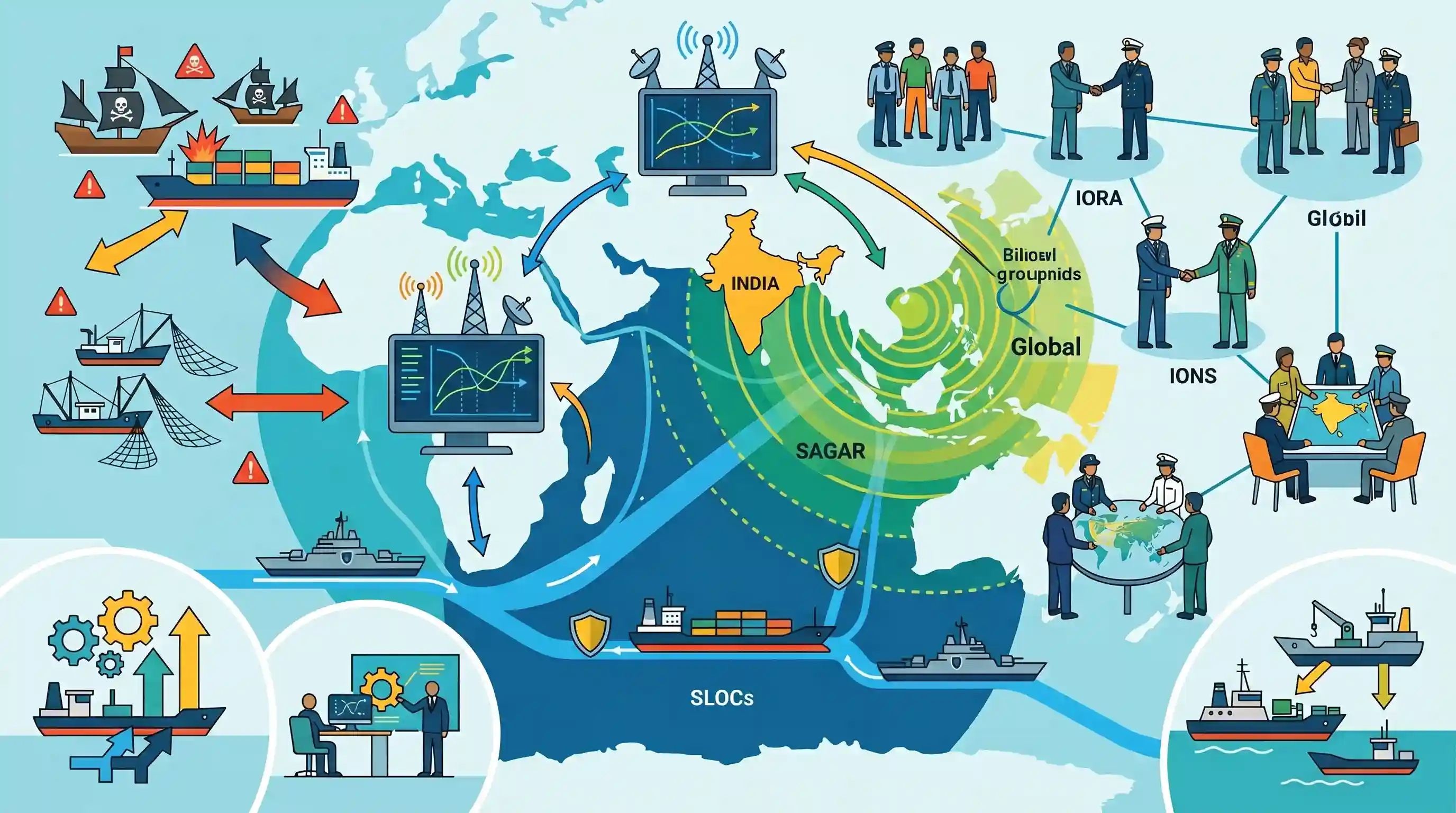
The article outlines a strategic template for enhancing maritime security cooperation in the Indian Ocean Region (IOR) amidst growing geopolitical complexities and non-traditional threats like piracy and illegal fishing. It emphasizes the need to institutionalize regional frameworks such as the Indian Ocean Naval Symposium (IONS) and IORA to foster collaborative defense mechanisms. Highlighted by India's SAGAR doctrine, the piece underscores the importance of real-time intelligence sharing through platforms like the IFC-IOR and capacity-building among littoral states to secure vital Sea Lines of Communication (SLOCs) and ensure regional stability.
Key Points
- The Indian Ocean Region (IOR) is increasingly vulnerable to both traditional geopolitical competition and non-traditional threats such as piracy, maritime terrorism, smuggling, and illegal, unreported, and unregulated (IUU) fishing.
- Establishing a comprehensive template for maritime security cooperation requires strengthening regional architectures like the Indian Ocean Rim Association (IORA) and the Indian Ocean Naval Symposium (IONS).
- India's proactive role is guided by the SAGAR doctrine, which aims to position India as a net security provider by enhancing capacity building, joint exercises, and strategic trust among littoral states.
- Real-time intelligence and information sharing, facilitated through mechanisms like the Information Fusion Centre – Indian Ocean Region (IFC-IOR), are crucial for ensuring Maritime Domain Awareness (MDA) and protecting vital Sea Lines of Communication (SLOCs).
Important Terms
SAGAR (Security and Growth for All in the Region) doctrine

India's strategic vision (2015) for the Indian Ocean, emphasizing collective maritime security, economic cooperation, and sustainable growth while positioning India as a 'net security provider.'
UPSC context
GS-II/III: India’s foreign policy and maritime strategy; tests understanding of India's leadership in the Indian Ocean Region.
Indian Ocean Rim Association (IORA)
An inter-governmental organization of 23 Indian Ocean littoral states aimed at strengthening regional economic cooperation, sustainable development, and maritime safety through a tripartite forum.
UPSC context
GS-II: Important regional groupings involving India; tests knowledge of multilateral maritime diplomacy.
Indian Ocean Naval Symposium (IONS)
A voluntary biennial forum of navies from Indian Ocean littoral states, launched by India in 2008 to enhance maritime security cooperation and interoperability.
UPSC context
GS-III: Internal and maritime security; relevant for naval diplomacy and disaster management coordination.
Information Fusion Centre – Indian Ocean Region (IFC-IOR)
A Gurugram-based maritime intelligence hub hosted by the Indian Navy to enhance 'Maritime Domain Awareness' by sharing real-time information on non-traditional threats.
UPSC context
GS-III: Security challenges and management; tests knowledge of maritime surveillance and intelligence infrastructure.
Colombo Security Conclave (CSC)
A minilateral security grouping (India, Sri Lanka, Maldives, Mauritius, Bangladesh, Seychelles) focusing on maritime safety, counter-terrorism, and cyber security in the Indian Ocean.
UPSC context
GS-II: India and its neighborhood; focuses on regional minilateralism and security architecture.
United Nations Convention on the Law of the Sea (UNCLOS)
The 1982 international legal framework defining maritime zones (Territorial Waters, EEZ) and governing nations' rights and responsibilities in the use of the world's oceans.
UPSC context
GS-II: International law and global governance; critical for discussing maritime disputes and boundary rights.
Prelims Trap
IFC-IOR was established to track and monitor military warships and submarines operating in the Indian Ocean.
The IFC-IOR primarily tracks commercial "white shipping" to build Maritime Domain Awareness against non-traditional threats like piracy and illegal fishing, not military (grey) vessels.
Static Concepts Connected
What is the difference between IORA and IONS in the Indian Ocean Region?
- IORA: An inter-governmental organization of foreign ministries focusing broadly on economic cooperation, disaster management, and blue economy alongside maritime safety.
- IONS: A voluntary initiative specifically bringing together the navies of IOR littoral states to enhance military interoperability, HADR coordination, and security.
What are White Shipping Agreements in the context of Maritime Domain Awareness (MDA)?
- White Shipping: Bilateral or multilateral pacts to share advance, real-time information regarding the identity and movement of commercial, non-military maritime vessels.
- Colour Codes: Under maritime parlance, 'White' denotes commercial shipping, 'Grey' denotes military vessels, and 'Black' denotes illegal or clandestine vessels.
- MDA Utility: Helps the IFC-IOR filter out normal commercial traffic to easily identify suspicious activities, piracy, or IUU fishing in vital SLOCs.
Cross-Topic Patterns
IUU fishing as a border security threat
Illegal, unreported, and unregulated (IUU) fishing often overlaps with arms smuggling and maritime terrorism, making coastal security a critical subset of GS-3 border management challenges.
Agile Minilaterals over Stagnant Regionalism
The evolution of the Colombo Security Conclave highlights India's shift toward functional, issue-based minilaterals for immediate maritime security needs, bypassing broader, stalled frameworks like SAARC.
SAGAR linking security to the Blue Economy
India's SAGAR doctrine is not purely military; it closely intertwines maritime security with sustainable ocean resource harvesting (Deep Ocean Mission) and ecological conservation in GS-3.

Expect a Prelims trap mixing the exact mandates of IORA, IONS, and IFC-IOR, specifically testing 'white shipping' vs military tracking.
Linked PYQs · 5
Linked PYQs · 5
- 2025MainsGS3
Why is maritime security vital to protect India's sea trade? Discuss maritime and coastal security challenges and the way forward.
- 2022MainsGS3
What are the maritime security challenges in India ? Discuss the organisational, technical and procedural initiatives taken to improve the maritime security.
- 2017PrelimsGS1
Consider the following in respect of Indian Ocean Naval Symposium (IONS): 1. Inaugural IONS was held in India in 2015 under the chairmanship of the Indian Navy. 2. IONS is a voluntary initiative that seeks to increase maritime co-operation among navies of the littoral states of the Indian Ocean Region. Which of the above statements is/are correct?
- 2015PrelimsGS1
With reference to Indian Ocean Rim Association for Regional Cooperation (IOR-ARC)', consider the following statements: 1. It was established very recently in response to incidents of piracy and accidents of oil spills. 2. It is an alliance meant for maritime security only. Which of the statements given above is/are correct?
- 2024MainsGS2
Discuss the geopolitical and geostrategic importance of Maldives for India with a focus on global trade and energy flows. Further also discuss how this relationship affects India's maritime security and regional stability amidst international competition ?
