Evaluating Restrictions on Children Using Social Media Platforms
Source:The Hindu ↗
Why It Matters
The debate over children's digital safety intersects critically with GS2 (Governance and Vulnerable Sections), GS1 (Social Issues), and GS3 (Cyber Security). With India implementing the DPDP Act, 2023, and global models (like Australia's age bans) dominating headlines, understanding the limitations of prohibitive policies versus regulatory frameworks for Big Tech is essential for essay writing and policy-oriented questions.
Summary
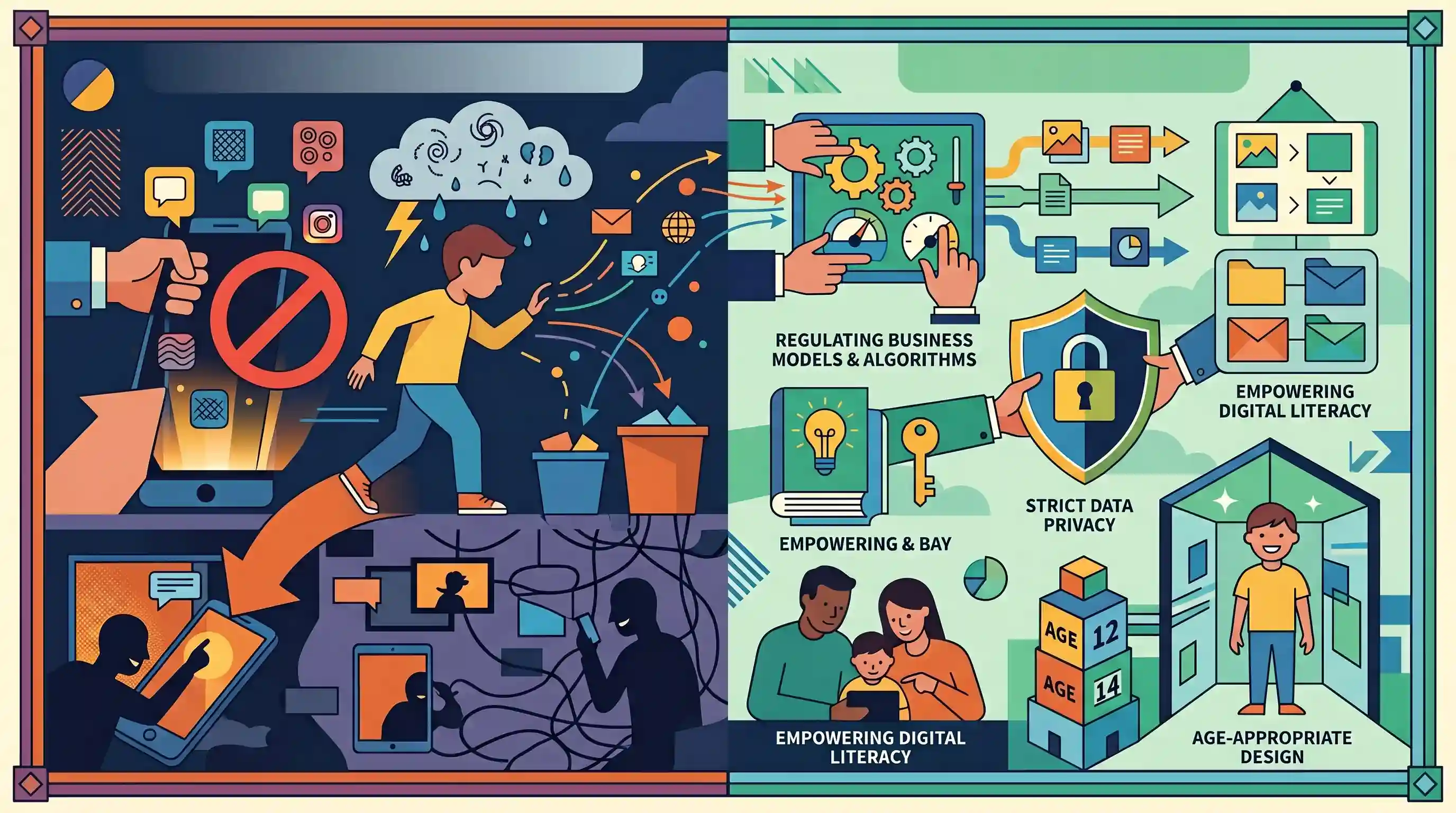
The article argues against the growing international trend of imposing blanket social media bans on minors, asserting that such measures fail to address the root causes of digital harm. While acknowledging the adverse mental health and social impacts of unregulated digital exposure on children, it highlights that outright bans can backfire by pushing youth into covert, unmonitored online spaces. It suggests that regulating Big Tech's business models—specifically their addictive algorithms and data-harvesting practices—is a more effective strategy. Meaningful child protection requires enforcing strict data privacy laws (like India's DPDP Act), mandating age-appropriate platform designs, and empowering children and parents with robust digital literacy, rather than resorting to state-mandated digital exclusion.
Key Points
- A blanket ban on social media for children (such as Australia's proposed ban for under-16s) is an ineffective solution to the digital challenges faced by youth.
- Bans often drive children to use unmonitored digital spaces, Virtual Private Networks (VPNs), and fake age profiles, exposing them to greater risks.
- Focusing on access bans ignores the fundamental issues of predatory algorithms, profit-driven engagement models, and the lack of platform accountability by Big Tech.
- Digital environments can provide vital communities, learning resources, and support systems for young people, which a ban would sever.
- Instead of bans, the emphasis should be on 'Safety by Design', algorithmic transparency, strengthening data protection laws (like the DPDP Act 2023 in India), and fostering digital literacy among both parents and children.
Important Terms
Digital Personal Data Protection (DPDP) Act, 2023

India’s primary data privacy law mandating 'verifiable parental consent' for children (under 18) and prohibiting tracking, behavioral monitoring, or targeted advertising directed at minors.
UPSC context
GS Paper II & III: Governance, privacy rights, and digital economy; tests understanding of India's legislative framework for data sovereignty and protection.
Age-Appropriate Design Code (UK)
A UK statutory code (the 'Children’s Code') setting 15 standards for online services likely to be accessed by children, prioritizing the 'best interests of the child' in platform design.
UPSC context
GS Paper II: International regulatory benchmarks and comparative digital governance; highlights global trends in child-first digital safety and platform design.
National Commission for Protection of Child Rights (NCPCR)
An Indian statutory body established under the CPCR Act, 2005, responsible for monitoring the implementation of child rights and recommending safety guidelines for digital spaces and social media.
UPSC context
GS Paper II: Statutory bodies and social justice; critical for questions on state-led child protection mechanisms and institutional oversight.
IT Rules, 2021 (Intermediary Guidelines)
Regulations requiring social media platforms to exercise 'due diligence,' remove harmful content, and establish grievance mechanisms, specifically prohibiting content that is 'harmful to a child.'
UPSC context
GS Paper II & III: Governance and cybersecurity; tests knowledge of intermediary accountability and state regulation of digital content platforms.
Verifiable Parental Consent
A legal requirement under the DPDP Act where platforms must authenticate the permission of a parent or legal guardian before processing the personal data of a minor.
UPSC context
GS Paper II & III: Policy implementation and digital ethics; focuses on technical hurdles and privacy trade-offs in enforcing age-restricted access.
Digital Literacy
The ability to find, evaluate, and communicate information through various digital platforms; cited as a sustainable alternative to blanket bans for empowering youth in digital spaces.
UPSC context
GS Paper II: Issues relating to Education and Human Resources; emphasizes long-term social capacity building over restrictive state interventions.
Prelims Trap
"The DPDP Act 2023 allows targeted behavioral advertising directed at minors if verifiable parental consent is obtained."
The DPDP Act explicitly prohibits tracking, behavioral monitoring, and targeted advertising directed at children, completely regardless of whether parental consent is obtained.
Static Concepts Connected
What are the key child-protection provisions under the DPDP Act 2023?
- Definition: The Act classifies anyone under the age of 18 as a child.
- Parental Consent: Data fiduciaries must obtain verifiable consent from a parent or lawful guardian before processing a child's data.
- Strict Prohibitions: The Act strictly prohibits tracking, behavioral monitoring, and targeted advertising directed at children.
How do digital access bans intersect with India's Fundamental Rights?
- Right to Internet: Courts have increasingly recognized internet access as integral to the right to education and privacy (Art 21) and free speech (Art 19).
- Proportionality Test: Any state-mandated ban must pass the doctrine of proportionality established in the Puttaswamy judgment, proving it is the least restrictive measure possible.
Cross-Topic Patterns
Mental health + Big Tech regulation
The intersection of youth anxiety and algorithmic addiction elevates mental health from a pure healthcare issue to a strict digital governance and data privacy challenge.
Encryption tools + State censorship
Technical bypasses like VPNs highlight the futility of demographic access bans, linking cybersecurity tools directly to civil liberties, law enforcement, and policy implementation challenges.

Expect a GS-2 mains question contrasting 'Safety by Design' with blanket bans for child online safety, testing knowledge of the DPDP Act.
Linked PYQs · 3
Linked PYQs · 3
- 2025MainsGS2
The National Commission for Protection of Child Rights has to address the challenges faced by children in the digital era. Examine the existing policies and suggest measures the Commission can initiate to tackle the issue.
- 2023MainsGS1
Child cuddling is now being replaced by mobile phones. Discuss its impact on the socialization of children.
- 2024MainsGS3
Social media and encrypting messaging services pose a serious security challenge. What measures have been adopted at various levels to address the security implications of social media? Also suggest any other remedies to address the problem.
