Himalayan Disasters Demand Regional Cooperation Beyond Geopolitics
Source:The Hindu ↗
हे का महत्त्वाचे आहे
The article provides an insightful case study on how disaster relief operations double as instruments of foreign policy and soft power. It addresses the critical intersection of disaster management (GS3) and international relations/diplomacy (GS2), illustrating the challenges of managing transboundary hazards in a geopolitically contested neighborhood like South Asia.
सारांश
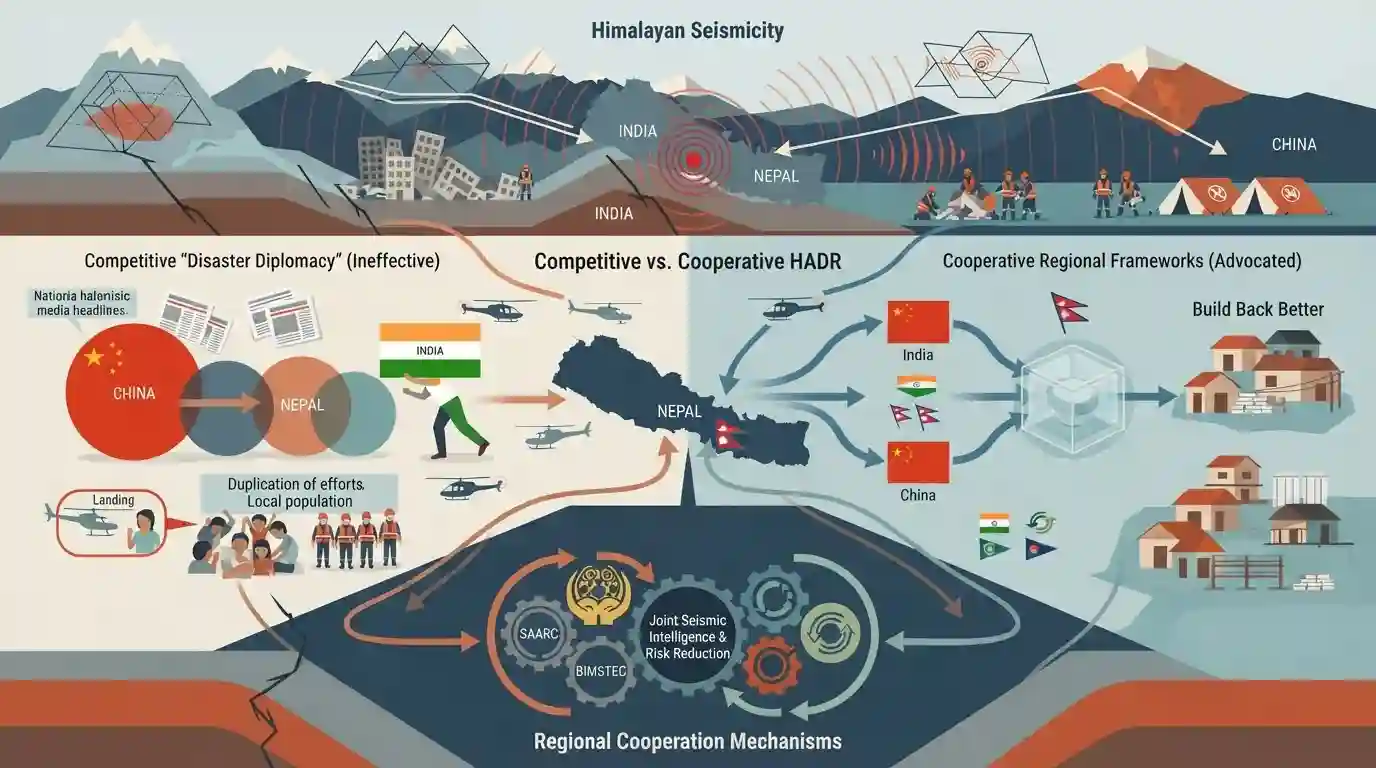
Published in the aftermath of the devastating April 2015 Nepal earthquake, the article argues that transboundary natural disasters in the seismically fragile Himalayan region require cooperative disaster management that transcends geopolitical rivalries. It examines the humanitarian responses of India (Operation Maitri) and China, warning against competitive 'disaster diplomacy' and nationalistic media narratives that can alienate local populations. The author advocates for regional frameworks (such as under SAARC or BIMSTEC) to be insulated from political differences to enable shared seismic intelligence, joint disaster risk reduction, and collaborative 'Build Back Better' reconstruction efforts.
मुख्य मुद्दे
- Transboundary Nature of Himalayan Disasters: The 2015 Nepal earthquake demonstrated that the Himalayan ecosystem is a contiguous, highly active seismic zone. Disasters in this region do not respect political boundaries, making vulnerability a shared, regional concern.
- Competitive 'Disaster Diplomacy': Both India (through Operation Maitri) and China deployed substantial rescue and relief resources to Nepal. While essential, the aid delivery assumed the character of a strategic and diplomatic race for influence in Kathmandu, demonstrating the limits of competitive geopolitics in humanitarian spaces.
- Backlash of Insensitive Media Coverage: The self-congratulatory and nationalistic tone of the Indian electronic media during rescue operations provoked a severe public backlash in Nepal (exemplified by the hashtag #GoBackIndianMedia). This highlighted that humanitarian aid can backfire if delivered without humility and respect for the host nation’s sovereignty and dignity.
- Inadequacy of Existing Multilateral Frameworks: Despite the existence of regional mechanisms like the SAARC Disaster Management Centre, bilateral geopolitical tensions (primarily between India and Pakistan) have stalled effective, region-wide disaster response. The article argues for insulating disaster cooperation from political disputes.
- Collaborative Mitigation and Reconstruction: To mitigate future crises, Himalayan nations must establish institutional mechanisms for real-time seismic data sharing, joint search-and-rescue exercises, and coordinated logistics. Long-term reconstruction must adopt the Sendai Framework's 'Build Back Better' principles to construct seismically resilient infrastructure.
महत्त्वाच्या संज्ञा
Operation Maitri

A massive humanitarian assistance and disaster relief (HADR) operation launched by India in April 2015 to rescue and provide aid to earthquake-hit Nepal.
UPSC context
GS II (India & Neighborhood) & GS III (Disaster Management); tests India's role as a regional first responder.
Sendai Framework for Disaster Risk Reduction (2015-2030)
A voluntary, non-binding global agreement under the UN that shifts the focus of disaster management from post-disaster response to proactive disaster risk reduction.
UPSC context
GS III (Disaster Management); tests global frameworks, priorities, and their integration into national disaster policies.
SAARC Disaster Management Agreement
Formally known as the SAARC Agreement on Rapid Response to Natural Disasters, signed in 2011 to institutionalize a regional rapid response mechanism.
UPSC context
GS II (Regional Groupings) & GS III; tests transboundary response mechanisms and regional coordination challenges.
SAARC
An intergovernmental organization of eight South Asian nations established in 1985 to promote regional integration, economic growth, and social progress.
UPSC context
GS II (Regional Groupings); tests South Asian geopolitics, challenges in regional cooperation, and institutional gridlocks.
BIMSTEC
A regional organization of seven South and Southeast Asian nations established in 1997 to foster rapid economic cooperation and connectivity.
UPSC context
GS II (Regional Groupings); tests India's foreign policy pivots, 'Act East,' and alternatives to SAARC.
NDMA (National Disaster Management Authority)
India's apex statutory body for disaster management, established under the Disaster Management Act, 2005, and chaired by the Prime Minister.
UPSC context
GS III (Disaster Management); tests domestic institutional frameworks, policy formulation, and disaster response guidelines.
NDRF (National Disaster Response Force)
A specialized, multi-disciplinary central force in India, raised under the Disaster Management Act, 2005, for dedicated disaster response.
UPSC context
GS III (Disaster Management); tests operational emergency capabilities and federal-state coordination during crises.
पूर्वपरीक्षा सापळा
India's seismic zonation map classifies risk strictly into four categories (Zones II to V), with Zone V representing the maximum possible hazard.
Standard textbooks and NCERTs still teach that India is divided into four seismic zones (II, III, IV, and V). Candidates will easily miss the newly introduced Seismic Zone VI classification.
संबंधित स्थिर संकल्पना
What are the three major parallel thrust fault systems driving Himalayan seismicity?
- Main Central Thrust (MCT): Northernmost fault boundary where the Great Himalayas are thrust over the Lesser Himalayas.
- Main Boundary Thrust (MBT): Middle fault boundary separating the Lesser Himalayas from the outer Sub-Himalayan (Shiwalik) range.
- Himalayan Frontal Thrust (HFT): Southernmost active fault boundary where the Shiwaliks meet the Indo-Gangetic alluvial plains.
Where are the key SAARC and BIMSTEC institutional disaster/weather centers located in India?
- SAARC SDMC: The SAARC Disaster Management Centre Interim Unit is located at the GIDM campus in Gandhinagar, Gujarat.
- BIMSTEC BCWC: The BIMSTEC Centre for Weather and Climate is located in NOIDA, Uttar Pradesh.
- BIMSTEC BEC: The BIMSTEC Energy Centre is situated in Bengaluru, Karnataka.
आंतर-विषय नमुने
Disaster Diplomacy vs. Sovereignty Sensitivities
India's HADR capacity acts as a soft power tool under "Neighborhood First," but aggressive domestic media narratives can trigger local sovereignty concerns and dilute geopolitical goodwill.
Seismicity meets linear infrastructure expansion
The highly active tectonic nature of MCT/MBT faults exposes large-scale Himalayan dam and highway projects to extreme risk, requiring transboundary Environmental Impact Assessments (EIAs).

Questions will likely pair Himalayan tectonic fault lines (MCT/MBT/HFT) with BIS's new Seismic Zone VI and regional HADR institutional locations.
संबंधित PYQ · 4
संबंधित PYQ · 4
- 2024MainsGS3
What is disaster resilience? How is it determined? Describe various elements of a resilience framework. Also mention the global targets of Sendai Framework for Disaster Risk Reduction (2015–2030).
- 2016MainsGS2
Increasing cross-border terrorist attacks in India and growing interference in the internal affairs of several member-states by Pakistan are not conducive for the future of SAARC (South Asian Association for Regional Cooperation)." Explain with suitable examples.
- 2025PrelimsGS1
Consider the following statements in respect of BIMSTEC : I. It is a regional organization consisting of seven member States till January 2025. II. It came into existence with the signing of the Dhaka Declaration, 1999. III. Bangladesh, India, Sri Lanka, Thailand and Nepal are founding member States of BIMSTEC. IV. In BIMSTEC, the subsector of 'tourism' is being led by India. Which of the statements given above is/are correct?
- 2026PrelimsGS1
Match List I with List II and select the answer using the code given below the Lists: List I (BIMSTEC Centre/Establishment) A. BIMSTEC Cultural Industries Observatory B. BIMSTEC Energy Centre C. BIMSTEC Centre for Weather and Climate D. BIMSTEC Technology Transfer Facility List II (Location) 1. NOIDA 2. Bengaluru 3. Colombo 4. Thimphu Code:
