Critical Analysis of Transgender Persons Rights Amendment Legislation
Source:The Hindu ↗
Why It Matters
The article is highly relevant for GS-2 as it touches upon the welfare and legal protections of marginalized communities (transgender rights). It also raises critical polity questions regarding the legislative process, the bypassing of parliamentary debate, and the conflict between statutory amendments and judicial precedents (NALSA judgment).
Summary
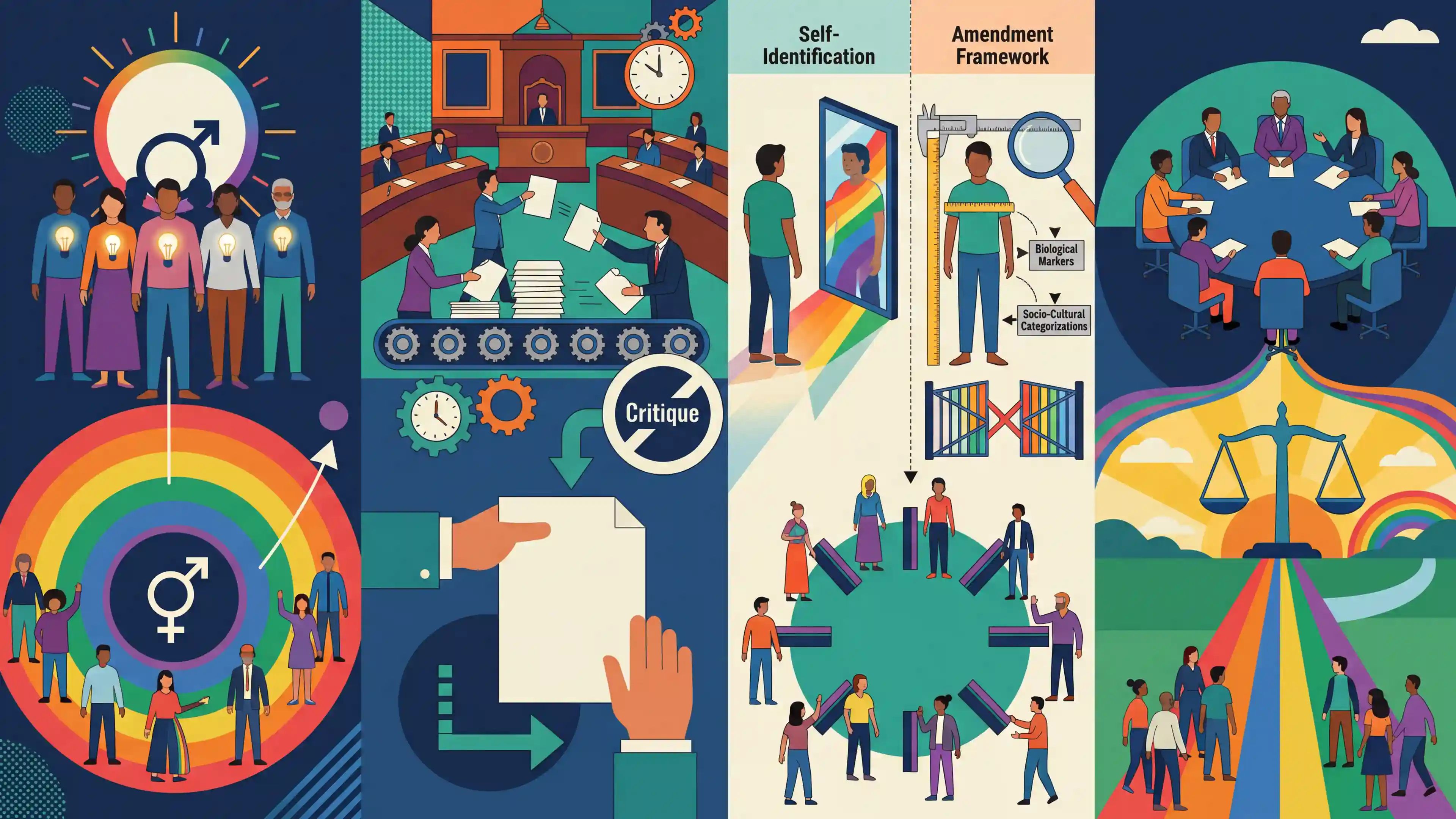
The editorial strongly critiques the Transgender Persons (Protection of Rights) Amendment Bill, 2026, which was hastily passed by Parliament without adequate consultation or debate. The Bill is accused of applying a heteronormative approach and diluting the progressive framework set by the NALSA judgment, particularly the right to self-identification of gender. By imposing mandatory biological markers or socio-cultural categorizations for legal recognition, the amendment restricts the protections available to the broader LGBTQIA+ community. The piece urges the government to adopt a rights-based, consultative approach to ensure true gender justice and equal rights.
Key Points
- The Transgender Persons (Protection of Rights) Amendment Bill, 2026 was pushed through Parliament without a transparent consultative process, ignoring protests from LGBTQIA+ communities.
- The legislation is criticized for applying a heteronormative lens and explicitly stating it does not intend to protect all gender identities and fluidities.
- It dilutes the Supreme Court's NALSA vs Union of India judgment by shifting away from the principle of self-perceived gender identity without medical certification.
- The Bill makes recognition contingent on mandatory biological markers (like chromosomes and genitalia) or belonging to specific socio-cultural communities (e.g., kinner, hijra).
- Critics argue that by conflating sex and gender and limiting protections, the government must adopt a more collaborative, rights-based approach to ensure dignity and equality.
Important Terms
Transgender Persons (Protection of Rights) Amendment Bill, 2026

2026 legislation mandating medical board certification for gender recognition, narrowing the definition of 'transgender' and removing the statutory right to self-identification.
UPSC context
GS Paper II: Mechanisms/laws for vulnerable sections; tests impact on civil rights and constitutional safeguards.
NALSA Judgment (2014)
The 2014 Supreme Court ruling that recognized transgender people as the 'third gender' and upheld their fundamental right to self-identification.
UPSC context
GS Paper II: Judiciary/Fundamental Rights; tests knowledge of legal precedents expanding Article 21 rights.
Right to Self-Identification
The legal right of an individual to determine their own gender identity based on personal psyche rather than biological or medical tests.
UPSC context
GS Paper II: Fundamental Rights; relates to autonomy, privacy, and dignity under the Constitution.
Medical Board (Gender Recognition)
A government panel (often led by medical officers) mandated by the 2026 Bill to verify a person's transgender status for legal certification.
UPSC context
GS Paper II: Welfare mechanisms; examines 'medical gatekeeping' and administrative hurdles for marginalized groups.
Heteronormativity
A worldview promoting binary gender (male/female) and heterosexuality as the norm, often used to critique regressive gender-based legislation.
UPSC context
GS Paper I/II: Indian Society and Social Justice; analyzes societal biases in policy-making.
Voice Vote
A parliamentary procedure where a motion is passed by oral 'ayes' or 'noes', criticized for bypassing detailed debate on rights-based legislation.
UPSC context
GS Paper II: Parliament; tests understanding of legislative conduct and the role of parliamentary scrutiny.
SMILE Scheme
(Support for Marginalized Individuals for Livelihood and Enterprise) A central scheme for the welfare and rehabilitation of transgender persons and those engaged in begging.
UPSC context
GS Paper II: Welfare schemes; tests knowledge of specific interventions for vulnerable sections.
Constitutional Morality
The principle of adherence to constitutional values like equality and liberty, regardless of prevailing societal norms or majority views.
UPSC context
GS Paper IV/II: Ethics and Constitution; essential for discussing the rights of minority communities.
Prelims Trap
"The NALSA judgment mandated certification by a Medical Board to legally recognize a person's transgender identity."
The NALSA judgment (2014) explicitly upheld self-perceived gender identity without medical certification. It is the 2026 Amendment Bill that introduces mandatory medical boards and biological markers.
Static Concepts Connected
How did the NALSA judgment (2014) expand Fundamental Rights for transgender persons?
- Article 14 & 15: Extended equal protection and non-discrimination guarantees to explicitly include gender identity, rather than just biological sex assigned at birth.
- Article 19(1)(a): Protected gender expression and presentation as a fundamental right falling under the freedom of speech and expression.
- Article 21: Recognized the right to self-determine one's gender identity as an integral component of life, dignity, and personal autonomy.
What is the role of Department-Related Standing Committees (DRSCs) in legislation?
- Scrutiny function: Ensures detailed, clause-by-clause scrutiny of legislative bills, allowing expert input and non-partisan debate away from the main parliamentary floor.
- Composition & referral: Consists of 31 members (21 from Lok Sabha, 10 from Rajya Sabha). Bills are referred at the discretion of the Presiding Officer, not automatically.
- Advisory nature: Recommendations made by the DRSCs are persuasive and advisory in nature; they are not strictly binding on Parliament or the government.
Cross-Topic Patterns
Legislative bypass & marginalized rights
The sharp decline in referring bills to DRSCs reduces critical scrutiny of socio-economic legislations, often disproportionately impacting the rights and welfare of vulnerable communities.
Clinical gatekeeping & bodily autonomy
Mandating medical boards for gender identity connects to GS4/GS2 themes of medical ethics and state interference in bodily autonomy, echoing debates seen in abortion and surrogacy laws.

Expect a Prelims question contrasting NALSA's self-identification principle (Article 21) with the 2026 Bill's medical board requirements.
Linked PYQs · 3
Linked PYQs · 3
- 2023MainsGS2
Explain the constitutional perspectives of Gender Justice with the help of relevant Constitutional Provisions and case laws.
- 2015MainsGS2
If amendment bill to the Whistleblowers Act, 2011 tabled in the Parliament is passed, there may be no one left to protect. Critically evaluate.
- 2023MainsGS2
Who are entitled to receive free legal aid? Assess the role of the National Legal Services Authority (NALSA) in rendering free legal aid in India.
