Smartphone scrolling impact on family dynamics and mental health
Source:The Hindu ↗
Why It Matters
The impact of technology, specifically smartphones and social media, on social institutions like the family and child socialization is an increasingly relevant topic for UPSC Mains GS1 (Society), as reflected in recent previous year questions.
Summary
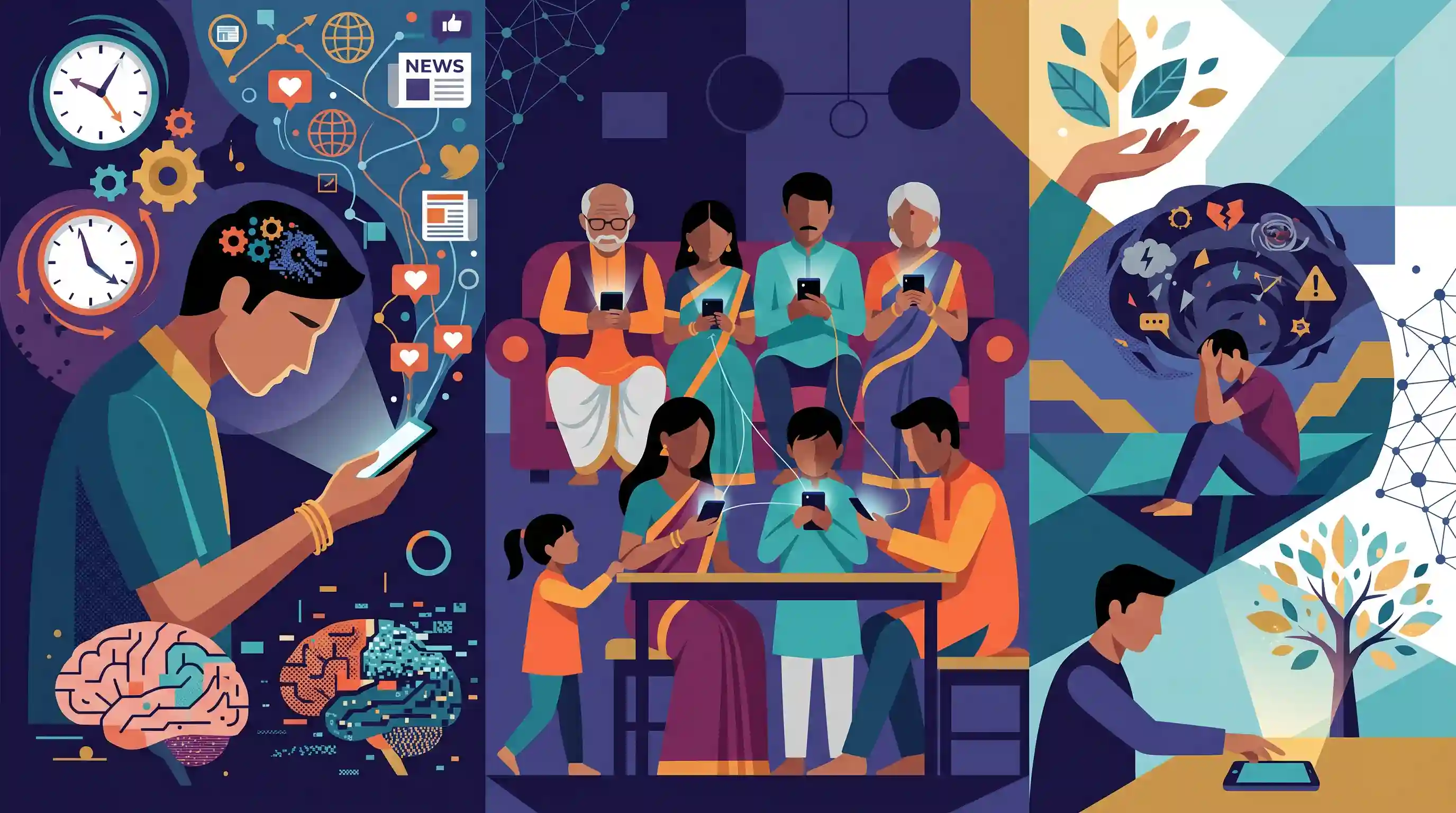
The article offers a reflective commentary on the contemporary habit of endless smartphone scrolling and its socio-psychological consequences. It highlights how digital consumption patterns, often characterized by 'doomscrolling', are fundamentally altering human attention, daily routines, and socialization. By exploring the intrusion of screens into personal spaces, the piece underscores the adverse effects of mobile addiction on interpersonal relationships, family dynamics, and overall mental well-being, ultimately calling for greater digital mindfulness in modern times.
Key Points
- The article reflects on the modern phenomenon of endless smartphone scrolling and digital media consumption.
- It highlights how excessive screen time and 'doomscrolling' are altering human attention spans and cognitive habits.
- The commentary emphasizes the adverse impacts of mobile phone addiction on interpersonal socialization, family relationships, and mental well-being.
- It advocates for digital mindfulness and a balanced approach to technology integration in daily life.
Prelims Trap
Digital Detox initiatives in India are statutory mandates enforced centrally under the Mental Healthcare Act.
Emerging "Digital Detox" policies and counseling centers are largely state-led initiatives (e.g., Karnataka's collaboration with AIGDF), not statutory central mandates.
Static Concepts Connected
What is the difference between primary and secondary socialization?
- Primary Socialization: Occurs within the family during early childhood, establishing foundational emotional bonds, language, and basic values.
- Secondary Socialization: Happens outside the home via schools, peers, and media, teaching individuals broader societal norms and behaviors.
- Digital Intrusion: Screen addiction substitutes physical family interactions, allowing digital media to prematurely dominate early emotional development.
How does compulsive digital consumption affect cognitive and neurological health?
- Amygdala Overstimulation: Constant exposure to negative news (doomscrolling) triggers chronic stress responses, anxiety, and emotional burnout.
- Prefrontal Cortex Weakening: Habitual endless scrolling impairs the brain's impulse control, sustained focus, and long-term decision-making capabilities.
- Attention Fragmentation: Prolonged exposure forces the brain into 'continuous partial attention', diminishing the capacity for deep cognitive work.
Cross-Topic Patterns
WFH and Boundary Blurring
Smartphone intrusion mirrors the WFH model's socio-psychological challenges, where the collapse of physical and mental boundaries strains domestic relationships and accelerates emotional burnout.
Digital Detox vs. Attention Economy
As tech platforms use behavioral nudges to retain attention, states like Karnataka are countering this via novel collaborations with game developer forums (AIGDF) to promote digital mindfulness.

Expect a GS1 Mains question linking doomscrolling and continuous partial attention to the erosion of primary socialization & family norms.
Linked PYQs · 2
Linked PYQs · 2
- 2023MainsGS1
Child cuddling is now being replaced by mobile phones. Discuss its impact on the socialization of children.
- 2022MainsGS1
Explore and evaluate the impact of 'Work From Home' on family relationships.
