Roadmap Proposed to Fast-Track Women Reservation in Parliament
Source:Indian Express ↗
Why It Matters
Understanding the statutory link between the Census, delimitation, and the Women's Reservation Bill is critical for GS2. It highlights the practical challenges of enacting constitutional reforms and addresses core themes of gender equity and political representation.
Summary
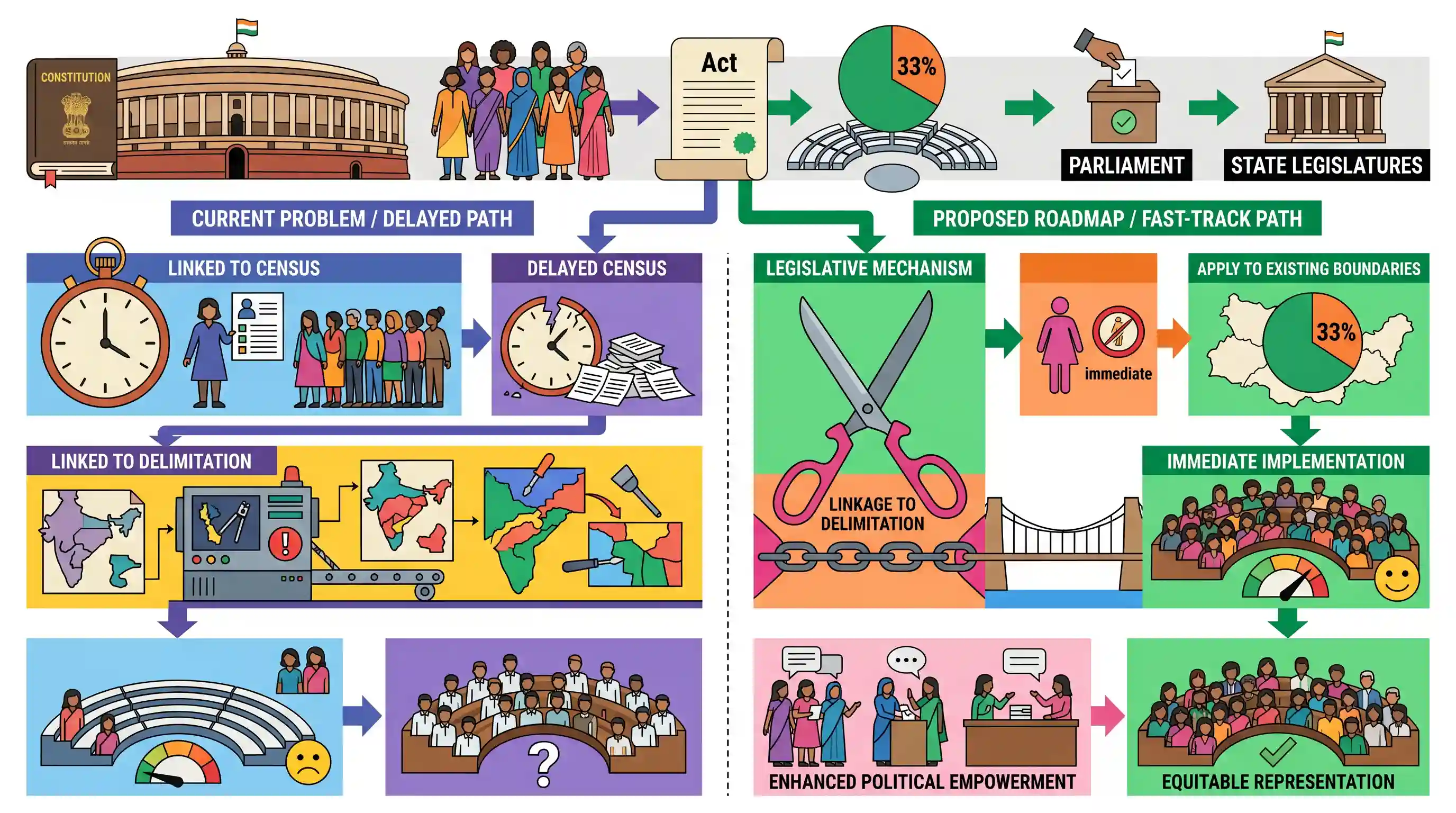
The article examines the procedural hurdles delaying the implementation of the Nari Shakti Vandan Adhiniyam (Women's Reservation Act, 2023) and proposes a roadmap to fast-track its execution. Currently, the 33% quota for women in Parliament and state assemblies is linked to the completion of the next Census and the subsequent delimitation of constituencies. Due to significant delays in the Census, this linkage could postpone women's reservation for several years. To circumvent this, the piece advocates for delinking the quota from the delimitation process, suggesting legislative mechanisms that would allow the reservation to be applied immediately within existing constituency boundaries. This approach would accelerate women's political empowerment and ensure equitable representation without waiting for prolonged demographic exercises.
Key Points
- The Nari Shakti Vandan Adhiniyam mandates a 33% reservation for women in the Lok Sabha and State Legislative Assemblies but is currently contingent on the next delimitation exercise.
- The dependency on a yet-to-be-conducted Census and the subsequent delimitation process threatens to significantly delay the implementation of the women's quota, potentially pushing it beyond 2029.
- Experts advocate for a roadmap that delinks the reservation from the complex delimitation process, proposing methods to apply the quota within the existing framework of constituencies.
- Fast-tracking the reservation is vital for immediate political empowerment, ensuring gender parity, and making legislative bodies more representative.
Important Terms
Nari Shakti Vandan Adhiniyam (106th Constitutional Amendment Act, 2023)

A constitutional law reserving 33% of seats for women in the Lok Sabha, State Legislative Assemblies, and the Delhi Assembly, including a horizontal quota for SC/ST women.
UPSC context
GS-II (Polity/Social Justice); tests understanding of landmark amendments, gender-based electoral reforms, and substantive equality.
Delimitation Commission of India
A powerful statutory and quasi-judicial body appointed by the President to redraw constituency boundaries. Its decisions carry the force of law and are immune to judicial review.
UPSC context
GS-II (Electoral Reforms); tests knowledge of the mechanism and independence of bodies redrawing political boundaries.
Article 334A
The specific provision inserted by the 106th Amendment that links the commencement of women's reservation to a post-2026 Census and delimitation exercise, featuring a 15-year sunset clause.
UPSC context
GS-II (Polity); tests awareness of the legislative hurdles and implementation clauses that delay constitutional mandates.
Census of India
The decennial statistical exercise collecting demographic data. Under the 106th Amendment, the publication of the first Census after the Act's commencement is a mandatory prerequisite for women's reservation.
UPSC context
GS-II (Governance); tests understanding of the interplay between demographic data and the execution of constitutional rights.
Delimitation Act
Legislation enacted by Parliament under Article 82 after a Census to facilitate seat readjustment and provide the legal framework for redrawing electoral constituencies.
UPSC context
GS-II (Parliament); tests familiarity with the legal processes governing the allocation and revision of legislative seats.
Election Commission of India
A permanent constitutional body responsible for managing elections. It provides technical data and the Chief Election Commissioner serves as a key member of the Delimitation Commission.
UPSC context
GS-II (Constitutional Bodies); tests knowledge of its role in ensuring fair representation and assisting delimitation.
Prelims Trap
"The Nari Shakti Vandan Adhiniyam mandates 33% reservation for women in both Houses of Parliament and all State Legislatures."
The 106th Amendment applies strictly to the Lok Sabha, State Legislative Assemblies, and the NCT of Delhi. It does NOT extend to the Rajya Sabha or State Legislative Councils.
Static Concepts Connected
How is the Delimitation Commission constituted and what are its powers?
- Statutory Body: It is a statutory body appointed by the President of India and works in collaboration with the Election Commission of India.
- Legal Immunity: Its orders have the force of law and cannot be questioned before any court, ensuring electoral boundaries are drawn without legal delays.
- Seat Freeze: The 84th Constitutional Amendment (2001) froze the total number of Lok Sabha seats allocated to states until the publication of the first Census after 2026.
What are the key constitutional mechanisms of the 106th Amendment Act (2023)?
- Articles Inserted: Inserts Articles 330A and 332A to guarantee one-third reservation for women in the Lok Sabha and State Legislative Assemblies, including a sub-quota within SC/ST seats.
- Implementation Clause: Article 334A specifically delays enforcement until a delimitation exercise is conducted, based on the first Census published after the Act's commencement.
- Sunset Clause: The reservation has a 15-year sunset clause from its commencement, which will require a parliamentary law for further extension.
Cross-Topic Patterns
Local vs National Quota Mechanics
Unlike the 73rd and 74th Amendments which immediately instituted women's quotas in local bodies, the 106th CAA's reliance on the Census and delimitation creates unique demographic dependencies.
Delimitation & Federal Faultlines
Delinking the quota from delimitation temporarily bypasses the looming North-South federal clash over Article 82, where Southern states fear losing representation due to their successful population control.

Expect a tricky 2026 Prelims question mixing the 106th CAA's sunset clause, Delimitation Commission's legal immunity, and Article 82.
Linked PYQs · 3
Linked PYQs · 3
- 2023MainsGS2
Discuss the contribution of civil society groups for women's effective and meaningful participation and representation in state legislatures in India.
- 2019MainsGS2
“The reservation of seats for women in the institutions of local self-government has had a limited impact on the patriarchal character of the Indian Political Process.” Comment.
- 2024PrelimsGS1
How many Delimitation Commissions have been constituted by the Government of India till December 2023?
