Legal personhood for rivers shifts focus to ecocentric jurisprudence
Source:The Hindu ↗
Why It Matters
The 'Rights of Nature' is a critical, evolving area in environmental law and constitutional jurisprudence. For UPSC aspirants, understanding this paradigm shift is essential for answering questions on judicial innovations in environmental protection (GS2) and analyzing the efficacy of conservation programs against industrial pollution (GS3).
Summary
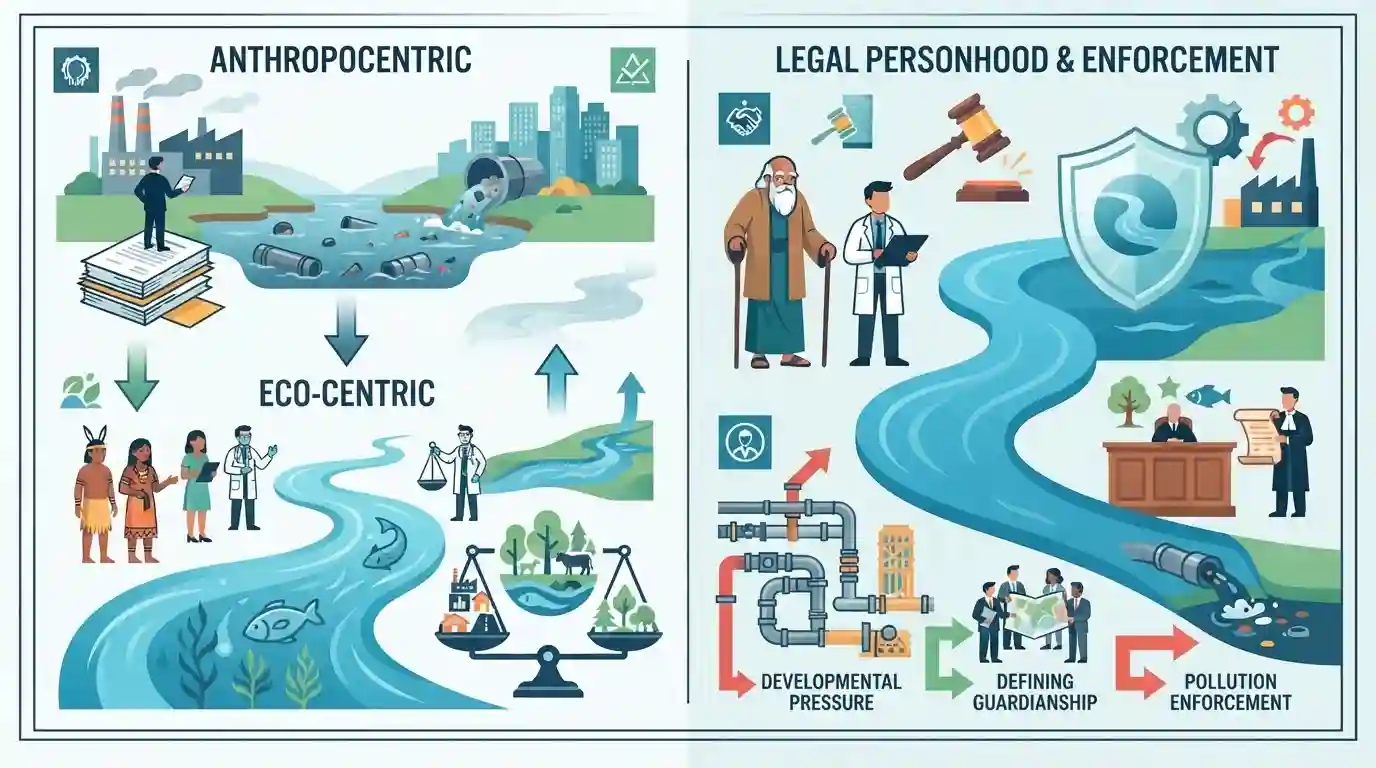
The article analyzes the emerging legal concept of granting 'legal personhood' to rivers, known broadly as the Rights of Nature. By examining global and Indian precedents—such as the Whanganui River in New Zealand and the Uttarakhand High Court's ruling on the Ganga and Yamuna—it highlights the shift from anthropocentric environmental laws to an eco-centric framework. While recognizing rivers as living entities allows guardians to legally protect them from pollution and exploitation, the article also notes the practical challenges of enforcing these rights, defining guardianship, and balancing ecological preservation with human developmental activities.
Key Points
- Granting legal personhood to rivers allows them to hold fundamental rights, enabling guardians to sue on their behalf against pollution and degradation.
- This represents a significant jurisprudential shift from an anthropocentric (human-centered) legal system to an eco-centric (nature-centered) approach.
- Global precedents include New Zealand granting personhood to the Whanganui River; in India, the Uttarakhand High Court declared the Ganga and Yamuna rivers as living entities (though stayed by the Supreme Court).
- The practical application faces challenges, such as determining who acts as the 'loco parentis' (guardian) and resolving conflicts between a river's rights and human developmental needs.
- Provides an alternative or supplementary legal avenue to traditional environmental regulations and river cleaning initiatives like Namami Gange.
Important Terms
Environment (Protection) Act, 1986

India's umbrella environmental legislation enacted under Article 253 after the Bhopal Gas Tragedy, empowering the Central Government to protect environmental quality, set emission standards, and coordinate national pollution control.
UPSC context
GS Paper III: Environment. Tests environmental governance, regulatory frameworks, environmental impact assessments, and legislative powers.
Namami Gange
An Integrated Conservation Mission launched as a flagship programme in 2014 under the Ministry of Jal Shakti to abate pollution, conserve, and rejuvenate the National River Ganga and its tributaries.
UPSC context
GS Paper III: Conservation. Relevant for water resource management, ecological restoration initiatives, and cooperative federalism in river basin cleaning.
Uttarakhand High Court
The state's apex judicial body, which in 2017 delivered the historic ruling in the Mohd. Salim case, conferring legal personhood on the Ganga and Yamuna rivers to protect them from environmental degradation.
UPSC context
GS Paper II: Judiciary, Judicial Activism. Analyzes judicial interventions, the evolution of environmental jurisprudence, and rights-of-nature legal frameworks.
Supreme Court of India
India's apex court, which stayed the Uttarakhand High Court's 'living entities' ruling, citing the legal, administrative, and multi-state liability challenges of declaring rivers as juristic persons.
UPSC context
GS Paper II: Constitutional Bodies, Federalism. Evaluates the separation of powers, judicial overreach, and administrative constraints of court-directed environmental policies.
Prelims Trap
The Supreme Court of India upheld the Uttarakhand High Court ruling declaring the Ganga and Yamuna as living legal entities.
The Supreme Court stayed the HC ruling in 2017, highlighting administrative complexities like cross-border liability if the river floods or causes damage.
Static Concepts Connected
What is the difference between anthropocentric and ecocentric environmental jurisprudence?
- Anthropocentrism: Focuses on human utility; nature has only instrumental value to serve human needs and development.
- Ecocentrism: Focuses on intrinsic value; nature has an inherent right to exist, persist, and regenerate regardless of human utility.
What is a juristic person in Indian law?
- Definition: A non-human entity recognized by law as having legal rights, duties, and the capacity to sue or be sued.
- Precedents: Indian courts have long recognized corporate bodies, public trusts, and temple deities as juristic or legal persons.
- Guardianship: Requires designated human representatives to act 'in loco parentis' (in place of a parent) to exercise those legal rights.
Cross-Topic Patterns
Federalism + Transboundary Rivers
Declaring a transboundary river a legal entity in one state creates immense jurisdictional and liability conflicts with adjacent states sharing the same basin.
Deity Rights + Green Jurisprudence
The legal fiction of recognizing Hindu deities as juristic entities provided the foundational jurisprudential framework for granting legal rights to sacred rivers like Ganga.

Analyses of ecocentric judicial activism vs. executive river missions (NMCG) are highly likely in GS-2/GS-3 Mains.
Linked PYQs · 3
Linked PYQs · 3
- 2022MainsGS2
“The most significant achievement of modern law in India is the constitutionalization of environmental problems by the Supreme Court.” Discuss this statement with the help of relevant case laws.
- 2024MainsGS3
Industrial pollution of river water is a significant environmental issue in India. Discuss the various mitigation measures to deal with this problem and also the government's initiatives in this regard.
- 2015MainsGS3
Discuss the Namami Gange and National Mission for Clean Ganga (NMCG) programmes and causes of mixed results from the previous schemes. What quantum leaps can help preserve the river Ganga better than incremental inputs?
