Legal Personhood for Rivers in Environmental Jurisprudence
Source:The Hindu ↗
কেন এটি গুরুত্বপূর্ণ
It highlights a critical evolution in environmental law and constitutional rights (Article 21), heavily emphasized by the Supreme Court. Understanding the 'Rights of Nature' and the shift to eco-centrism is crucial for GS2 (Judicial trends) and GS3 (Conservation).
সারসংক্ষেপ
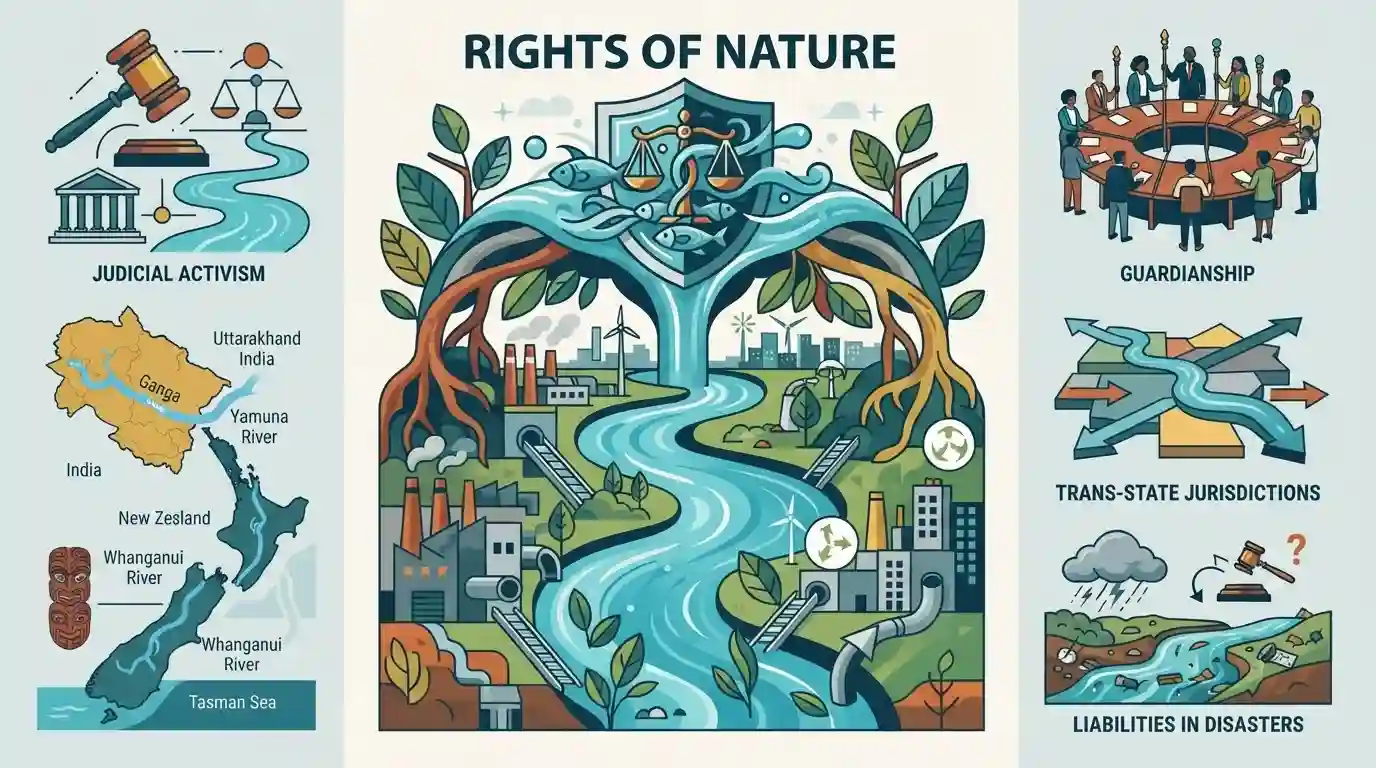
The article examines the evolving environmental jurisprudence of granting 'legal personhood' to rivers and other natural entities. Originating from the 'Rights of Nature' movement, this eco-centric approach aims to combat severe environmental degradation by treating rivers not merely as resources, but as living entities with legal rights to exist, thrive, and be protected. The piece highlights landmark instances such as the Uttarakhand High Court's ruling on the Ganga and Yamuna, and international examples like New Zealand's Whanganui River. While providing a powerful tool against pollution and exploitation, the concept poses practical challenges regarding guardianship (who represents the river), trans-state jurisdictions, and legal liabilities in the event of natural disasters.
মূল বিষয়
- The concept of granting 'legal personhood' to rivers marks a shift from anthropocentric to eco-centric environmental jurisprudence.
- Legal personhood grants natural entities like rivers the rights, duties, and liabilities of a living human, enabling them to be represented in courts to sue for damages against pollution and encroachment.
- In India, the Uttarakhand High Court (2017) declared the Ganga and Yamuna rivers as living entities, though the Supreme Court later stayed the order citing practical implications.
- Globally, New Zealand's Whanganui River and Colombia's Atrato River have been granted legal rights, often emphasizing indigenous guardianship models.
- The approach raises complex questions about transboundary jurisdictions, the 'parens patriae' (guardianship) doctrine, and accountability when a river causes damage (e.g., floods).
গুরুত্বপূর্ণ শব্দ
Rights of Nature

An emerging eco-centric legal doctrine recognizing that ecosystems—like rivers or forests—have intrinsic rights to exist, thrive, and regenerate, rather than being treated merely as property to be exploited by humans.
UPSC context
Crucial for GS3 (Environment) and GS2 (Judicial Activism). Marks a paradigm shift from anthropocentric to eco-centric environmental jurisprudence.
Legal Personhood
The legal recognition of a non-human entity (such as a river, corporation, or idol) as a "juristic person" possessing rights, duties, and liabilities akin to a human being, represented by guardians.
UPSC context
Important for GS2 (Polity). Explains the mechanism by which natural entities or non-human subjects can enforce their rights in courts.
Uttarakhand High Court
The Indian state high court that issued a landmark 2017 judgment declaring the Ganga and Yamuna rivers as "living persons" with legal rights, initiating the 'Rights of Nature' discourse in India.
UPSC context
A key case study for GS2 (Judicial Pronouncements) and GS3 (River Conservation) regarding innovative environmental protection mechanisms.
Supreme Court of India
The apex judicial body that, in 2017, stayed the Uttarakhand High Court's order granting legal personhood to the Ganga and Yamuna, citing practical, administrative, and inter-state jurisdictional challenges.
UPSC context
Highlights the practical limitations of judicial activism and federal complexities (GS2) when granting rights to trans-boundary ecological entities.
Madras High Court
The state high court that, in a 2022 ruling, invoked its "parens patriae" jurisdiction to declare "Mother Nature" a living being with all corresponding legal rights, duties, and liabilities.
UPSC context
Relevant for GS2 and GS3 as an example of expanding the judicial interpretation of Article 21 to encompass overarching environmental stewardship.
Parens Patriae
A legal doctrine meaning "parent of the nation," which allows the state or courts to act as a legal guardian for those unable to protect themselves, such as minors or ecosystems.
UPSC context
Vital for GS2 (Judicial Activism). Illustrates the specific legal rationale Indian courts use to appoint human guardians for rivers and nature.
প্রিলিমস ফাঁদ
The Supreme Court of India recently recognized the Ganga and Yamuna rivers as legal persons with human-like rights.
The Uttarakhand High Court declared them legal persons in 2017, but the Supreme Court subsequently stayed the order due to practical issues like trans-state jurisdiction and liability.
সংযুক্ত স্থির ধারণা
What is the 'Parens Patriae' doctrine in Indian constitutional law?
- Meaning: Translates to 'parent of the nation'. It empowers the State to act as the legal protector for those who cannot protect themselves (e.g., minors, disabled, ecosystems).
- Application: Famously used in the Bhopal Gas Leak Act to allow the government to represent victims, and invoked by High Courts to appoint guardians for rivers.
How does Eco-centric jurisprudence differ from Anthropocentric environmental law?
- Anthropocentric: Views the environment merely as a resource to be protected for human benefit and survival (e.g., Right to Life).
- Eco-centric: Recognizes the intrinsic value of nature. It argues that ecosystems have an independent right to exist and thrive, regardless of their utility to humans.
আন্তঃবিষয় প্যাটার্ন
Article 21 vs. Environmental Ethics
The shift from 'right to a clean environment' under Article 21 to intrinsic 'Rights of Nature' directly links GS2 constitutional evolution with GS4 environmental ethics.
Indigenous Conservation Models
New Zealand’s Maori guardianship model for the Whanganui river provides a strong comparative framework for community-led conservation and Forest Rights Act debates in India.

Expect a multi-statement question mixing India's Ganga/Yamuna HC ruling (and SC stay) with global precedents like Ecuador or New Zealand.
সংযুক্ত PYQ · 3
সংযুক্ত PYQ · 3
- 2022MainsGS2
“The most significant achievement of modern law in India is the constitutionalization of environmental problems by the Supreme Court.” Discuss this statement with the help of relevant case laws.
- 2024MainsGS3
Industrial pollution of river water is a significant environmental issue in India. Discuss the various mitigation measures to deal with this problem and also the government's initiatives in this regard.
- 2013MainsGS3
Enumerate the National Water Policy of India. Taking river Ganges as an example, discuss the strategies which may be adopted for river water pollution control and management. What are the legal provisions of management and handling of hazardous wastes in India?
