Renewable Energy Transition Strategies and Net Zero Goals for India
Source:Indian Express ↗
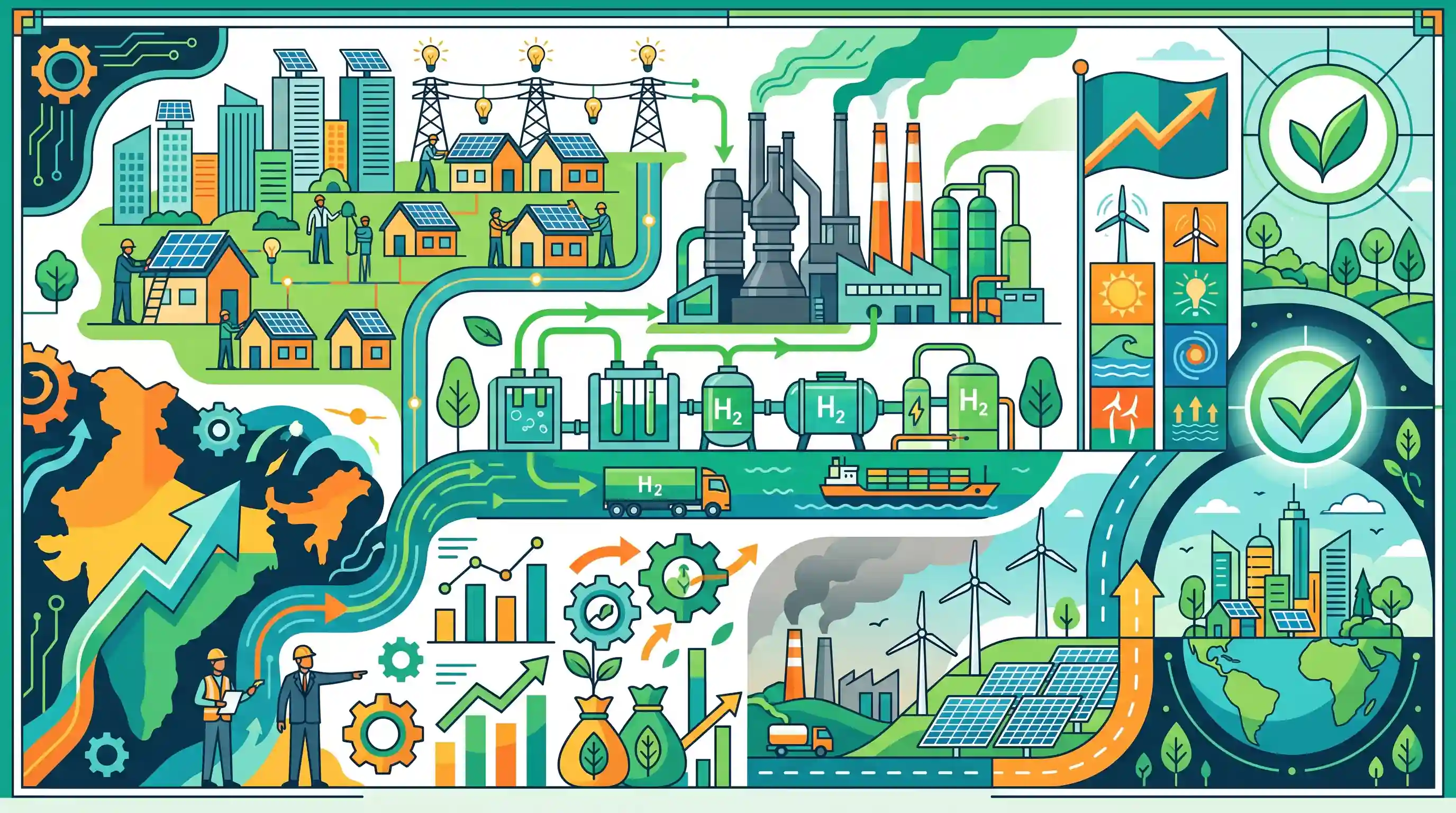
Why It Matters
The transition to clean energy is a core focus area for UPSC, reflecting India's international climate commitments (Panchamrit) and domestic energy security needs. Candidates must understand the integration of distributed energy resources, green hydrogen applications in industry, and the socio-economic impacts of government schemes like PM Surya Ghar.
Summary
The article outlines the rapid momentum of India's clean energy revolution, emphasizing a strategic pivot towards decentralized renewable energy generation and clean technologies. By promoting rooftop solar through initiatives like the PM Surya Ghar Muft Bijli Yojana and investing in green hydrogen to decarbonize heavy industries, India is building a robust foundation for energy independence and economic growth. This multi-pronged approach is essential for meeting the nation's commitment to 500 GW of non-fossil fuel capacity by 2030 and achieving net-zero emissions by 2070.
Key Points
- India is accelerating its transition to renewable energy sources like solar, wind, and green hydrogen to ensure long-term energy security and environmental sustainability.
- Decentralized energy models, championed by schemes like PM Surya Ghar Muft Bijli Yojana, are vital for empowering households and transforming residential rooftops into distributed energy resources (DERs).
- Green hydrogen is emerging as an indispensable technology for decarbonizing hard-to-abate heavy industries, including steel plants, fertilizers, and oil refineries.
- Achieving the ambitious targets of 500 GW of non-fossil capacity by 2030 and net-zero emissions by 2070 requires a fundamental shift in investments from fossil fuels to clean energy infrastructure and battery storage.
Important Terms
PM Surya Ghar Muft Bijli Yojana

A central scheme launched in 2024 providing up to 300 units of free monthly electricity to one crore households through rooftop solar installations.
UPSC context
GS Paper II & III; tests knowledge of decentralized renewable energy and social welfare policy implementation.
National Green Hydrogen Mission
A flagship initiative launched in 2023 to make India a global hub for green hydrogen production, targeting 5 MMT annual capacity by 2030.
UPSC context
GS Paper III (Energy/Environment); critical for understanding industrial decarbonization and energy security targets.
Sustainable Development Goals (SDGs)
A set of 17 global goals adopted by the UN in 2015 to address poverty, inequality, and climate change by 2030.
UPSC context
GS Paper II & III; foundational framework for international commitments, particularly Goal 7 (Clean Energy).
Ministry of New and Renewable Energy (MNRE)
The nodal central ministry responsible for policy, research, and international cooperation in renewable energy sectors like solar, wind, and green hydrogen.
UPSC context
GS Paper II (Governance); tests understanding of the institutional architecture driving India's energy transition.
DISCOMs
Power distribution utilities responsible for last-mile delivery of electricity; their financial health is often measured by AT&C losses and ACS-ARR gaps.
UPSC context
GS Paper III (Infrastructure: Energy); essential for discussing structural reforms in the power sector value chain.
Prelims Trap
India has set a target to achieve 500 GW of renewable energy capacity by 2030.
The Panchamrit target is 500 GW of *non-fossil fuel* energy capacity, which includes Nuclear and Large Hydro. It is not exclusively *renewable energy*.
Static Concepts Connected
What differentiates Green Hydrogen from other hydrogen types?
- Green Hydrogen: Produced via electrolysis of water using renewable energy, resulting in a zero-carbon footprint.
- Grey Hydrogen: Produced from natural gas (methane) using steam methane reforming, which emits carbon dioxide into the atmosphere.
- Blue Hydrogen: Similar to grey hydrogen but incorporates Carbon Capture and Storage (CCS) to capture and mitigate the resulting emissions.
What are Distributed Energy Resources (DERs) and their benefits?
- Definition: Small-scale power generation or storage units (e.g., rooftop solar, microgrids) located close to the point of electricity consumption.
- T&D Losses: By localizing power generation, DERs significantly reduce the power lost during transmission and distribution over long distances.
- Grid Resilience: DERs reduce peak load stress on centralized grids, improving local power reliability and overall energy security.
Cross-Topic Patterns
Green Hydrogen + Hard-to-abate Sectors
Decarbonizing steel and fertilizers links the National Green Hydrogen Mission directly to core industrial policy and the EU's Carbon Border Adjustment Mechanism (CBAM) impacts on Indian exports.
Rooftop Solar + DISCOM Financials
Widespread rooftop solar impacts the cross-subsidy model of DISCOMs, linking residential energy independence with the ongoing power sector financial stress and the Revamped Distribution Sector Scheme (RDSS).

Expect a 2026 prelims question pairing 'Non-Fossil' vs 'Renewable' capacity targets with specific industrial applications of Green Hydrogen.
Linked PYQs · 5
Linked PYQs · 5
- 2022MainsGS3
Do you think India will meet 50 percent of its energy needs from renewable energy by 2030 ? Justify your answer. How will the shift of subsidies from fossil fuels to renewables help achieve the above objective ? Explain.
- 2018MainsGS3
“Access to affordable, reliable, sustainable and modern energy is the sine qua non to achieve Sustainable Development Goals (SDGs).” Comment on the progress made in India in this regard.
- 2025MainsGS3
How can India achieve energy independence through clean technology by 2047? How can biotechnology can play a crucial role in this endeavour?
- 2024PrelimsGS1
Consider the following: 1. Battery storage 2. Biomass generators 3. Fuel cells 4. Rooftop solar photovoltaic units How many of the above are considered "Distributed Energy Resources"?
- 2025PrelimsGS1
Consider the following statements about 'PM Surya Ghar Muft Bijli Yojana': I. It targets installation of one crore solar rooftop panels in the residential sector. II. The Ministry of New and Renewable Energy aims to impart training on installation, operation, maintenance and repairs of solar rooftop systems at grassroot levels. III. It aims to create more than three lakhs skilled manpower through fresh skilling, and up-skilling, under scheme component of capacity building. Which of the statements given above are correct?
