GDP base year revision and macroeconomic impacts on India
Source:The Hindu ↗
Why It Matters
The GDP base year revision fundamentally alters India's macroeconomic aggregates and shifts timelines for major national targets like the $5 trillion economy. It is highly relevant for GS-3 topics on resource mobilization, growth, and national income computation, as past UPSC Mains questions have directly asked about GDP methodology changes and sectoral shares.
Summary
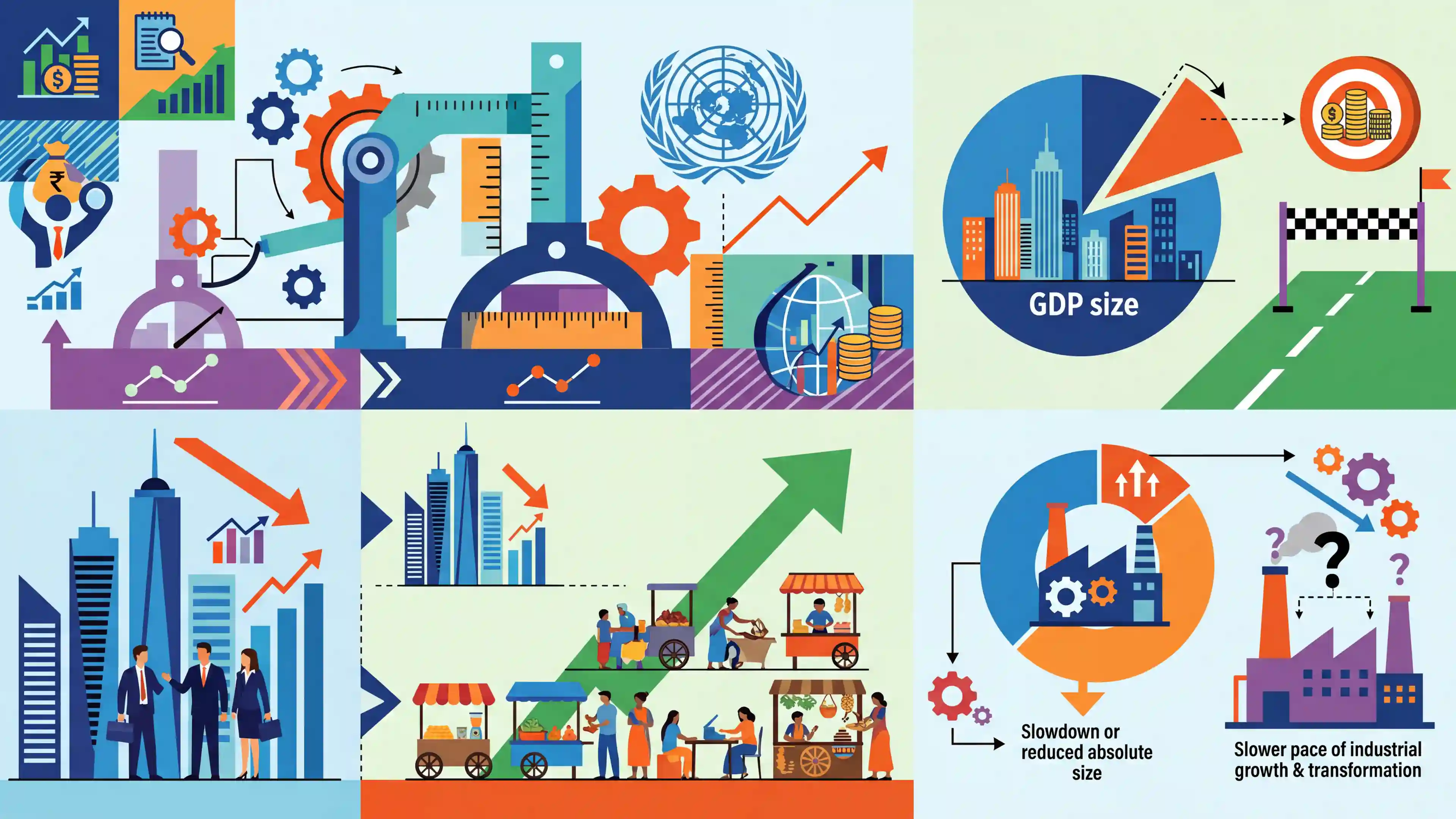
The article analyzes the implications of the National Statistical Office's (NSO) decision to revise the base year for India's GDP estimation from 2011-12 to 2022-23. The new series, aligned with the latest UN System of National Accounts, addresses previous overestimation concerns that had drawn international criticism. While the revision does not drastically alter annual growth rates, it reveals a 3-4% contraction in the absolute size of the GDP, pushing back the target for a $5 trillion economy. Crucially, the revised data indicates structural economic shifts: the private corporate sector's share in Gross Value Added (GVA) has surprisingly declined, while the household/informal sector's share has grown. Furthermore, despite a slight percentage increase in its overall share, the absolute size of the manufacturing sector has shrunk, raising concerns about the pace of India's industrial growth and structural transformation.
Key Points
- The National Statistical Office (NSO) revised the base year for India’s GDP to 2022-23, replacing the controversial 2011-12 series and aligning with the 2025 UN System of National Accounts.
- The revision resulted in a 3-4% contraction in the absolute size of India's GDP, which may delay the timeline for achieving a $5 trillion economy.
- Annual economic growth rates remained largely unaffected (changing by plus or minus 1%), but the sectoral composition saw notable shifts.
- The share of agriculture and industry increased, while the services sector saw a decline; however, the absolute size of the manufacturing sector shrank by 1.5-1.6% despite a marginal percentage increase in its overall share (to 14.7%).
- Contrary to popular narratives of corporate dominance, the Private Corporate Sector's (PCS) share in Gross Value Added (GVA) declined from 35.4% to 33.9% in 2022-23, while the household/informal sector witnessed a marginal increase.
Important Terms
National Statistical Office (NSO)

India's central statistical agency under MoSPI, formed by merging the CSO and NSSO. It compiles key macroeconomic indicators like GDP, IIP, and CPI.
UPSC context
GS Paper 3 (Economy). Tests knowledge of the institutional framework for national income accounting and data credibility.
UN System of National Accounts (UNSNA)
The international standard framework for compiling national accounts. It ensures global comparability of economic data like GDP and is periodically updated (e.g., SNA 2008, SNA 2025).
UPSC context
GS Paper 3. Relevant for international economic standards and India's alignment with global statistical best practices.
Gross Value Added (GVA)
A measure of the value of goods and services produced in an area, industry, or sector, calculated as total output minus intermediate consumption.
UPSC context
GS Paper 3. Essential for understanding sectoral contributions to the economy and supply-side growth dynamics.
Base Year Revision
Updating the reference year for GDP calculation (e.g., from 2011-12 to 2022-23) to reflect current economic structures, consumption patterns, and new data sources.
UPSC context
GS Paper 3. Tests understanding of how real growth is calculated and the impact of statistical resets on economic narratives.
Structural Transformation
The shift of an economy's labor and production from low-productivity sectors (agriculture) to higher-productivity ones (manufacturing/services), often a hallmark of development.
UPSC context
GS Paper 3. Core concept for analyzing India's growth trajectory and sectoral imbalances in the labor market.
International Monetary Fund (IMF)
An international organization that sets global data dissemination standards (like SDDS) and monitors the quality and transparency of member countries' national accounts.
UPSC context
GS Paper 2 & 3. Tests understanding of global economic governance and international pressure for data transparency.
Prelims Trap
"The new 2022-23 base year confirms the formal corporate sector's share in GVA increased at the expense of the informal sector."
Contrary to the formalization narrative, the revised 2022-23 data shows the Private Corporate Sector's share in GVA actually declined, while the household/informal sector grew marginally.
Static Concepts Connected
What is the significance of a Base Year and the UN SNA in GDP calculation?
- Base Year: A reference year with stable macroeconomic conditions used to measure real GDP, eliminating the effect of price inflation to show true volume growth.
- UN SNA: The internationally agreed standard set of recommendations on how to compile measures of economic activity, ensuring global comparability of macroeconomic aggregates.
- GVA vs GDP: GVA measures the value of goods and services produced in an economy. GDP is calculated as GVA plus taxes on products minus subsidies on products.
How are institutional sectors classified in India's National Accounts?
- Public Sector: Includes general government administration and public non-financial/financial corporations.
- Private Corporate: Comprises private non-financial and financial corporations, representing the formal, registered corporate economy.
- Household Sector: Includes pure households as well as unincorporated enterprises, which effectively represents India's vast informal sector.
Cross-Topic Patterns
Manufacturing stagnation vs. PLI efficacy
The absolute shrinkage of the manufacturing sector under the new series contrasts sharply with recent PLI scheme narratives, raising GS3 questions about the true efficacy of India's industrial policies.
GDP revision & socio-economic data recalibration
GDP base year revisions frequently trigger downstream recalibrations in poverty line estimations and employment data (PLFS), as the absolute size of the economy and consumption baselines shift.

Expect a multi-statement Prelims question on the 2022-23 GDP series, specifically targeting the informal sector's surprising GVA growth.
Linked PYQs · 3
Linked PYQs · 3
- 2021MainsGS3
Explain the difference between computing methodology of India's Gross Domestic Product (GDP) before the year 2015 and after the year 2015.
- 2023MainsGS3
Faster economic growth requires increased share of the manufacturing sector in GDP, particularly of MSMEs. Comment on the present policies of the Government in this regard.
- 2015PrelimsGS1
With reference to Indian economy, consider the following statements : 1. The rate of growth of Real Gross Domestic Product has steadily increased in the last decade. 2. The Gross Domestic Product at market prices (in rupees) has steadily increased in the last decade. Which of the statements given above is/are correct?
