Resumption of India Canada Diplomatic and Economic Relations
Source:The Hindu ↗
Why It Matters
The resumption of India-Canada ties serves as an important case study for UPSC aspirants on how nations balance domestic political constraints (like diaspora extremism) with strategic and economic imperatives. It also illustrates the rising significance of 'middle powers' forming multilateral alignments to counter the protectionist policies of great powers, alongside securing critical resources (like civil nuclear energy).
Summary
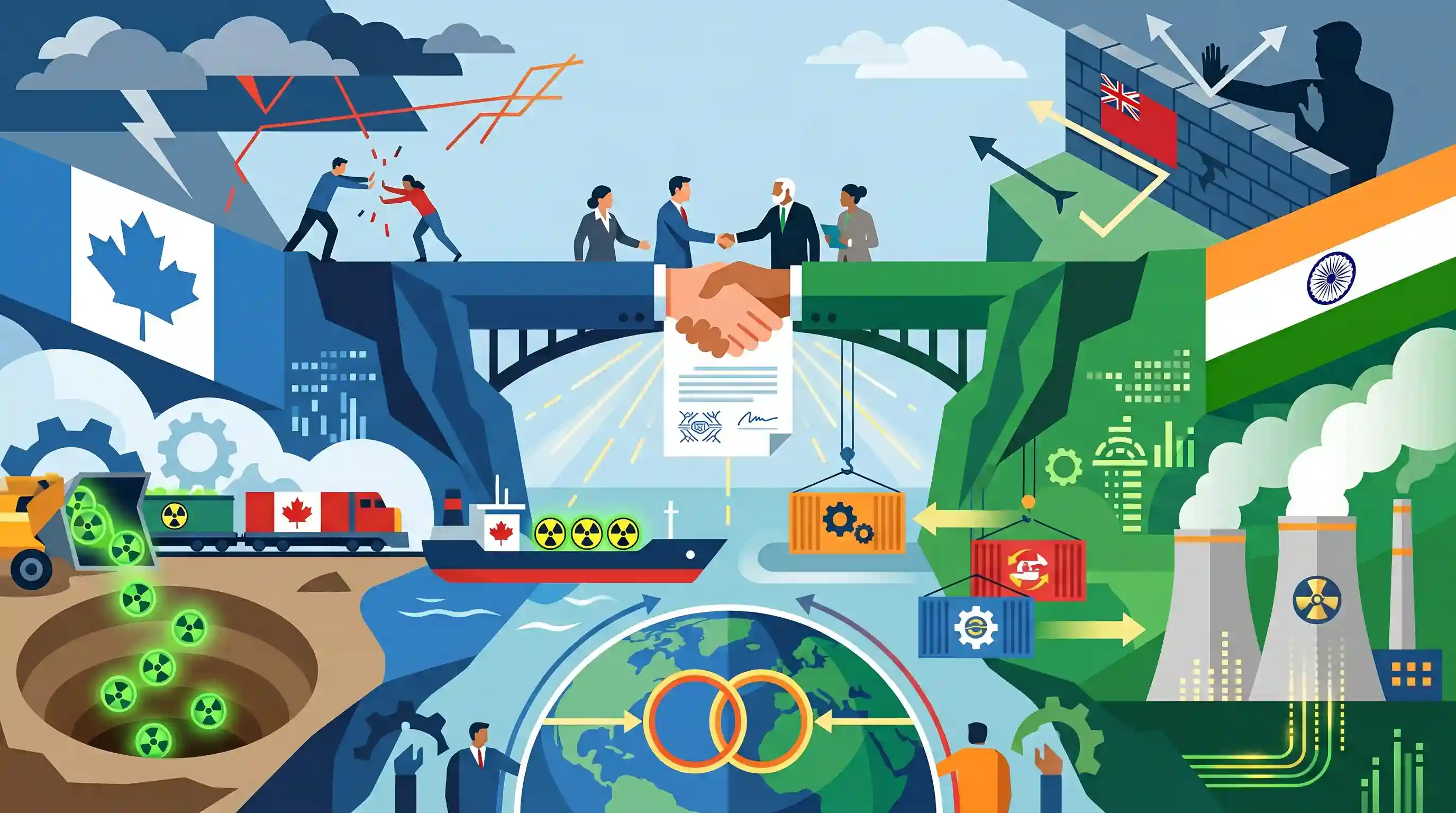
The editorial highlights the significant diplomatic and economic restoration of India-Canada bilateral ties following Canadian Prime Minister Mark Carney's visit to India. Relations had severely deteriorated in 2023 over Canada's public accusations involving the killing of Hardeep Singh Nijjar, leading to diplomatic expulsions. A major turning point occurred through NSA Ajit Doval's recent engagements in Ottawa, establishing a framework to handle the Khalistan extremism issue. Crucially, the countries are advancing a Comprehensive Economic Partnership Agreement (CEPA) and have secured a 10-year Canadian uranium supply deal for India's nuclear sector. The timing reflects broader geopolitical recalculations, as both nations seek to champion multilateralism and diversify trade in response to potential protectionist policies from the new U.S. administration.
Key Points
- India-Canada relations are experiencing a strategic "reboot" following Canadian Prime Minister Mark Carney’s visit to India and his meeting with PM Modi.
- Ties had previously ruptured in 2023 after the Canadian government’s allegations regarding the killing of Hardeep Singh Nijjar and subsequent diplomatic downgrades.
- A recent breakthrough was achieved by NSA Ajit Doval in Ottawa, yielding mutual understandings on resolving the Khalistan issue and addressing concerns over foreign interference.
- Economically, negotiations for a Comprehensive Economic Partnership Agreement (CEPA) have restarted, complemented by a new 10-year agreement ensuring Canadian uranium supplies for Indian nuclear reactors.
- The rapprochement is largely driven by evolving geopolitics; "middle powers" like India and Canada are increasing mutual cooperation to offset the unilateral trade and tariff policies expected from U.S. President Donald Trump.
Important Terms
Comprehensive Economic Partnership Agreement (CEPA)

A deep free trade agreement between nations covering goods, services, and investments. It is more comprehensive than a standard Free Trade Agreement (FTA).
UPSC context
GS2 (Bilateral Agreements) & GS3 (Economy); tests knowledge of trade diplomacy and India's target to double bilateral trade.
Five Eyes
An intelligence-sharing alliance comprising the United States, United Kingdom, Canada, Australia, and New Zealand, primarily focused on signals intelligence (SIGINT).
UPSC context
GS2 (Global Groupings); tests understanding of international security architectures and their impact on India's diplomatic and security interests.
Khalistan Movement
A separatist movement seeking to establish a sovereign Sikh state called Khalistan in India's Punjab region.
UPSC context
GS3 (Internal Security); focuses on secessionism, diaspora radicalization, and challenges to India's territorial integrity and foreign relations.
Uranium Supply Agreement
A 10-year, $1.9 billion contract between India and Canada (Cameco) to provide approximately 10,000 tonnes of uranium for India's civilian nuclear reactors.
UPSC context
GS3 (Energy Security) & GS2 (Bilateral Ties); crucial for India's nuclear energy program and diversifying fuel sources.
Transnational Repression
Actions by a state to silence or coerce its nationals or diaspora members across international borders.
UPSC context
GS2 (International Relations); pertains to sovereignty, international law, and diplomatic disputes involving the treatment of diaspora communities.
Multilateralism
The practice of coordinating national policies through international groups of three or more nations to solve global challenges.
UPSC context
GS2 (Global Groupings); essential for discussing India's strategic positioning in a multipolar world and its engagement in global governance.
Prelims Trap
India's domestic uranium ores are high-grade, making imports necessary only for future capacity expansion.
India's domestic uranium ores (Jaduguda, Tummalapalle) are exceptionally low-grade (0.02%–0.45%). India relies heavily on imported uranium to run its existing IAEA-safeguarded civilian reactors.
Static Concepts Connected
How does India source Uranium for its civilian nuclear reactors?
- Domestic reserves: Mines like Jaduguda (Jharkhand) and Tummalapalle (Andhra Pradesh) provide ore, but its low concentration (0.02-0.45%) severely constrains domestic fuel self-sufficiency.
- Foreign suppliers: Kazakhstan, Canada, Russia, and Australia are the primary global suppliers for India's IAEA-safeguarded Pressurized Heavy Water Reactors (PHWRs).
- NSG Waiver: The 2008 NSG waiver allowed India to sign bilateral Civil Nuclear Cooperation Agreements, enabling these critical imports despite not being an NPT signatory.
What distinguishes a CEPA from other international trade agreements?
- PTA: Preferential Trade Agreements (PTAs) reduce tariffs on a limited, positive list of specified items.
- FTA / CECA: Free Trade Agreements and Comprehensive Economic Cooperation Agreements (CECAs) focus primarily on eliminating tariffs for goods.
- CEPA: The most comprehensive agreement, covering goods, services, investment, intellectual property rights, and regulatory cooperation.
Cross-Topic Patterns
Energy security meets middle-power diplomacy
India leverages clean energy dependencies—like the 10-year Canadian uranium pact—to stabilize politically turbulent bilateral relationships, mirroring its earlier strategic bridging with Australia.
Geopolitical hedging against US protectionism
The resumption of CEPA negotiations showcases 'middle powers' proactively building alternative supply chains to insulate their economies from anticipated unilateral US tariff hikes.

Expect a 2026 Prelims geography/IR match-the-following pairing global uranium sources (Canada) with domestic Indian mines (Tummalapalle).
Linked PYQs · 3
Linked PYQs · 3
- 2025MainsGS2
"With the waning of globalization, post-Cold War world is becoming a site of sovereign nationalism.” Elucidate.
- 2020MainsGS2
Indian diaspora has a decisive role to play in the politics and economy of America and European Countries'. Comment with examples.
- 2018MainsGS3
“Access to affordable, reliable, sustainable and modern energy is the sine qua non to achieve Sustainable Development Goals (SDGs).” Comment on the progress made in India in this regard.
