Rajasthan High Court addresses social boycotts over death feasts
Source:theprint ↗
Why It Matters
RPSC frequently tests knowledge of Rajasthani traditions, customs, and reform legislation. Understanding the tension between formal laws (like the Mrityu Bhoj Act of 1960) and informal social governance (caste panchayats) is critical for questions on social issues and administration in Rajasthan.
Summary
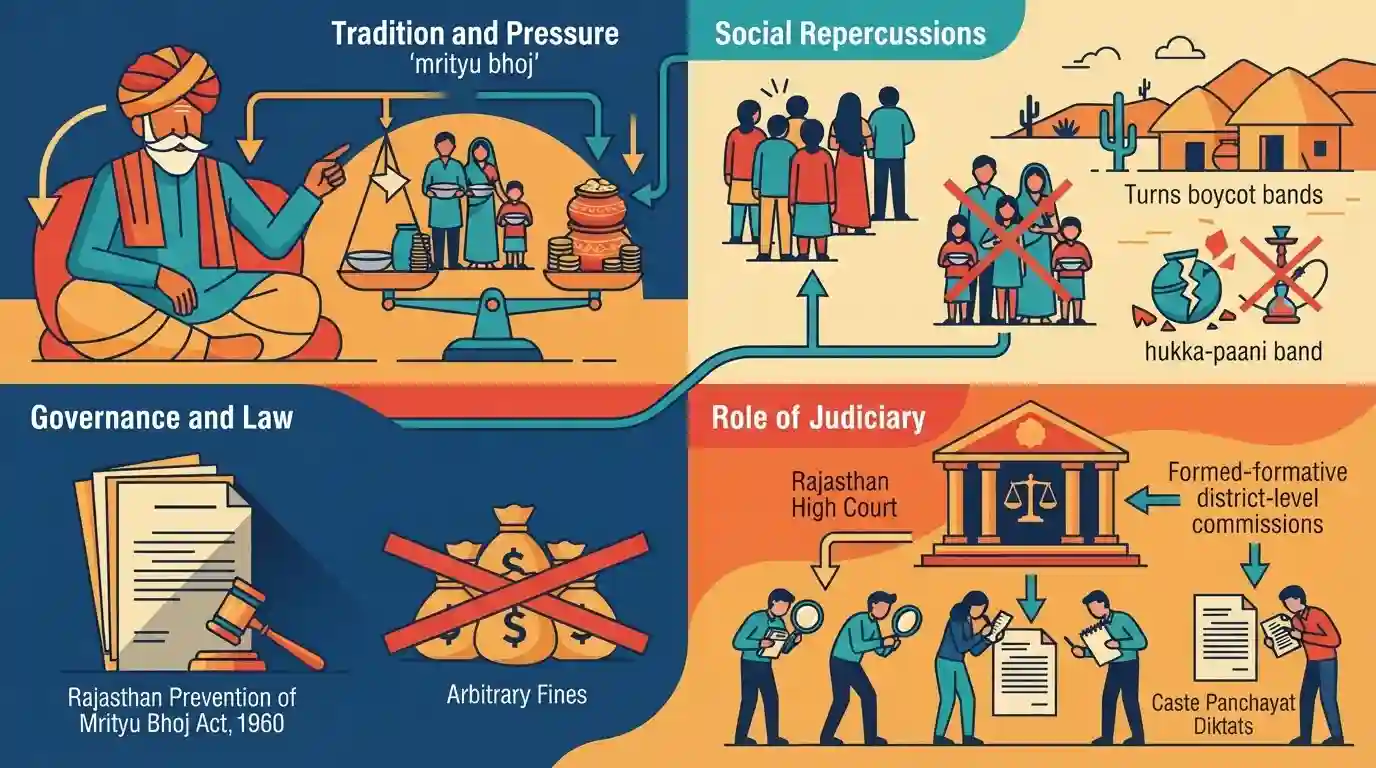
In rural Rajasthan, families attempting to avoid the financially ruinous tradition of 'mrityu bhoj' (death feast) are facing severe repercussions from local caste panchayats. A case in Sirohi district highlights how refusing to host such feasts can lead to arbitrary fines and strict social boycotts ('hukka-paani band'). Despite the existence of the Rajasthan Prevention of Mrityu Bhoj Act, 1960, enforcement remains weak in the face of entrenched social customs. The Rajasthan High Court has taken cognizance of the issue, ordering the formation of district-level commissions to probe the illegal diktats of caste panchayats.
Key Points
- A family in Mandwariya, Sirohi district, faced social boycott and arbitrary fines from their caste panchayat for refusing to host an elaborate 'mrityu bhoj' (death feast) serving malpuas.
- The Rajasthan Prevention of Mrityu Bhoj Act, 1960, formally outlaws this traditional death feast (locally known as Mosar), but informal caste panchayats continue to aggressively enforce the custom.
- Families often incur severe debt to pay for these feasts or risk being subjected to 'hukka-paani band' (total social and economic boycott).
- In response to a PIL on caste panchayat tyranny, the Rajasthan High Court has ordered the creation of five-member commissions, headed by district collectors, to investigate social boycotts.
Important Terms
Rajasthan Prevention of Mrityu Bhoj Act, 1960

A 1960 state law banning extravagant death feasts (mrityu bhoj/mosar). Despite prescribing up to a year's imprisonment, enforcement remains poor due to entrenched social customs and caste panchayat pressures.
UPSC context
Tests RPSC Knowledge of Rajasthan Polity/Society. Candidates must know this specific state legislation and its failure to curb regressive social practices.
Rajasthan High Court
The top judicial body in the state, with its principal seat in Jodhpur. It recently ruled caste panchayat diktats and social boycotts unconstitutional, ordering the state to frame dedicated laws against them.
UPSC context
Important for State Polity and Judiciary topics. Shows the judiciary's proactive role in social reform and protecting fundamental rights against extra-constitutional bodies.
Meghwal samaj
A prominent Dalit community in Rajasthan. The article highlights intra-community struggles where some members are resisting expensive traditions mandated by their own caste panchayats.
UPSC context
Relevant for Rajasthan Society and Social Issues. Illustrates that regressive customs and social boycotts affect various communities, including marginalized groups.
Caste panchayat
Unelected, extra-constitutional village or community councils that enforce traditional caste rules. They often operate as a "parallel justice system," imposing illegal fines and social boycotts (hukka-paani band).
UPSC context
Critical for Governance and Social Issues. Explores the tension between constitutional law and traditional power structures enforcing regressive social practices.
Prelims Trap
Only the family organizing the mrityu bhoj is liable for punishment under the 1960 Act.
Section 5 places a mandatory duty on village officials (sarpanches, patwaris) to report and prevent these feasts, making them liable for imprisonment if they fail.
Static Concepts Connected
What are the traditional Rajasthani socio-cultural terms for community feasts?
- Mosar: Traditional funeral feast organized after a person's death (also known as Nukta).
- Josar: A pre-death feast organized by a person for their community while they are still alive.
- Chahallum: The 40th-day Islamic death ritual feast, which is also explicitly banned under the 1960 Act.
Which princely state ruler first initiated reforms against Mrityubhoj in Rajasthan?
- Maharaja Jai Singh: Ruler of Alwar State (1892-1937) who enacted early progressive social reforms in his territory.
- Key Reforms: He banned Mrityubhoj, prohibited child and mismatched marriages in 1903, and established local panchayats.
Cross-Topic Patterns
Khap Panchayats vs Article 21
Extralegal dictates (hukka-paani band) by caste panchayats violate the Right to Life, invoking High Court intervention to protect individual liberties and rule of law.
Custom-driven rural indebtedness
Compulsion for Mosar forces rural families into debt traps, highlighting the importance of Section 8 of the 1960 Act which completely voids loans taken for death feasts.

Match-the-following on 'Mosar/Josar' or statement-based questions on the 1960 Act's penal provisions for Sarpanches are highly likely.
Linked PYQs · 2
Linked PYQs · 2
- 2024RPSC_PRELIMSGS1
For which of the following the words Aadi, Hiyali are popular in Rajasthani language?
- 2025RPSC_PRELIMSGS1
For what are the ‘Aadi, Hiyali’ words prevalent in the Rajasthani language?
