Dehradun Vulture Conservation Shift Mitigates Electrocution Risks
Source:The Hindu ↗
Why It Matters
This article is extremely relevant for UKPSC PCS Prelims as it showcases a successful local conservation initiative in Dehradun, Uttarakhand. It underscores the interface between livestock waste management (animal husbandry) and avian wildlife conservation, and offers insights into mitigating infrastructural threats (power line electrocutions) to threatened raptors and vultures.
Summary
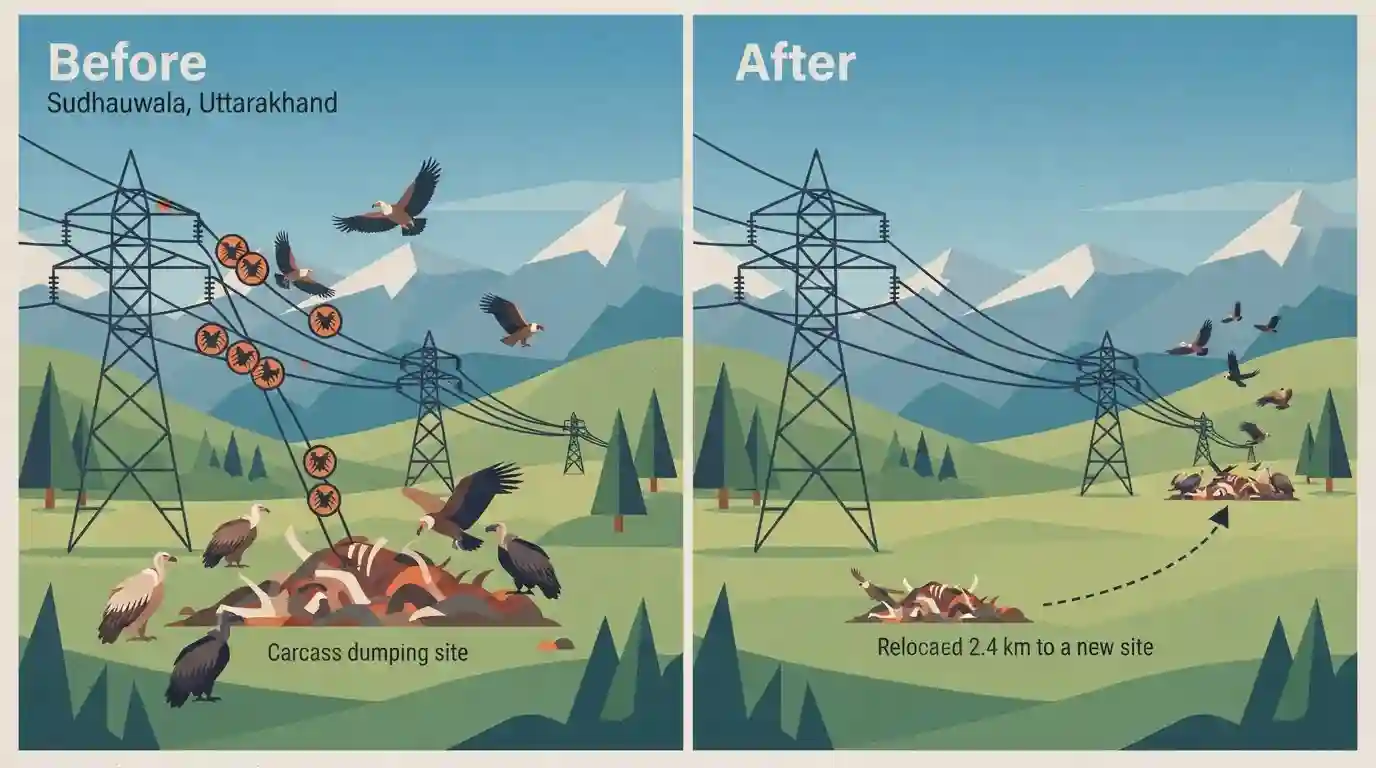
A study in Dehradun, Uttarakhand, highlights a highly effective and low-cost conservation intervention where local authorities successfully mitigated vulture electrocution mortalities. Between 2011 and 2014, 46 vulture electrocutions—primarily of Himalayan griffons, Eurasian griffons, and Cinereous vultures—occurred near a carcass dumping site in Sudhauwala due to nearby high-tension power lines. Relocating the carcass dumping site 2.4 km away in April 2015 completely eliminated further electrocution deaths. This provides a practical model for resolving developmental infrastructure-wildlife conflicts, particularly for endangered scavenging bird species.
Key Points
- A study published in the Journal of Threatened Taxa highlighted that electrocution from high-tension power lines was a major localized threat to scavenging vultures in the Sudhauwala region of Dehradun, Uttarakhand.
- Between May 2011 and February 2014, a total of 46 vulture deaths due to electrocution were documented near a livestock carcass dumping site.
- The species most affected were the Himalayan griffon (Gyps himalayensis), Eurasian griffon (Gyps fulvus), and Cinereous vulture (Aegypius monachus).
- In April 2015, local authorities quietly relocated the carcass dumping site 2.4 km away from the hazardous power lines.
- Post-relocation monitoring showed a significant conservation success, with zero vulture electrocutions recorded at the new site.
- The relocation also benefited other local raptors, including the black kite and the crested serpent eagle, which feed at the site.
- In addition to electrocution, vultures across India face existential threats from veterinary Non-Steroidal Anti-Inflammatory Drugs (NSAIDs) like diclofenac, alongside food scarcity and habitat destruction.
Important Terms
Wildlife Protection Act 1972

A landmark Indian environmental law enacted to protect wild animals, birds, and plants. It establishes schedules of protection, with Schedule I offering the highest security against hunting, poaching, and trade.
UPSC context
GS Paper on Environment & Ecology; tests central conservation acts, species legal protection statuses, and schedules.
Action Plan for Vulture Conservation in India
A policy framework launched by India's Ministry of Environment, Forest and Climate Change to conserve vultures, regulate toxic veterinary drugs, establish rescue/breeding centers, and create Vulture Safe Zones.
UPSC context
GS Paper on Environment & Biodiversity; tests flagship species recovery programs, policy interventions, and ecotoxicology.
Journal of Threatened Taxa
A peer-reviewed, open-access international journal dedicated to conservation, taxonomy, and biodiversity research. It published the key Dehradun study on mitigating vulture electrocution risk by relocating carcass dumps.
UPSC context
GS Paper on Environment; tests scholarly publications on wildlife-infrastructure conflicts and localized conservation research.
Diclofenac
A veterinary non-steroidal anti-inflammatory drug (NSAID) whose residues in cattle carcasses cause lethal kidney failure in vultures, prompting a veterinary ban in India in 2006.
UPSC context
GS Paper on Ecology & S&T; tests veterinary ecotoxicology, biomagnification, and chemical hazards to keystone species.
Prelims Trap
The Himalayan Griffon and Eurasian Griffon, heavily impacted by electrocution in Dehradun, are classified as Critically Endangered under the IUCN Red List.
While three resident Indian Gyps species are Critically Endangered, the Himalayan Griffon is Near Threatened and the Eurasian Griffon is Least Concern.
Static Concepts Connected
What are the primary policy actions and protected areas for vulture conservation in India?
- NSAID Bans: Veterinary Diclofenac was banned in 2006; Ketoprofen and Aceclofenac were banned in 2023 due to vulture toxicity.
- State Reserves: Uttarakhand’s Asan Conservation Reserve and Kedarnath Wildlife Sanctuary are critical habitats for species like the Bearded Vulture.
- Action Plan: The Action Plan for Vulture Conservation (2020-25) mandates setting up vulture conservation breeding centres and vulture safe zones.
How does veterinary diclofenac pathologically affect the vulture population?
- Visceral Gout: Ingestion of diclofenac-treated carcasses leads to acute renal failure, causing uric acid accumulation on internal organs.
- Trophic Impact: High mortality rates (97-99%) disrupt the ecological clean-up cycle, leading to increases in feral dog populations and rabies.
Cross-Topic Patterns
Linear infrastructure vs Hill ecology
Power transmission lines in Uttarakhand's fragile valleys pose electrocution risks to raptors, demanding ecologically-sensitive grid planning.
Veterinary policies and conservation
Decisions by the Central Drugs Standard Control Organisation (CDSCO) on livestock NSAIDs directly dictate avian survival rates.

UKPSC likely to combine Dehradun's vulture mitigation with veterinary drug bans (Ketoprofen/Aceclofenac) in a multi-statement environment MCQ.
Linked PYQs · 3
Linked PYQs · 3
- 2025UKPSC_PRELIMSGS1
Consider the following statements and select the correct answer from the options given below : Statement 1 : Uttarakhand is highly vulnerable to climate change. Statement 2 : Climate change is causing water stress and depleting biodiversity in Uttarakhand.
- 2025UKPSC_PRELIMSGS1
Consider the following statements with reference to animal husbandry in Uttarakhand. Select the correct answer from the codes given below : 1. Animal husbandry is a supplementary occupation of agriculture. 2. Sheep rearing in the mountainous areas has been affected by environmental degradation.
- 2024UKPSC_PRELIMSGS1
Which Constitutional Amendment Act relates to the protection and improvement of environment and safeguarding of forests and wildlife ?
