India adopts pragmatic quiet diplomacy anchored in national interest
Source:Indian Express ↗
Why It Matters
Understanding India's shift from non-alignment to multi-alignment is crucial for Mains GS2. It provides analytical depth for questions on how India navigates contemporary geopolitical crises (like the Russia-Ukraine war or Middle East tensions) to secure its strategic and economic objectives.
Summary
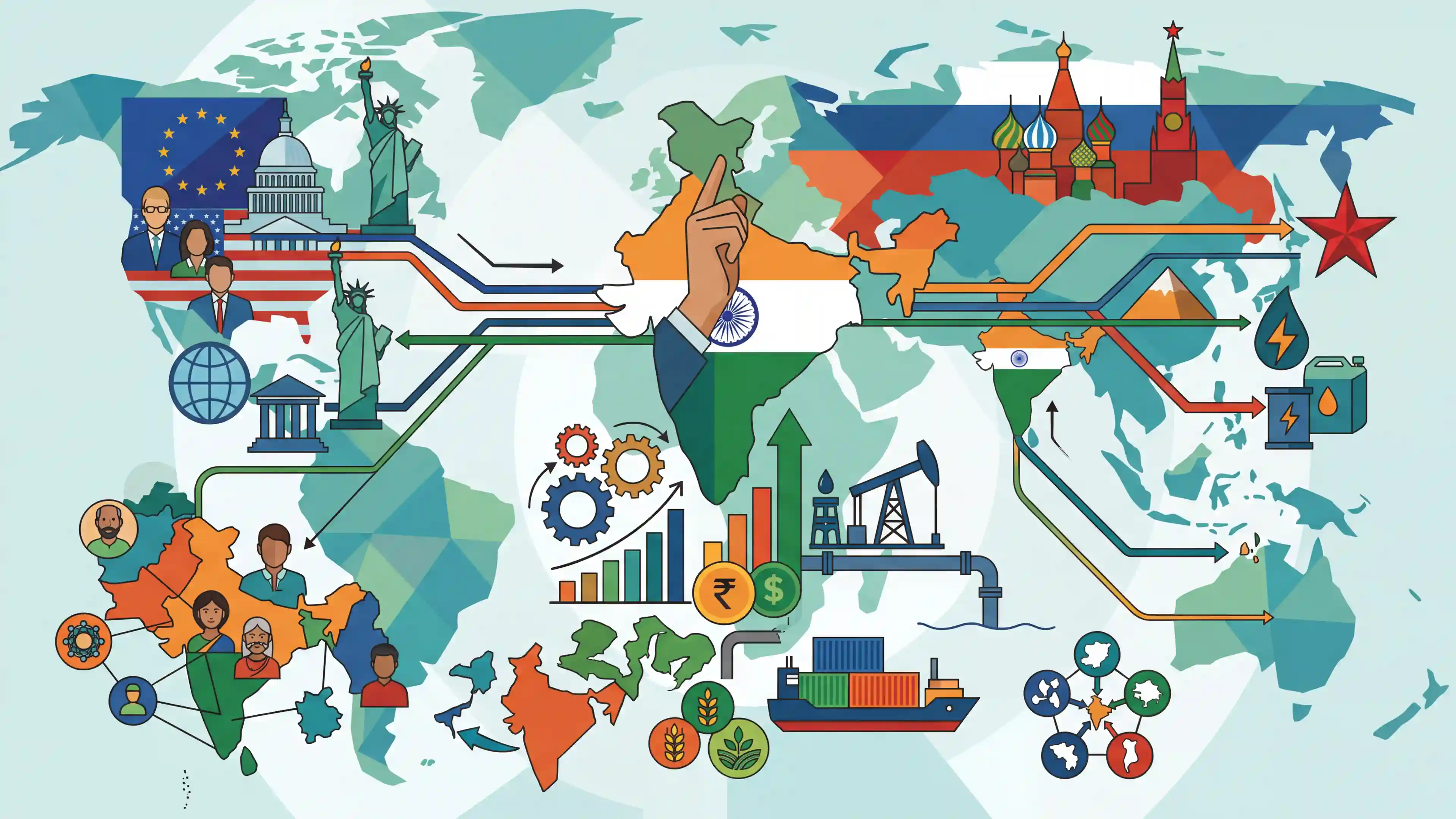
The article discusses India's evolving approach to international relations, characterizing it as a 'quiet diplomacy' anchored firmly in national interest. Moving away from historical ideological constraints and loud global posturing, India now pursues strategic autonomy and multi-alignment. This pragmatic stance allows New Delhi to maintain robust relations with conflicting global powers—such as balancing ties between Russia and the West—ensuring energy security, economic growth, and supply chain resilience. Ultimately, India's measured diplomatic maneuvers position it as a critical stabilizing force and an emerging pole in a polarized global order.
Key Points
- India has transitioned toward a pragmatic 'quiet diplomacy' focused strictly on securing core national interests rather than engaging in ideological posturing.
- By embracing multi-alignment and strategic autonomy, India successfully navigates major global polarizations, including the Russia-West divide and Middle Eastern conflicts.
- This approach enables India to secure essential economic objectives, such as energy security, while simultaneously attracting Western partnerships aimed at countering China.
- Rather than leading through loud rhetoric, India increasingly positions itself as a stabilizing dialogue partner and a voice for the Global South in a multipolar world order.
Important Terms
Multi-alignment

A strategy of maintaining parallel, issue-based relationships with multiple, often competing, powers to maximize national interests without joining a fixed military or political bloc.
UPSC context
GS Paper II (International Relations). Evaluates India’s transition from Non-Alignment to a pragmatic, interest-driven foreign policy.
Strategic Autonomy
The capacity of a state to make independent foreign policy decisions and pursue national interests without being structurally dependent on or constrained by external powers.
UPSC context
GS Paper II. Central to India’s sovereign decision-making and its refusal to join formal military alliances.
Quad (Quadrilateral Security Dialogue)
A strategic forum between India, USA, Japan, and Australia promoting a free, open, and inclusive Indo-Pacific and a rules-based international order.
UPSC context
GS Paper II. Vital for maritime security and balancing regional power dynamics in the Indo-Pacific.
BRICS
An intergovernmental organization of major emerging economies (Brazil, Russia, India, China, South Africa, and others) focused on South-South cooperation and global governance reform.
UPSC context
GS Paper II. Important for India’s leadership in the Global South and reforming Western-led international institutions.
United Nations
The primary global organization for maintaining international peace and security; India is a founding member and a leading contributor to its peacekeeping operations.
UPSC context
GS Paper II. Focuses on India’s demand for permanent UNSC membership and its role in multilateralism.
Global South
A collective term for developing and least-developed nations, primarily in Africa, Asia, and Latin America, which India increasingly seeks to represent globally.
UPSC context
GS Paper II. Tests knowledge of India’s advocacy for equitable development and representation for developing nations.
Prelims Trap
India's multi-alignment strategy involves forming formal military alliances to counterbalance China.
Multi-alignment explicitly avoids formal military alliances. It relies on issue-based, strategic partnerships (like Quad) while simultaneously maintaining ties with opposing blocs (like SCO).
Static Concepts Connected
How does Multi-Alignment differ from traditional Non-Alignment (NAM)?
- NAM (Cold War): Focused on maintaining equal distance from rival superpower blocs, emphasizing ideological purity and anti-imperialism.
- Multi-Alignment: Focuses on concurrent, pragmatic engagement with multiple, often opposing, poles (e.g., USA and Russia) for national interest.
- Issue-based Groupings: Leverages overlapping memberships in diverse forums (Quad, SCO, BRICS) without committing to formal mutual-defense treaties.
What is India's 'De-hyphenation' policy in diplomacy?
- Independent Engagement: Treating bilateral relations with two rival nations independently, rather than viewing one through the lens of the other.
- West Asia Example: Best exemplified by India's parallel, independent strategic ties with both Israel and Palestine, or Iran and Saudi Arabia.
Cross-Topic Patterns
Strategic Autonomy & Energy Security
India's discounted Russian oil purchases demonstrate how foreign policy directly subsidizes domestic inflation management and energy security, blending international relations with macroeconomics.
China-Plus-One and Tech Alliances
Multi-alignment allows India to attract Western critical technology transfers (like iCET) by positioning itself as a democratic supply-chain alternative, without signing military pacts.

Expect a 2026 GS2 Mains question comparing 'Multi-Alignment' with 'Non-Alignment' in the context of energy security and tech supply chains.
Linked PYQs · 4
Linked PYQs · 4
- 2019MainsGS2
‘The long-sustained image of India as a leader of the oppressed and marginalised nations has disappeared on account of its new found role in the emerging global order.’ Elaborate.
- 2024MainsGS2
‘The West is fostering India as an alternative to reduce dependence on China's supply chain and as a strategic ally to counter China's political and economic dominance.’ Explain this statement with examples.
- 2025MainsGS2
"With the waning of globalization, post-Cold War world is becoming a site of sovereign nationalism.” Elucidate.
- 2025MainsGS2
"Energy security constitutes the dominant kingpin of India's foreign policy, and is linked with India's overarching influence in Middle Eastern countries.” How would you integrate energy security with India's foreign policy trajectories in the coming years?
