Fiscal Implications of Populist Election Guarantees on States
Source:The Hindu ↗
Why It Matters
Evaluates the macroeconomic impact of populist policies on state and national fiscal health. Directly relevant to GS3 (Indian Economy, mobilization of resources, government budgeting) and GS2 (governance, welfare schemes).
Summary
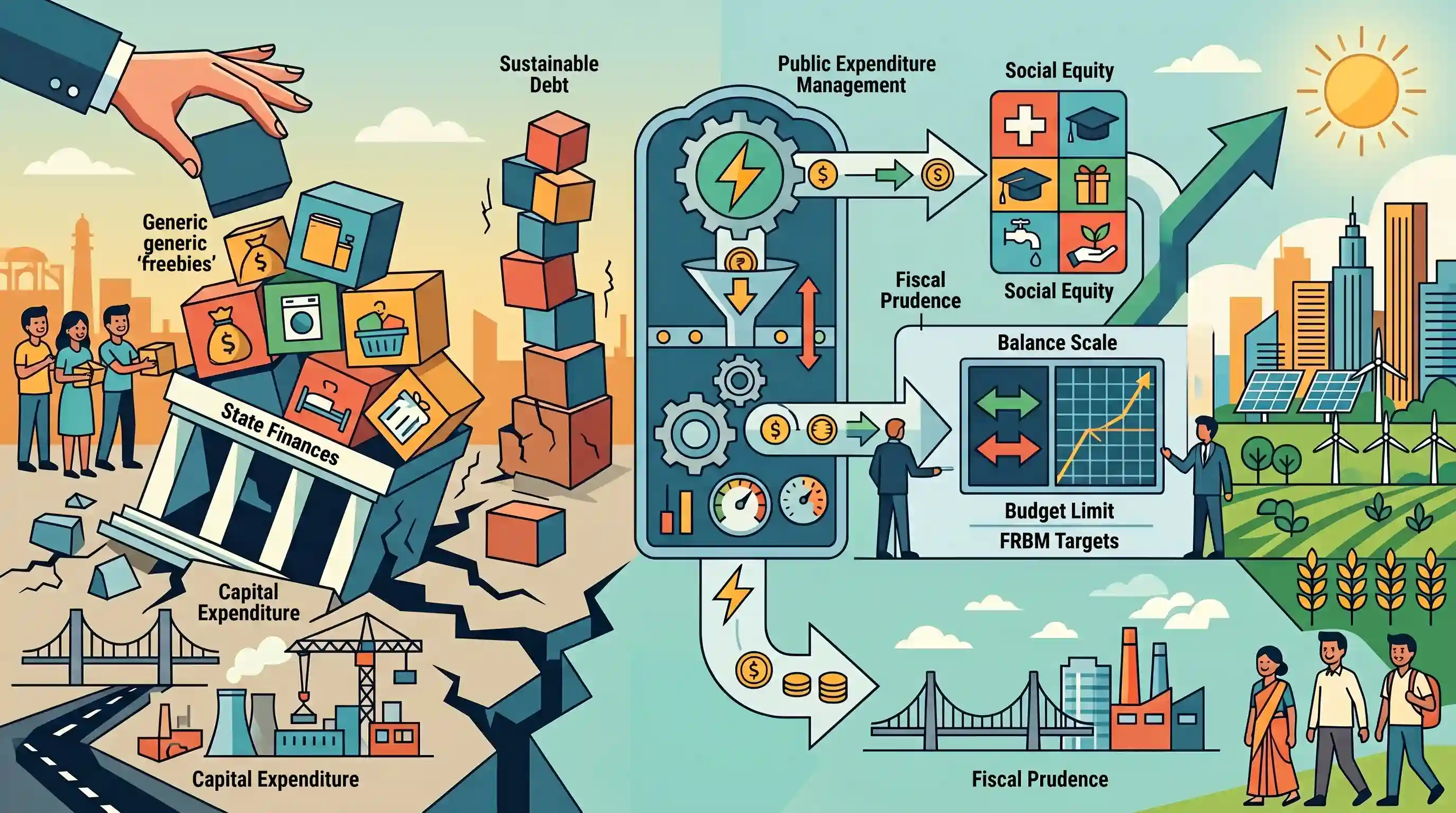
The article critically analyzes the growing trend of political parties offering sweeping election guarantees and welfare schemes, highlighting the severe fiscal strain these promises place on state finances. It underscores that while welfare measures are essential for social equity, indiscriminate promises (often termed 'freebies') compromise capital expenditure and push states toward unsustainable debt levels. The author advocates for balancing social welfare with fiscal prudence, suggesting that robust public expenditure management and adherence to FRBM targets are necessary to ensure long-term economic stability.
Key Points
- The proliferation of competitive election guarantees places an enormous burden on the state exchequer, leading to unsustainable fiscal deficits.
- Unchecked expenditure on populist measures often crowds out crucial capital expenditure, which is essential for long-term economic growth and infrastructure development.
- State governments face challenges in adhering to the Fiscal Responsibility and Budget Management (FRBM) Act targets due to mounting debt obligations.
- There is an urgent need for institutional mechanisms to assess and ensure the fiscal viability of electoral promises before they are implemented.
- Balancing social welfare goals with macroeconomic stability requires prudent public expenditure management and targeted delivery of benefits.
Important Terms
FRBM Act (2003)

A legislative framework mandating the government to ensure fiscal discipline, limit fiscal deficits (target 3% of GDP), and reduce public debt to maintain macroeconomic stability and inter-generational equity.
UPSC context
GS Paper III (Economy); tests knowledge of fiscal consolidation, debt-to-GDP targets, and N.K. Singh Committee recommendations.
Finance Commission
A constitutional body (Article 280) that recommends the division of tax revenues between the Union and States (vertical devolution) and among individual States (horizontal devolution) to ensure fiscal federalism.
UPSC context
GS Paper II (Polity) and III (Economy); vital for understanding resource allocation and the center-state financial relationship.
Reserve Bank of India (RBI)
India’s central bank responsible for managing government debt, regulating the banking system, and monitoring state fiscal health through its annual "State Finances" report.
UPSC context
GS Paper III (Economy); tests its role as a debt manager and its warnings on state-level fiscal sustainability.
Capital Expenditure (CapEx)
Government spending on creating long-term physical or financial assets, such as infrastructure or machinery, which enhances the economy's productive capacity and future growth potential.
UPSC context
GS Paper III (Economy); tests the "quality of expenditure" and the trade-off between asset creation and populist spending.
Revenue Expenditure
Recurring government spending on operational needs, such as salaries, pensions, interest payments, and subsidies, which neither creates assets nor reduces liabilities.
UPSC context
GS Paper III (Economy); critical for analyzing the fiscal deficit and the sustainability of welfare-driven budget allocations.
Welfare Schemes vs. Freebies
A debate distinguishing long-term investments in human capital (merit goods like health/education) from short-term, populist handouts (non-merit goods like electronics) meant for immediate electoral gain.
UPSC context
GS Paper II (Governance) and III (Economy); covers "Revdi culture," electoral ethics, and the Supreme Court’s stance on fiscal prudence.
Prelims Trap
States have full autonomy to raise market loans if they meet FRBM deficit targets.
Under Article 293(3), States cannot raise new loans without the Centre's prior consent if ANY previous central loan or guarantee remains outstanding.
Static Concepts Connected
What are off-budget borrowings and how do they bypass FRBM rules?
- Definition: Loans raised by state-owned entities (SPVs/PSUs) where repayment of principal and interest is serviced directly from the state budget.
- FRBM Loophole: They are traditionally excluded from official fiscal deficit calculations, allowing states to spend beyond FRBM borrowing caps.
- Regulatory Stance: The RBI and CAG increasingly flag these liabilities, urging their inclusion in total state debt metrics to reflect true fiscal health.
How does Revenue Expenditure differ from Capital Expenditure in government budgeting?
- Revenue Expenditure: Consumption spending like salaries, subsidies, and freebies that neither creates productive assets nor reduces financial liabilities.
- Capital Expenditure: Investment spending on physical infrastructure, loans given, or asset creation that yields long-term economic benefits.
- Crowding Out: A surge in populist revenue expenditure (freebies) shrinks the fiscal space available for crucial capital investments, stunting future growth.
Cross-Topic Patterns
Freebies & RPA 1951 Corrupt Practices
Crosses Macroeconomics with Polity. The 2013 Balaji judgment ruled election freebies do not constitute 'corrupt practices' under RPA 1951, shifting the solution from election law to fiscal constraints.
Article 293(3) and Federalism
Links state fiscal policy to Centre-State relations. The Centre uses its leverage under Article 293(3) over outstanding loans to enforce state borrowing limits, frequently sparking federalism debates.

Expect a multi-statement Prelims question testing the interplay of Article 293(3), off-budget borrowing, and N.K. Singh limits.
Linked PYQs · 3
Linked PYQs · 3
- 2025MainsGS3
Explain how the Fiscal Health Index (FHI) can be used as a tool for assessing the fiscal performance of states in India. In what way would it encourage the states to adopt prudent and sustainable fiscal policies?
- 2019MainsGS3
The public expenditure management is a challenge to the Government of India in the context of budget making during the post-liberalization period. Clarify it.
- 2020MainsGS3
Explain the rationale behind the Goods and Services Tax (Compensation to States) Act of 2017. How has COVID-19 impacted the GST compensation fund and created new federal tensions?
