Judicial Intervention and Urban Solid Waste Management in India
Source:The Hindu ↗
Why It Matters
This topic bridges GS-2 (Judicial Activism, Tribunals, Local Government) and GS-3 (Environmental Pollution, Solid Waste Management), highlighting how institutional mechanisms compensate for administrative failures in environmental governance.
Summary
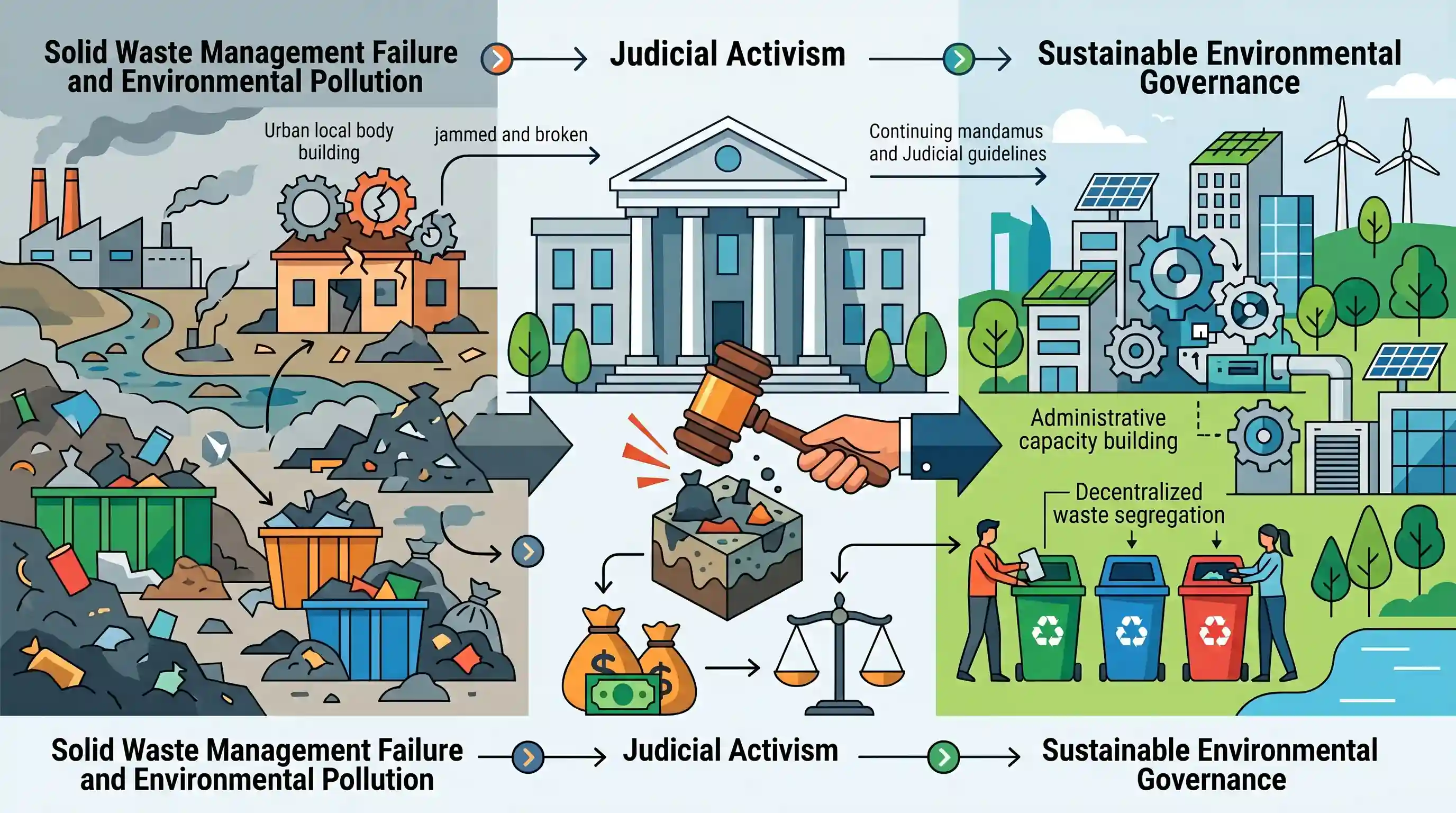
The article discusses the critical role of judicial remedies in addressing India's escalating waste management crisis. With Urban Local Bodies (ULBs) frequently failing to implement the Solid Waste Management Rules, 2016, constitutional courts and the National Green Tribunal (NGT) have stepped in to enforce accountability. Through tools like Public Interest Litigation (PIL), continuing mandamus, and the 'polluter pays' principle, the judiciary is imposing environmental compensation and strict guidelines to spur administrative action. However, while these judicial directives are powerful catalysts for change, sustainable environmental governance ultimately requires administrative capacity building, decentralized waste segregation, and proactive local governance.
Key Points
- India faces a severe urban solid waste management crisis due to inadequate administrative capacity and compliance by local governments.
- Judicial interventions, particularly by the National Green Tribunal (NGT) and constitutional courts, act as powerful remedies to enforce executive accountability.
- Courts are increasingly applying the 'polluter pays' principle and imposing heavy environmental compensation on non-compliant states and municipalities.
- While public interest litigation (PIL) and judicial monitoring are crucial catalysts, long-term success requires decentralized waste segregation, capacity building in ULBs, and active citizen participation.
Important Terms
National Green Tribunal (NGT)

A statutory body established under the NGT Act, 2010, for the effective and expeditious disposal of cases relating to environmental protection and forest conservation.
UPSC context
GS-2/GS-3: Tests the role of specialized tribunals in environmental adjudication and judicial activism.
Solid Waste Management Rules, 2016
A regulatory framework mandating waste segregation at source (biodegradable, dry, and domestic hazardous) and defining responsibilities for waste generators and local authorities.
UPSC context
GS-3: Crucial for topics on environmental pollution, urban waste management, and sustainable development.
Urban Local Bodies (ULBs)
Constitutional governance units (e.g., Municipal Corporations) empowered by the 74th Amendment Act to manage urban services, including solid waste management under the 12th Schedule.
UPSC context
GS-2: Tests understanding of decentralization and the administrative challenges of local self-governance.
Continuing Mandamus
A judicial innovation where a court keeps a matter pending and monitors implementation through periodic directions and progress reports from authorities.
UPSC context
GS-2: Highlights judicial tools used to ensure administrative accountability and long-term enforcement of rights.
Environment (Protection) Act, 1986
An umbrella legislation granting the Central Government wide powers to coordinate environmental protection, set pollutant standards, and manage hazardous substances.
UPSC context
GS-3: Fundamental for questions on India's environmental legal framework and executive regulatory powers.
Polluter Pays Principle
An environmental law principle stating that those responsible for pollution must bear the financial costs of remediation and compensate for ecological damage.
UPSC context
GS-3: Relevant for environmental economics, liability frameworks, and NGT-led environmental compensation.
Prelims Trap
The National Green Tribunal is bound by the procedures laid down in the Code of Civil Procedure, 1908.
The NGT is not bound by the CPC, 1908 or the Indian Evidence Act, 1872. It operates flexibly on the principles of natural justice.
Static Concepts Connected
What are the three core statutory principles guiding the National Green Tribunal?
- Sustainable Development: The mandate to balance necessary economic and developmental activities with the protection and preservation of the environment.
- Precautionary Principle: Lack of full scientific certainty shall not be used as a reason to postpone measures to prevent environmental degradation.
- Polluter Pays Principle: The entity or individual causing pollution must bear the absolute cost of managing the waste and compensating affected victims.
How does 'Continuing Mandamus' differ from a standard writ of Mandamus?
- Standard Mandamus: A one-time, final court order directing a public authority or lower court to perform its mandatory public duty.
- Continuing Mandamus: An ongoing judicial monitoring mechanism where courts keep a case open to continuously track and direct executive compliance over time.
- Application in PILs: Heavily utilized in Public Interest Litigations (PILs) for systemic issues like environmental governance, where overnight executive compliance is impossible.
Cross-Topic Patterns
SWM and the 74th Amendment
ULB failures in waste management (Schedule 12) highlight the critical gap between devolved constitutional functions and actual financial or administrative capacity at the local level.
Judicial Activism vs Separation of Powers
The use of continuing mandamus for local waste monitoring frequently triggers GS2 debates on whether constitutional courts and tribunals are overstepping into executive administrative domains.

Expect a GS2/GS3 mains question in 2026 linking ULB capacity deficits (74th CAA) with the increasing reliance on NGT for waste governance.
Linked PYQs · 4
Linked PYQs · 4
- 2018MainsGS3
What are the impediments in disposing the huge quantities of discarded solid wastes which are continuously being generated? How do we remove safely the toxic wastes that have been accumulating in our habitable environment?
- 2024MainsGS2
Explain the reasons for the growth of public interest litigation in India. As a result of it, has the Indian Supreme Court emerged as the world's most powerful judiciary ?
- 2020MainsGS2
Judicial Legislation is antithetical to the doctrine of separation of powers as envisaged in the Indian Constitution. In this context justify the filing of large number of public interest petitions praying for issuing guidelines to executive authorities.
- 2025MainsGS2
Comment on the need of administrative tribunals as compared to the court system. Assess the impact of the recent tribunal reforms through rationalization of tribunals made in 2021.
