Poverty Line Estimation Methodologies and Welfare Policy Challenges
Source:The Hindu ↗
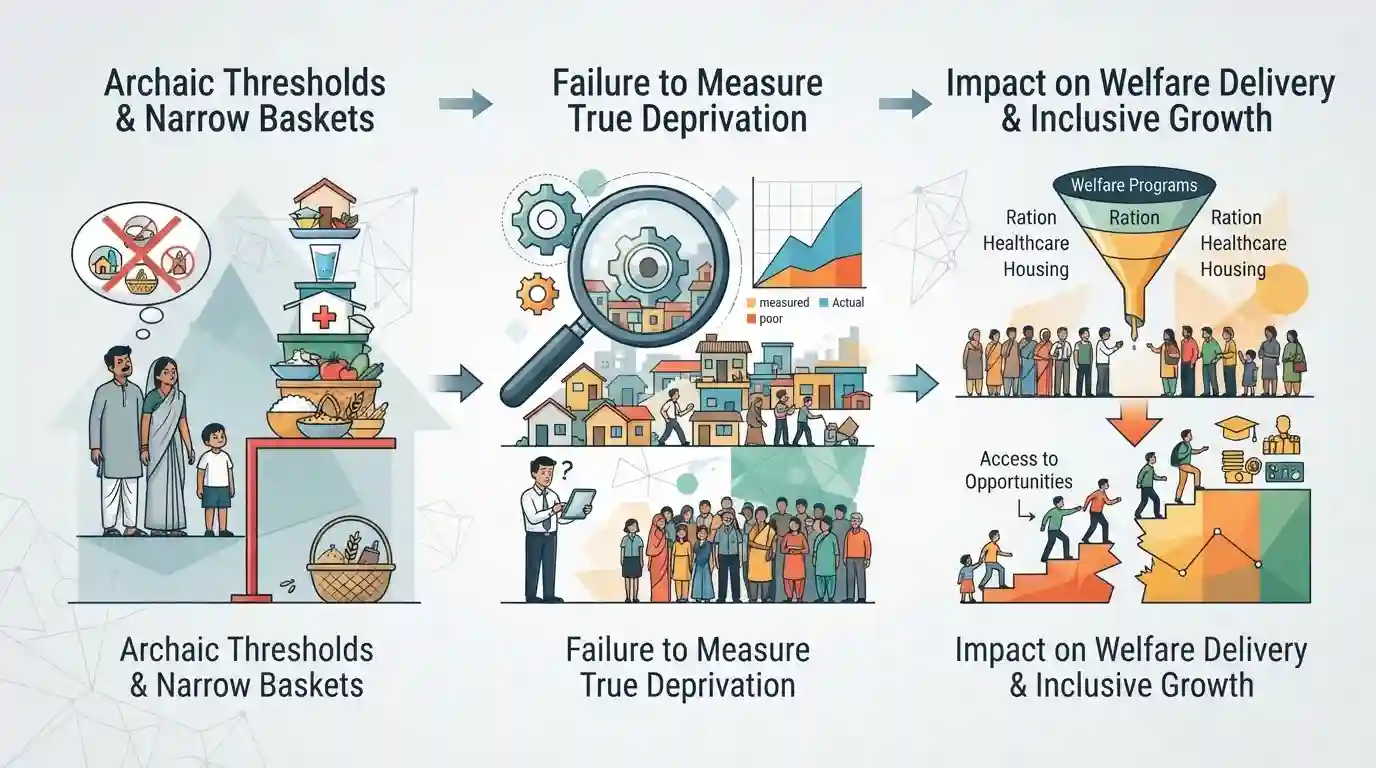
Why It Matters
Understanding the flaws in poverty estimation is critical for evaluating social sector schemes, public policy, and inclusive growth strategies under GS Paper 3.
Summary
The article examines the limitations of current poverty line estimations in India, highlighting how archaic thresholds and narrow consumption baskets fail to measure true economic deprivation, thereby impacting welfare delivery and inclusive growth.
Key Points
- Official poverty estimation methods in India often rely on outdated consumption baskets and low thresholds that fail to capture true deprivation.
- Multidimensional poverty metrics like the MPI provide a broader view but require continuous refinement regarding depth and severity of poverty.
- Inadequate poverty lines affect targeted social welfare distribution, food security entitlements, and inclusive growth policies.
- Economists argue for recalibrating welfare benchmarks to reflect contemporary living standards, inflation, and non-food essential costs.
Prelims Trap
The Rangarajan Committee recommendations were officially adopted as the uniform national poverty line by the Union Government.
Aspirants often assume the Rangarajan Committee recommendations on poverty estimation were officially accepted and implemented by the Government of India, whereas Tendulkar Committee norms remained the baseline for a long time.
Static Concepts Connected
What are the key committees constituted in India for poverty line estimation?
- Alagh Committee: Alagh Committee (1979) constructed a poverty line based on calorie consumption (2100 kcal for urban, 2400 kcal for rural areas).
- Lakdawala Committee: Lakdawala Committee (1993) used calorie-based consumption baskets anchored to state-specific Consumer Price Index for Industrial Workers (CPI-IW) and Agricultural Labourers (CPI-AL).
- Tendulkar Committee: Tendulkar Committee (2009) moved away from calorie norms alone, including spending on health and education using Mixed Reference Period (MRP).
- Rangarajan Committee: Rangarajan Committee (2012) recommended higher consumption thresholds and a normative requirement for protein and fat alongside calories, though it was not officially adopted.
Cross-Topic Patterns
Poverty Lines + National Food Security Act
Official poverty thresholds dictate beneficiary quotas under the NFSA 2013, directly impacting statutory entitlements and fiscal outlays for food subsidies.
Multidimensional Poverty + Human Capital Formation
Shifting from purely monetary consumption expenditure to the Alkire-Foster methodology bridges economic growth metrics with human capital development indicators.

Expect statement-based questions comparing monetary consumption-based poverty lines with Alkire-Foster method MPI indicators.
Linked PYQs · 2
Linked PYQs · 2
- 2026PrelimsGS1
Consider the following statements about Multidimensional Poverty Index (MPI) : 1. MPI is calculated using Alkire-Foster methodology. 2. MPI calculated by NITI Aayog has a total of twelve indicators. 3. Maternal Health and Bank Account are common indicators in the MPI of NITI Aayog and MPI of United Nations Development Programme (UNDP). Which of the statements given above is/are correct ?
- 2019PrelimsGS1
In a given year in India, official poverty lines are higher in some States than in others because
