India Strategic Autonomy and US Peace Board Proposals
Source:The Hindu ↗
Why It Matters
This highlights the tension between India's pursuit of strategic autonomy, its historical principles on the Palestinian cause, and the pragmatic pressures from major global and regional partners over multilateralism versus US-led unilateralism.
Summary
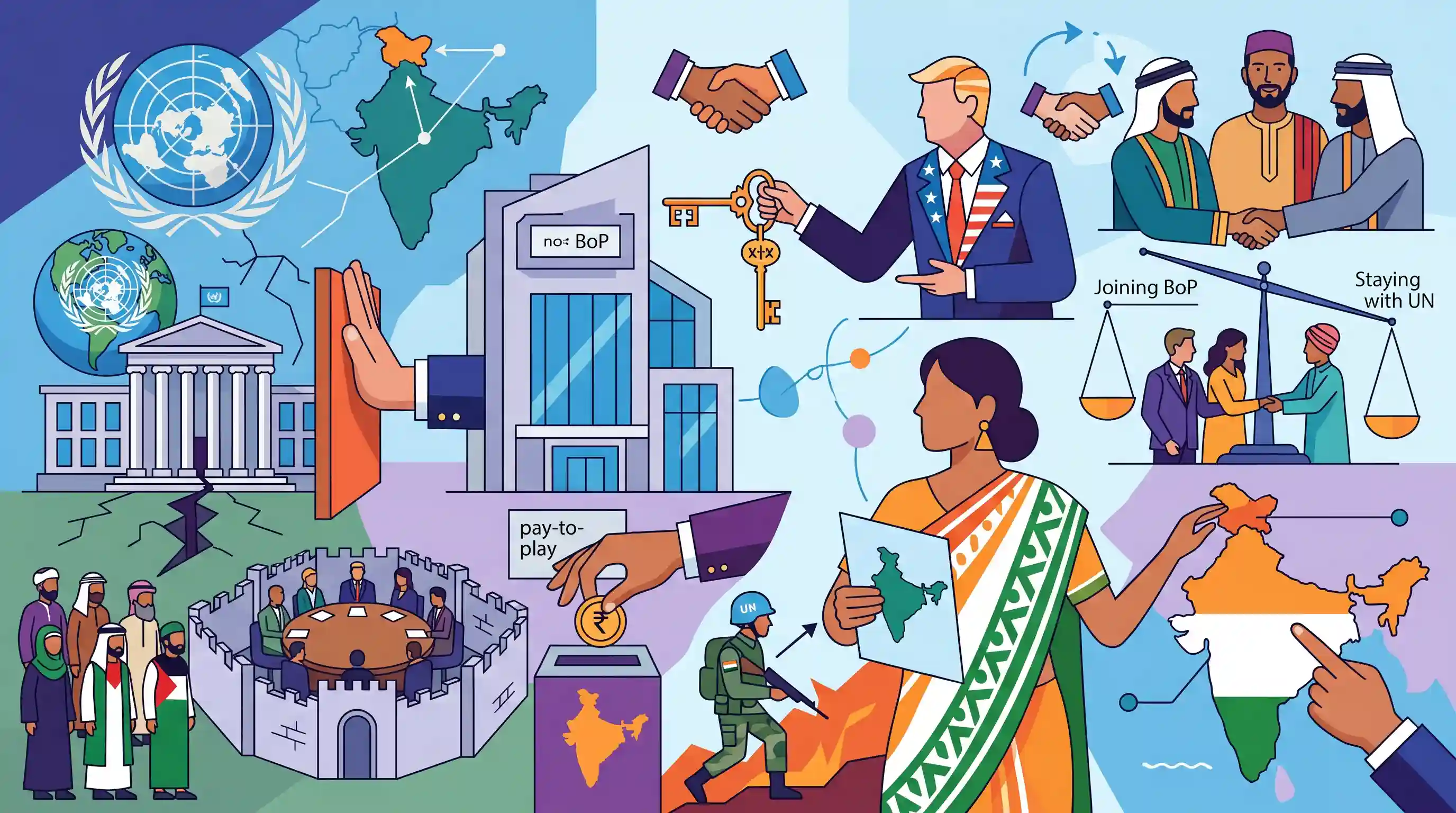
The editorial argues that India should decline an invitation to join US President Donald Trump's 'Board of Peace' (BoP), a unilateral mechanism intended to oversee Gaza's security and reconstruction. While joining might appease the US and West Asian partners, the BoP fundamentally undermines the UN, excludes Palestinian leadership, introduces a pay-to-play membership model, and could force India into non-UN peacekeeping while exposing issues like Kashmir to external mediation.
Key Points
- The US-led 'Board of Peace' (BoP) is part of Trump's Gaza Peace Proposal to oversee security and reconstruction in Gaza, though its mandate has been unilaterally altered by the US to potentially supplant the UN.
- Despite pressure from the US and regional powers like the UAE and Saudi Arabia, India should resist joining due to concerns over its strategic autonomy and principled support for Palestine.
- Structural red flags of the BoP include Trump serving as Chairman alongside his family, a $1 billion fee for permanent membership, and the exclusion of Palestinian leadership while including Israel's Netanyahu.
- Joining the BoP could force Indian troops into a non-UN International Stabilization Force (ISF) and risks opening the Kashmir dispute to outside interference due to Pakistan's involvement.
Important Terms
Board of Peace (BoP)

A US-led international body, chaired by Donald Trump, established to oversee Gaza’s post-war governance and reconstruction. It operates under a personal leadership model and was mandated by UNSC Resolution 2803.
UPSC context
GS Paper II: International Relations. Tests knowledge of emerging global governance structures and their impact on traditional multilateralism.
International Stabilization Force (ISF)
A multinational peacekeeping force authorized by the UN Security Council to secure and demilitarize Gaza. It operates under the Board of Peace to train Palestinian police and decommission weapons.
UPSC context
GS Paper II: International Relations. Relevant for India’s policy on participating in non-UN-led peacekeeping missions.
Gaza Peace Proposal
Also known as the 'Comprehensive Plan to End the Gaza Conflict,' this 20-point framework proposes a ceasefire, hostage exchange, and a transitional governance model led by the Board of Peace.
UPSC context
GS Paper II: Bilateral and Global Groupings. Tests understanding of West Asian geopolitics and US-led peace initiatives.
Two-state solution
The traditional diplomatic framework for resolving the Israeli-Palestinian conflict by establishing an independent State of Palestine alongside Israel, typically based on the 1967 borders.
UPSC context
GS Paper II: International Relations. A core concept in Indian foreign policy and global conflict resolution.
UN Security Council (UNSC)
The primary UN organ tasked with maintaining international peace. It controversially endorsed the Trump-led Board of Peace via Resolution 2803, marking a shift toward unilateral-multilateral hybrids.
UPSC context
GS Paper II: Important International Institutions. Relevant for UN reforms and the effectiveness of the Security Council.
Hamas
The Palestinian militant group that governed Gaza since 2007. The Board of Peace framework aims for its disarmament and replacement by a transitional technocratic government.
UPSC context
GS Paper II: West Asia Geopolitics. Essential for understanding regional security dynamics and non-state actors.
UNRWA
The principal UN agency providing humanitarian aid and social services to Palestinian refugees. Its role and funding are often debated within new peace frameworks like the BoP.
UPSC context
GS Paper II: International Institutions. Relevant for humanitarian issues and global refugee crises.
Prelims Trap
The 'Board of Peace' is a UN-backed multilateral mechanism to oversee Gaza reconstruction.
The BoP is not a UN body; it is a unilateral, US-led mechanism designed to bypass the UN, featuring a $1 billion 'pay-to-play' permanent membership model.
Static Concepts Connected
What is India's historical stance on overseas military deployment?
- UN Mandate: India strictly deploys military troops only under a United Nations mandate, consistently refusing to join unilateral or Western-led international stabilization forces.
- Strategic Autonomy: This stance prevents entanglement in superpower rivalries and ensures participation only in interventions with broad, multilateral international legitimacy.
What is India's 'De-hyphenation' policy in West Asia?
- Independent Relations: India engages with Israel and Palestine independently, ensuring that strategic ties with one nation are not dictated by or linked to its relationship with the other.
- Two-State Commitment: This pragmatic policy allows India to deepen defense ties with Israel while retaining its historical, principled support for a sovereign Two-State Solution.
Cross-Topic Patterns
Rise of 'Minilaterals' bypassing the UN
The BoP reflects a trend where major powers bypass paralyzed UN structures to create ad-hoc coalitions, challenging India's traditional reliance on inclusive, UN-led global governance.
Kashmir and third-party mediation fears
India strictly avoids extra-UN dispute resolution mechanisms involving Pakistan. Participating in the BoP risks creating a precedent that legitimizes third-party mediation in the bilateral Kashmir dispute.

Expect Prelims traps framing 'Board of Peace' as UN-led, or a Mains question on how US plurilateralism challenges India's UN reliance.
Linked PYQs · 3
Linked PYQs · 3
- 2025MainsGS2
"The reform process in the United Nations remains unresolved, because of the delicate imbalance of East and West and entanglement of the USA vs. Russo-Chinese alliance.” Examine and critically evaluate the East-West policy confrontations in this regard.
- 2025MainsGS2
"Energy security constitutes the dominant kingpin of India's foreign policy, and is linked with India's overarching influence in Middle Eastern countries.” How would you integrate energy security with India's foreign policy trajectories in the coming years?
- 2018MainsGS2
“India’s relations with Israel have, of late, acquired a depth and diversity, which cannot be rolled back.” Discuss.
