Coorg coffee plantations as biodiversity refuges for endemic frogs
Source:The Hindu ↗
Why It Matters
Provides a practical example of conservation outside protected areas through sustainable agroforestry. This is directly relevant to UPSC GS3 (Environment) discussions on mitigating habitat loss, the role of shared landscapes, and the criteria for biodiversity hotspots (often tested in Prelims).
Summary
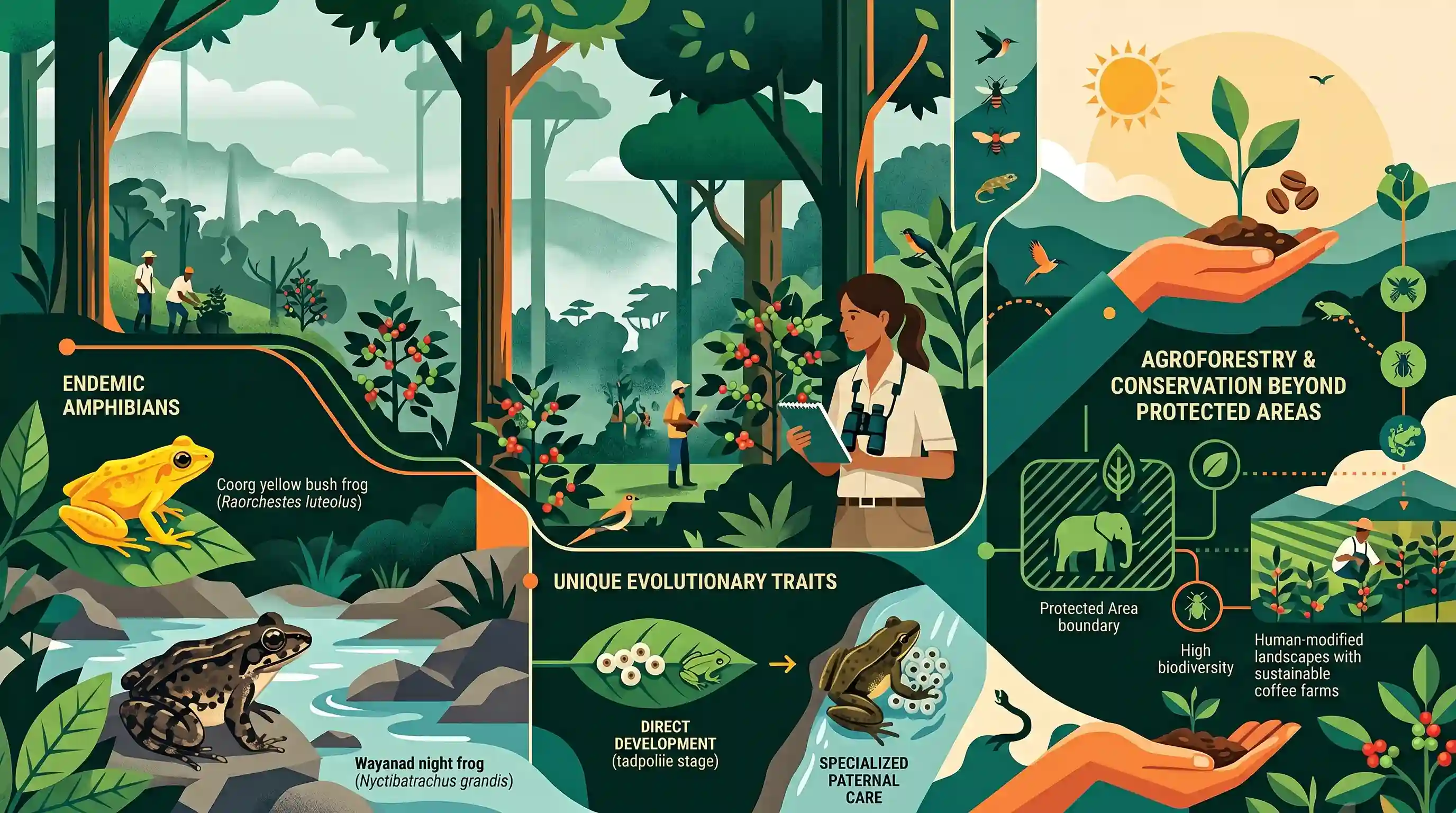
The article explores the rich amphibian biodiversity of Coorg within the Western Ghats, focusing on the research of conservation ecologist Vishnupriya Sankararaman. It highlights how shade-grown coffee plantations act as crucial "shared landscapes" that harbor endemic species like the Coorg yellow bush frog and Wayanad night frog. These amphibians exhibit unique evolutionary traits, such as direct development and specialized paternal care, to thrive in specific ecological niches. The narrative emphasizes the importance of sustainable agroforestry and conservation strategies that extend beyond formal protected areas to encompass human-modified landscapes.
Key Points
- The Western Ghats is a global biodiversity hotspot containing numerous endemic amphibian species with highly specialized ecological niches.
- Coffee plantations in Coorg function as vital shared landscapes (agroforestry systems), offering secondary habitats that support robust frog populations outside formal protected areas.
- Endemic frogs in the region display unique evolutionary adaptations such as direct development (bypassing the tadpole stage) and specialized paternal care.
- Since only around 9% of the Western Ghats is formally protected, sustainable human-modified landscapes are critical for long-term biodiversity conservation.
Important Terms
Western Ghats

A 1,600-km mountain range along India's west coast; a UNESCO World Heritage site and a global biodiversity hotspot with exceptionally high levels of endemism.
UPSC context
GS Paper 1 (Geography) and GS Paper 3 (Environment); critical for biodiversity, monsoon patterns, and conservation policy.
Endemism
The condition of a species being restricted to a specific geographic area, such as a mountain range or island, and found nowhere else on Earth.
UPSC context
GS Paper 3 (Biodiversity); identifying endemic species is vital for assessing the ecological health of regions like Coorg.
Agroforestry
A land-use system where trees or shrubs are grown around or among crops, combining agriculture and forestry to enhance biodiversity and sustainability.
UPSC context
GS Paper 3 (Agriculture/Environment); tested as a tool for carbon sequestration and wildlife conservation in human-modified landscapes.
Direct Development
A life cycle in amphibians where eggs hatch directly into fully formed froglets, skipping the aquatic tadpole stage; an adaptation to terrestrial habitats.
UPSC context
GS Paper 3 (Science/Environment); illustrates evolutionary adaptations to specific niches in the Western Ghats.
Shade-grown Coffee
Coffee cultivation under a canopy of diverse native trees, which preserves forest-like structures and supports high wildlife diversity compared to monoculture sun-coffee.
UPSC context
GS Paper 3 (Environment); represents the 'shared landscape' model where commercial farming coexists with biodiversity conservation.
Roundglass Sustain
A social impact media platform and digital archive documenting India's natural history to promote conservation awareness and bridge the gap between science and the public.
UPSC context
Current Affairs; notable for its role in biodiversity documentation and supporting conservation communication in India.
Prelims Trap
"All endemic amphibians in the Western Ghats pass through an aquatic tadpole stage before adulthood."
Many endemic Western Ghats frogs exhibit 'direct development,' an evolutionary adaptation where eggs hatch directly into miniature froglets, bypassing the tadpole stage.
Static Concepts Connected
What geographic factors drive high amphibian endemism in the Western Ghats?
- Geographic isolation: Millions of years of isolation following the Gondwana split created unique evolutionary pressures, allowing ancient lineages to survive and diversify.
- Topographic variation: Steep elevation gradients, orographic rainfall, and distinct shola-grassland complexes create highly localized microclimates, restricting species to narrow ranges.
Why is shade-grown coffee ecologically significant compared to sun-grown varieties?
- Canopy retention: It relies on a multi-tiered canopy of native shade trees, which mimics natural forest architecture and preserves crucial leaf-litter habitats.
- Corridor creation: These agroforestry systems act as vital ecological corridors and buffer zones, connecting fragmented protected forests for wildlife movement.
Cross-Topic Patterns
Ecologically Sensitive Areas (ESA) debate
The status of human-modified landscapes like Coorg's plantations directly connects to the Gadgil and Kasturirangan committee reports on demarcating Western Ghats Ecologically Sensitive Areas (ESAs).
OECMs (Other Effective Conservation Measures)
Shade-grown coffee plantations perfectly exemplify OECMs, highlighting how lands outside formal Protected Areas (like agroforestry networks) deliver long-term, in-situ biodiversity conservation.

Expect a multi-statement Prelims question linking unique species traits (direct development) with OECMs like shade-grown coffee ecosystems.
Linked PYQs · 1
Linked PYQs · 1
- 2011PrelimsGS1
Three of the following criteria have contributed to the recognition of Western Ghats-Sri Lanka and Indo-Burma regions as hotspots of biodiversity: 1. Species richness 2. Vegetation density 3. Endemism 4. Ethno-botanical importance 5. Threat perception 6. Adaptation of flora and fauna to warm and humid conditions Which three of the above are correct criteria in this context?
