Himalayan Ecology: Carrying Capacity and Infrastructure Risks
Source:The Hindu ↗
Why It Matters
The article serves as a crucial case study for understanding the conflict between rapid infrastructure development and ecological conservation in fragile environments. This is a recurring theme in UPSC exams, particularly regarding landslides, carrying capacity, and climate change in the Himalayan region.
Summary
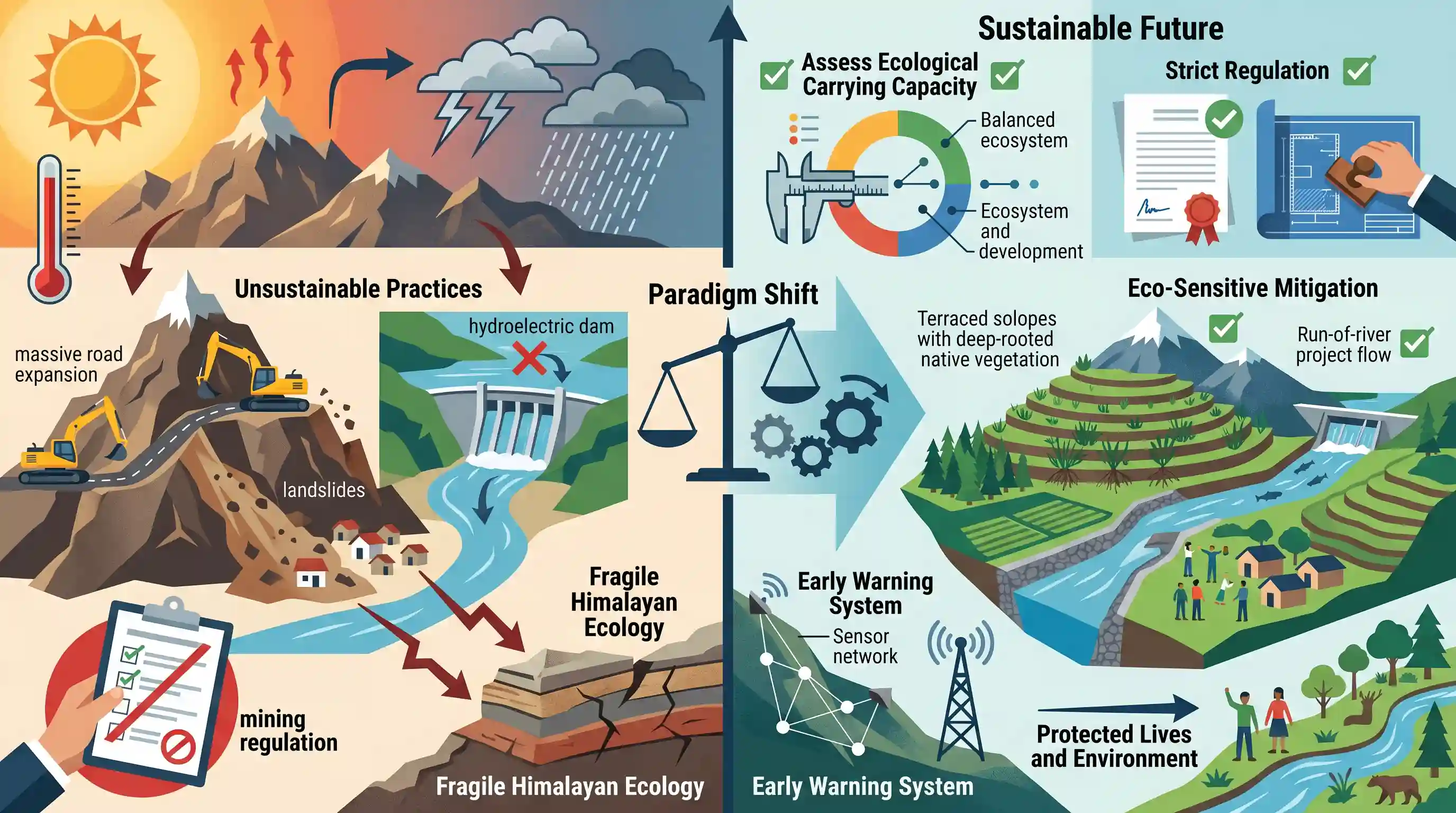
The article analyzes the recent environmental and humanitarian disasters in Himachal Pradesh, attributing them to a combination of climate change and unsustainable developmental practices. It highlights how unchecked infrastructure projects, such as massive road expansions and hydroelectric dams, have destabilized the fragile Himalayan ecology. The increasing frequency of extreme weather events like flash floods and landslides necessitates a paradigm shift in how mountain states are developed. The author advocates for assessing the ecological carrying capacity, strictly regulating construction and mining, and adopting eco-sensitive disaster mitigation strategies to protect both lives and the environment.
Key Points
- Recent disasters in Himachal Pradesh expose the severe ecological vulnerability of the Himalayan region to both anthropogenic activities and climatic stressors.
- Unregulated infrastructure development, particularly road widening (four-laning) and large-scale hydropower projects, has destabilized fragile mountain slopes and disrupted natural drainage.
- Climate change has exacerbated the situation by altering precipitation patterns, leading to a higher frequency of extreme weather events such as cloudbursts and flash floods.
- There is a pressing need to assess the ecological carrying capacity of Himalayan states to ensure that tourism and infrastructure do not exceed environmental limits.
- A sustainable path forward requires eco-sensitive urban planning, strict regulation of river basin development and mining, and the implementation of robust disaster mitigation and early warning systems.
Important Terms
Environmental Impact Assessment (EIA)

A systematic process to evaluate the potential environmental consequences of proposed development projects before implementation. In India, it is statutorily backed by the Environment Protection Act, 1986.
UPSC context
GS Paper 3: Environment & Ecology; vital for analyzing the balance between infrastructure development and conservation.
National Landslide Risk Management Strategy
A 2019 policy framework by the NDMA focusing on landslide hazard mapping, early warning systems, awareness generation, and mountain-specific zoning regulations to reduce disaster vulnerability.
UPSC context
GS Paper 3: Disaster Management; critical for questions on hilly terrain safety and institutional frameworks.
Ecological Carrying Capacity
The maximum level of resource exploitation and population growth an ecosystem can sustain indefinitely without undergoing permanent environmental degradation or collapse.
UPSC context
GS Paper 3: Environment; tests understanding of limits to growth in sensitive zones like the Himalayas.
Fragile Himalayan Ecology
The unique vulnerability of the Himalayan range due to tectonic activity, steep slopes, and climate sensitivity, making it prone to landslides, flash floods, and seismic events.
UPSC context
GS Paper 1 (Geography) & GS Paper 3 (Disaster Management); essential for discussing regional environmental hazards.
National Mission for Sustaining the Himalayan Ecosystem (NMSHE)
One of eight missions under India's National Action Plan on Climate Change (NAPCC), aimed at protecting glaciers, biodiversity, and sustainable livelihoods in the Himalayan region.
UPSC context
GS Paper 3: Climate Change; key for policy-related questions on mountain conservation.
Disaster Mitigation Strategies
The proactive measures to reduce disaster impact, categorized as structural (physical constructions like retaining walls) and non-structural (policies, zoning laws, and public awareness).
UPSC context
GS Paper 3: Disaster Management; tests the ability to propose multi-dimensional solutions for disaster resilience.
Prelims Trap
"Run-of-the-river hydroelectric projects in the Himalayas do not alter natural drainage or require any dam construction."
While RoR projects lack large reservoirs, they still require weirs, barrages, and extensive underground tunneling, which destabilize fragile Himalayan slopes and disrupt local aquifers.
Static Concepts Connected
What is Ecological Carrying Capacity, and how does it differ from EIA?
- Carrying Capacity: The maximum population or development activity an environment can sustain indefinitely without permanent degradation. It evaluates cumulative, regional limits.
- EIA Focus: Environmental Impact Assessment evaluates the impact of individual proposed projects. It often misses the cumulative regional stress that Carrying Capacity captures.
What meteorological conditions define a 'Cloudburst' under IMD guidelines?
- IMD Definition: Unexpected precipitation exceeding 100 mm per hour over a geographical region of approximately 20-30 square kilometers.
- Mechanism: Strong cumulonimbus clouds cause them. The intensity is highly exaggerated by orographic lift when moisture-laden winds hit steep mountainous terrain.
Cross-Topic Patterns
Himalayan Subsidence & Char Dham Pariyojana
The HP disaster mirrors the Joshimath land subsidence crisis, linking unchecked tunneling and road-widening (like the Char Dham project) to tectonic and ecological vulnerabilities in GS-1 and GS-3.
Run-of-River dams & Indus Water Treaty
Massive hydro-expansion in fragile northern states intersects with India's permissible run-of-river rights on western rivers under the Indus Water Treaty, linking mountain ecology to international diplomacy.

Expect a multi-statement Prelims question merging IMD's cloudburst criteria with the ecological impacts of Run-of-River hydro projects.
Linked PYQs · 5
Linked PYQs · 5
- 2021MainsGS3
Describe the various causes and the effects of landslides. Mention the important components of the National Landslide Risk Management Strategy.
- 2015MainsGS1
The states of Jammu and Kashmir, Himachal Pradesh and Uttarakhand are reaching the limits of their ecological carrying capacity due to tourism. Critically evaluate.
- 2016MainsGS1
The Himalayas are highly prone to landslides. Discuss the causes and suggest suitable measures of mitigation.
- 2017MainsGS3
'Climate change' is a global problem. How India will be affected by climate change? How Himalayan and coastal states of India will be affected by climate change?
- 2013MainsGS3
What do you understand by Run-of-river hydroelectricity project ? How is it different from any other hydroelectricity project?
