Export Promotion Mission and Global Trade Protectionism
Source:The Hindu ↗
Why It Matters
It outlines India's policy responses to rising global protectionism and underscores the pivotal role of MSMEs in the manufacturing and export sectors. This connects well with GS3 topics on industrial policy, employment, and economic growth.
Summary
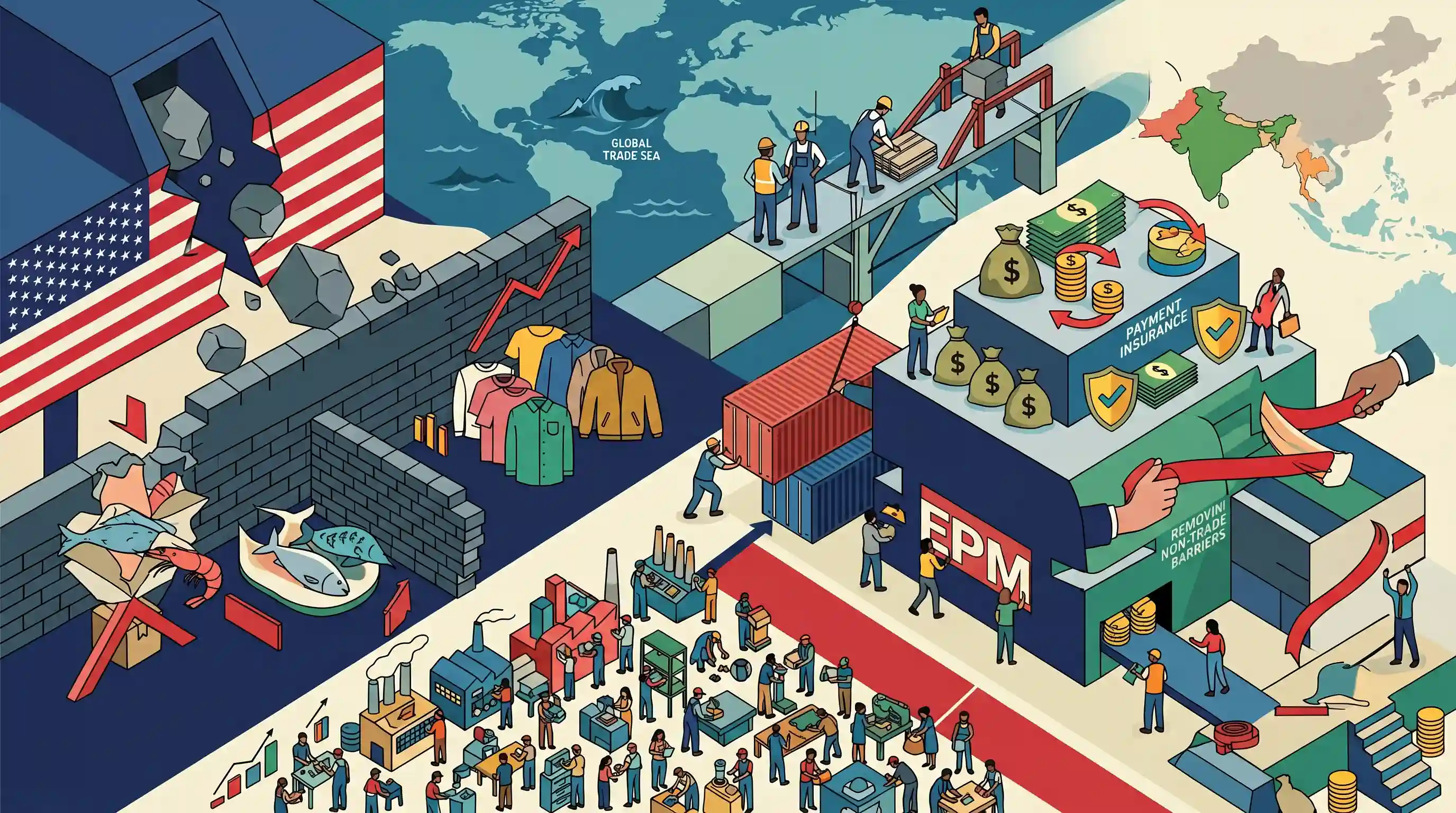
The article discusses India's new multi-Ministry Export Promotion Mission (EPM) aimed at boosting exports by addressing credit, payment insurance, and non-trade barriers. Against the backdrop of escalating US tariffs on Indian exports like seafood and apparel, the piece underscores the critical importance of the MSME sector, which contributes nearly half of India's goods exports and is a major employer. The editorial suggests that beyond the EPM's bureaucratic consolidation, India must undertake deeper structural reforms and reconsider its regional trade strategies, particularly concerning China, to navigate a protectionist global trade environment.
Key Points
- The 2025 Union Budget announced a multi-Ministry Export Promotion Mission (EPM) to provide cheaper export credit, insure payments, and overcome non-tariff barriers.
- The US has recently imposed heavy tariffs on Indian seafood and apparel exports, highlighting a rise in protectionism that affects Indian exports.
- MSMEs account for nearly half (45.79% in FY25) of India's goods exports and employ over 28 crore people, making their success vital for the manufacturing sector.
- While the EPM's inter-ministerial expansion is a positive step, more comprehensive structural reforms and a rethinking of regional trade relations, including with China, may be necessary.
Important Terms
Export Promotion Mission (EPM)

A flagship multi-ministry initiative (outlay ₹25,060 crore) announced in Budget 2025-26 to consolidate fragmented schemes and boost India’s export competitiveness, especially for MSMEs and labor-intensive sectors.
UPSC context
GS Paper 3: Economy (Trade Policy). Tests knowledge of new government flagship schemes and structural reforms in global trade.
MSME Sector
Small-scale businesses defined by specific investment and turnover limits; they contribute ~45% of India's total exports and are the primary beneficiaries of the Export Promotion Mission.
UPSC context
GS Paper 3: Economy (Growth & Employment). Vital for questions on inclusive growth and manufacturing-led export strategies.
Niryat Protsahan and Niryat Disha
The two sub-schemes of the EPM; Protsahan focuses on financial enablers like interest subvention and credit, while Disha provides non-financial support like quality compliance and branding.
UPSC context
GS Paper 3: Economic Development. Tests understanding of specific policy mechanisms used to bridge credit and knowledge gaps for exporters.
Directorate General of Foreign Trade (DGFT)
The nodal agency under the Ministry of Commerce and Industry responsible for implementing the EPM through a digital platform for applications and trade facilitation.
UPSC context
GS Paper 2: Governance/Statutory Bodies. Important for understanding the institutional framework of India’s foreign trade.
Non-Tariff Barriers (NTBs)
Trade restrictions such as quotas, sanitary standards, and technical barriers (e.g., carbon taxes) that limit imports without using traditional tariffs; EPM aims to help MSMEs overcome these.
UPSC context
GS Paper 3: International Trade. Crucial for analyzing modern protectionism and trade negotiations in the global economy.
Protectionism
Economic policies, such as the high US tariffs mentioned, designed to restrict imports and protect domestic industries, creating a challenging environment for Indian exporters.
UPSC context
GS Paper 2: International Relations. Relevant for discussing global trade tensions and India’s strategic response in FTAs.
Prelims Trap
"The MSME sector contributes the majority (over 50%) of India's overall goods exports."
MSMEs contribute nearly half (approx. 45.8% in FY25), not a mathematical majority (>50%). UPSC frequently uses "majority" to create false absolute statements.
Static Concepts Connected
What are the primary WTO agreements regulating Non-Tariff Barriers (NTBs)?
- SPS Agreement: Allows countries to set standards for food safety and animal/plant health. Often misused by developed nations as disguised protectionism against agricultural exports.
- TBT Agreement: Covers technical regulations, testing, and certification procedures (e.g., packaging, labeling) to ensure they do not create unnecessary obstacles to international trade.
What is the revised composite criteria for MSME classification in India?
- Micro Enterprise: Investment in Plant and Machinery or Equipment not more than ₹1 crore and Annual Turnover not more than ₹5 crore.
- Small Enterprise: Investment not more than ₹10 crore and Annual Turnover not more than ₹50 crore.
- Medium Enterprise: Investment not more than ₹50 crore and Annual Turnover not more than ₹250 crore.
Cross-Topic Patterns
GVCs vs. Import Substitution
Reducing reliance on China is difficult because cheap Chinese intermediate goods are vital for maintaining India's cost-competitiveness in Global Value Chains (GVCs).
MSMEs & Demographic Dividend
Protectionist tariffs on Indian apparel and seafood directly threaten MSME job creation, undermining India's capacity to absorb its vast, largely unskilled demographic dividend.

Expect a 2026 question analyzing the paradox of India's trade policy: targeting Chinese imports while needing them for GVC competitiveness.
Linked PYQs · 3
Linked PYQs · 3
- 2023MainsGS3
Faster economic growth requires increased share of the manufacturing sector in GDP, particularly of MSMEs. Comment on the present policies of the Government in this regard.
- 2017MainsGS3
Account for the failure of manufacturing sector in achieving the goal of labour-intensive exports. Suggest measures for more labour-intensive rather than capital-intensive exports.
- 2014MainsGS2
The aim of Information Technology Agreements (ITAs) is to lower all taxes and tariffs on information technology products by signatories to zero. What impact would such agreements have on India's interests?
