Sovereign Palestinian State Essential for West Asia Regional Peace
Source:The Hindu ↗
ఇది ఎందుకు ముఖ్యం
The Israel-Palestine conflict is a core issue in global geopolitics. Understanding the rationale behind the Two-State Solution and the dynamics of West Asian diplomacy is critical for UPSC aspirants, as instability in this region directly impacts India's energy security, diaspora, and broader strategic interests.
సారాంశం
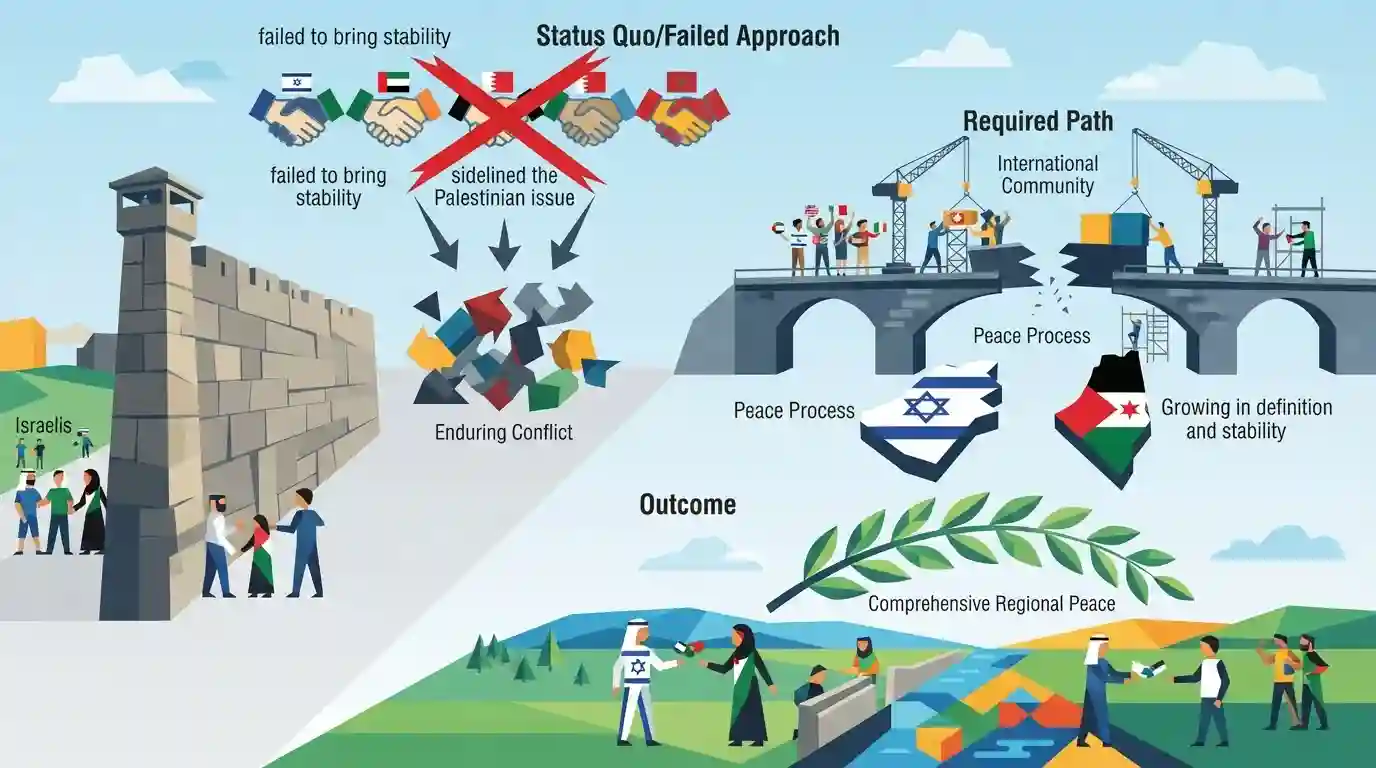
The article asserts that achieving a sustainable and comprehensive regional peace in West Asia is fundamentally contingent upon the creation of an independent and sovereign Palestinian state. It argues that recent attempts to sideline the Palestinian issue by focusing exclusively on diplomatic normalization between Israel and other Arab states have failed to bring true stability. The enduring conflict underscores the urgent need for the international community to reinvigorate the peace process, with the Two-State Solution at its core, to address the historical grievances and secure a peaceful future for both Israelis and Palestinians.
ముఖ్య అంశాలు
- The establishment of a sovereign Palestinian state is viewed as an indispensable prerequisite for achieving lasting peace and stability in West Asia.
- Bypassing the Palestinian issue through regional normalization deals (like the Abraham Accords) without addressing the core conflict has proven insufficient for sustainable peace.
- The ongoing cycle of violence and instability highlights the failure of the current status quo, necessitating a return to negotiations based on the Two-State Solution.
- Regional stakeholders and the international community must prioritize a just resolution to the Israel-Palestine conflict to prevent further escalation that threatens global security and economic stability.
ముఖ్యమైన పదాలు
Two-State Solution

A proposed diplomatic framework to resolve the Israeli-Palestinian conflict by establishing an independent, sovereign State of Palestine coexisting peacefully alongside the State of Israel.
UPSC context
GS Paper II (International Relations); tests understanding of West Asian geopolitics, peace frameworks, and India's balanced foreign policy.
Oslo Accords
A pair of landmark peace agreements signed in 1993 (Oslo I) and 1995 (Oslo II) between Israel and the PLO, establishing limited Palestinian self-rule in parts of the West Bank and Gaza.
UPSC context
GS Paper II (Bilateral & Regional Agreements); tests historical context of the West Asian peace process and major diplomatic initiatives.
Abraham Accords
A series of US-brokered diplomatic agreements signed in 2020 that normalized relations between Israel and several Arab nations, including the UAE, Bahrain, Sudan, and Morocco.
UPSC context
GS Paper II (International Relations); tests understanding of geopolitical realignments in West Asia and their implications for India's foreign policy.
United Nations
The premier global intergovernmental organization responsible for maintaining international peace, security, and facilitating diplomatic resolutions, including designating Palestine's non-member observer status.
UPSC context
GS Paper II (International Institutions); tests the role of multilateral organizations in conflict resolution, global governance, and international law.
ప్రిలిమ్స్ ఉచ్చు
India's de-hyphenation policy has led it to oppose or abstain on UN resolutions calling for full Palestinian UN membership.
Despite growing strategic ties with Israel and a 'de-hyphenated' policy, India has consistently voted in favor of Palestine's full membership at the United Nations.
అనుసంధానమైన స్థిర భావనలు
What is the administrative division of the West Bank under the 1993 Oslo Accords?
- Area A: Palestinian Authority exercises full civil and security control; covers about 18% of the West Bank.
- Area B: Palestinian civil control with joint/Israeli security control; covers roughly 22% of the territory.
- Area C: Full Israeli civil and military control; constitutes about 60% of the land and contains Israeli settlements.
What are the core tenets of India's 'De-hyphenation' policy in West Asia?
- Bilateral Independence: India assesses and conducts its relationships with Israel and Palestine independently on their individual merits.
- Non-Zero-Sum Diplomacy: Strategic defense and tech ties with Tel Aviv do not dilute India's historic commitment to a viable, independent Palestinian state.
అంతర-అంశ నమూనాలు
Normalization vs Economic Corridors
Regional instability from unresolved Palestinian statehood directly stalls US-backed integration initiatives like IMEC, which depend on normalized Arab-Israeli relations.
Chokepoint geopolitics & energy security
Escalations in the Levant trigger asymmetric threats in the Red Sea (Bab-el-Mandeb), directly raising India's maritime freight costs and energy import bills.

Map-based MCQs on West Bank divisions (Areas A, B, C) coupled with statements on India's voting history on Palestinian UN membership.
అనుసంధాన PYQలు · 3
అనుసంధాన PYQలు · 3
- 2018MainsGS2
“India’s relations with Israel have, of late, acquired a depth and diversity, which cannot be rolled back.” Discuss.
- 2015PrelimsGS1
The area known as 'Golan Heights' sometimes appears in the news in the context of the events related to
- 2023PrelimsGS1
Consider the following pairs: Regions often mentioned in news Reason for being in news 1. North Kivu and Ituri : War between Armenia and Azerbaijan 2. Nagorno-Karabakh : Insurgency in Mozambique 3. Kherson and Zaporizhzhia : Dispute between Israel and Lebanon How many of the above pairs are correctly matched?
