Decentralized Water Harvesting Models for Arid Agriculture
Source:The Hindu ↗
Why It Matters
Water scarcity is a defining challenge for Indian agriculture, particularly in arid regions like Rajasthan. Understanding localized water harvesting innovations is crucial for questions on water management, climate-resilient agriculture, and groundwater depletion in both GS-1 (Geography) and GS-3 (Agriculture/Environment).
Summary
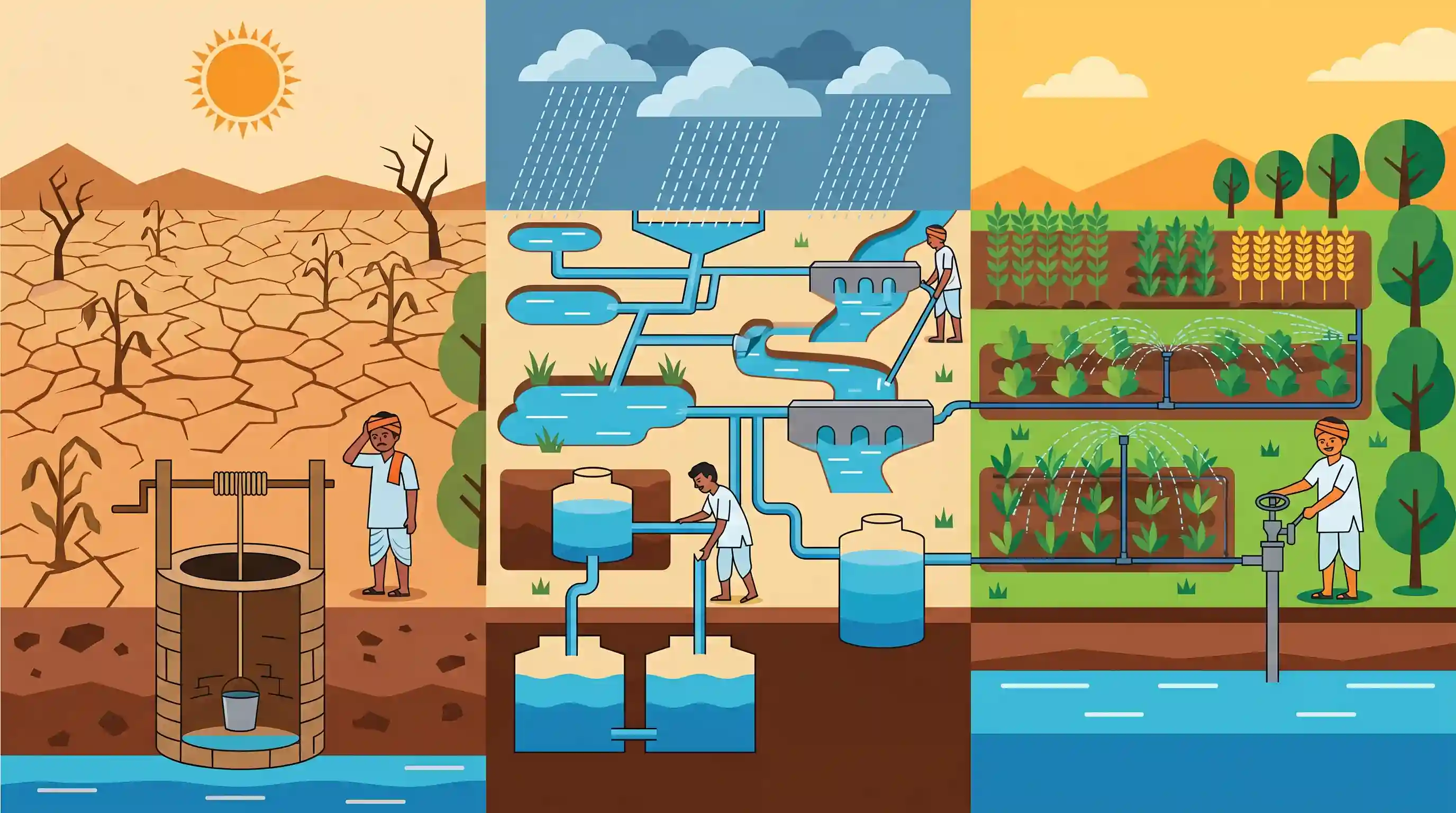
A new water harvesting model in Rajasthan offers a promising solution to the state's severe groundwater depletion and recurring droughts. By promoting decentralized water storage and efficient utilization, this model empowers local farmers to secure reliable irrigation, improve water-use efficiency, and build climate resilience in their agricultural practices.
Key Points
- A novel water harvesting model is being adopted in Rajasthan to address the critical challenge of groundwater depletion and erratic rainfall in the arid state.
- The decentralized water management approach provides farmers with localized water storage solutions, allowing them to provide life-saving irrigation during dry spells.
- This innovation improves climate resilience and enables farmers to diversify crops, boosting rural incomes and agricultural stability in drought-prone areas.
- When combined with micro-irrigation systems like drip and sprinkler irrigation, these harvesting models significantly enhance overall water-use efficiency.
Important Terms
Mukhyamantri Jal Swavlamban Abhiyan 2.0

Launched in 2024, this state-wide campaign aims to make 20,000 villages water-reliant over four years through decentralized harvesting, groundwater recharge, and the revival of traditional structures using the 'Four Waters Concept.'
UPSC context
GS-II (Schemes) and GS-III (Water Management). Tests knowledge of state-led decentralized interventions for drought-prone regions.
Atal Bhujal Yojana (Atal Jal)
A World Bank-funded Central Sector Scheme (2019) focused on participatory groundwater management. It empowers local communities in seven water-stressed states, including Rajasthan, to create and implement village-level Water Security Plans.
UPSC context
GS-III (Environment/Conservation). Tests understanding of community-led resource management and demand-side water interventions.
Jal Shakti Abhiyan (JSA)
A national mission-mode campaign with the slogan 'Catch the Rain, where it falls, when it falls.' It promotes rainwater harvesting, rejuvenation of traditional water bodies, and intensive afforestation through public participation.
UPSC context
GS-II/GS-III. Relevant for water security, climate resilience, and 'Jan Andolan' (people's movement) models of governance.
Four Waters Concept
A scientific water management strategy that integrates harvesting of four components: rainwater, surface runoff, soil moisture, and groundwater. It focuses on treatment from ridge to valley to maximize local water availability.
UPSC context
GS-III (Irrigation/Agriculture). Tests technical knowledge of integrated watershed management and drought-proofing techniques.
Climate-Resilient Farm Ponds
A decentralized model where small, often plastic-lined ponds are constructed on a portion of a farmer's land. These capture direct rainfall to provide reliable, year-round irrigation and support high-value horticulture.
UPSC context
GS-III (Agriculture). Critical for discussions on climate-smart agriculture, irrigation efficiency, and doubling farmers' income.
Participatory Groundwater Management (PGWM)
An approach where local users (Gram Panchayats/Water User Associations) take collective responsibility for monitoring and managing groundwater. It shifts the focus from government-led supply to community-led demand-side management.
UPSC context
GS-II (Governance) and GS-III (Environment). Key for sustainable development and decentralized resource governance topics.
Prelims Trap
"Plastic-lined farm ponds in Rajasthan primarily aim to enhance direct groundwater recharge in arid soils."
Plastic lining (geomembranes) intentionally prevents seepage to maximize surface water retention. It explicitly blocks percolation, meaning it does NOT directly recharge the groundwater aquifer.
Static Concepts Connected
What classifies a groundwater assessment unit as 'Over-exploited' in India?
- Extraction Ratio: Annual groundwater extraction exceeds 100% of the net annual extractable groundwater availability for that assessment unit.
- Water Level Trend: Significant long-term decline is observed in both pre-monsoon and post-monsoon groundwater levels.
How do micro-irrigation systems improve nutrient and water use efficiency?
- Targeted Root Delivery: Drip systems deliver water directly to the active root zone, virtually eliminating evaporation, deep percolation, and surface runoff.
- Fertigation Synergy: Micro-irrigation allows for fertigation—the simultaneous application of water-soluble fertilizers—preventing nutrient leaching and reducing total fertilizer demand.
Cross-Topic Patterns
Farm Ponds + Solar PM-KUSUM
Coupling decentralized surface water storage with PM-KUSUM’s standalone solar pumps creates a self-sustaining, zero-grid irrigation ecosystem crucial for remote arid zones.
Climate Resilience + Cropping Patterns
Secured surface water allows arid farmers to shift from drought-hardy but low-yield millets to higher-value, nitrogen-fixing pulses (cowpeas) and oilseeds (groundnuts).

Expect a multi-statement Prelims question contrasting seepage-blocking geomembrane farm ponds with aquifer-recharging percolation tanks.
Linked PYQs · 4
Linked PYQs · 4
- 2018MainsGS1
The ideal solution of depleting ground water resources in India is water harvesting system." How can it be made effective in urban areas?
- 2020MainsGS3
Suggest measures to improve water storage and irrigation system to make its judicious use under depleting scenario.
- 2016MainsGS3
What is water-use efficiency? Describe the role of micro-irrigation in increasing the water-use efficiency.
- 2021MainsGS3
How and to what extent would micro-irrigation help in solving India's water crisis?
