India Neighbourhood Engagement Policy and Regional Strategy
Source:The Hindu ↗
Why It Matters
Essential for understanding India's evolving foreign policy doctrine, the 'Neighbourhood First' approach, regional security architecture, and managing geopolitical competition in South Asia.
Summary
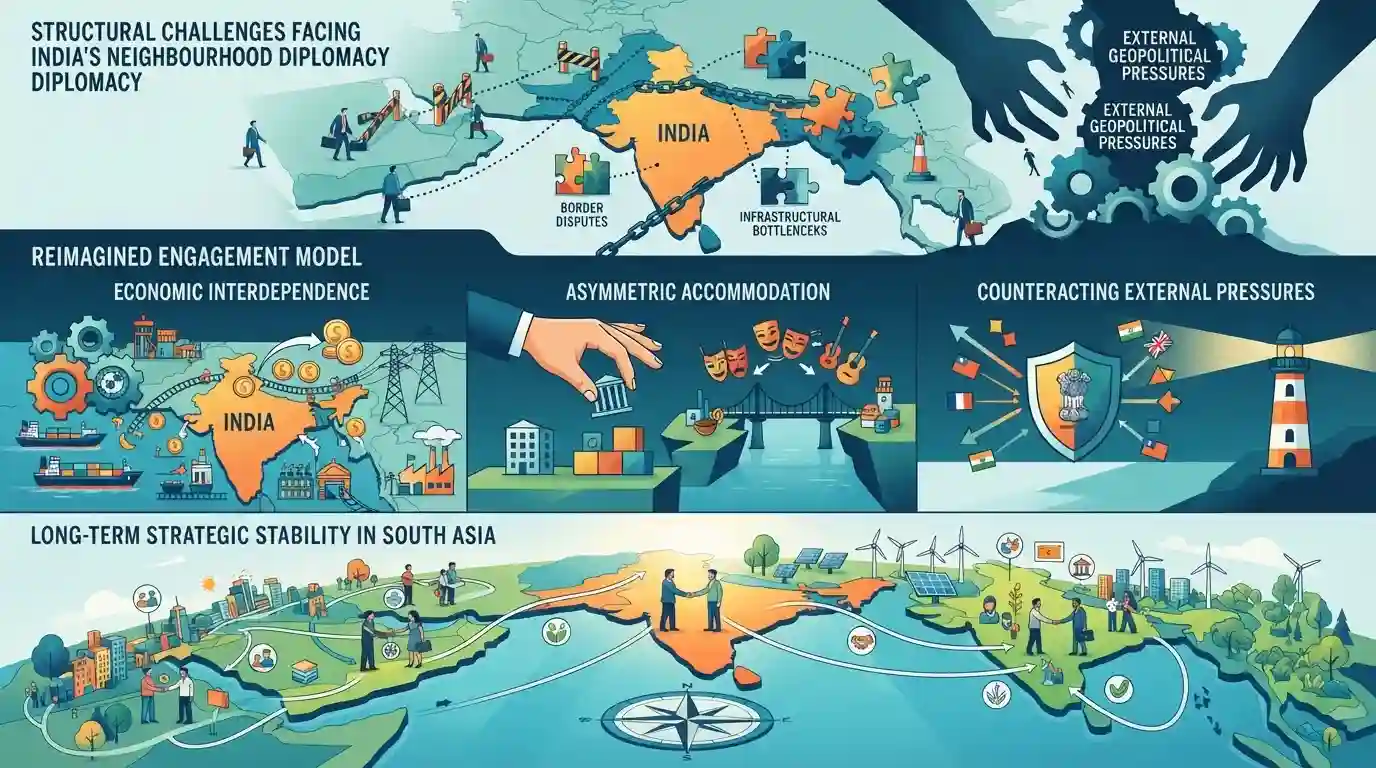
The article evaluates the structural challenges facing India's neighbourhood diplomacy and advocates for a reimagined engagement model. It emphasizes economic interdependence, asymmetric accommodation, and counteracting external geopolitical pressures to secure long-term strategic stability in South Asia.
Key Points
- India's traditional neighbourhood engagement model requires a strategic reassessment in light of shifting geopolitical realities, economic vulnerabilities, and internal political dynamics in neighbouring countries.
- The rise of competing regional influences, particularly China, necessitates a more flexible, empathetic, and economically integrated approach by New Delhi.
- A shift from purely transactional or security-centric diplomacy to long-term collaborative frameworks, enhanced connectivity, and people-to-people ties is vital for regional stability.
Important Terms
Neighbourhood First Policy

India's diplomatic framework prioritizing immediate South Asian neighbours for enhanced economic cooperation, strategic connectivity, and regional stability, while countering external geopolitical influences.
UPSC context
UPSC GS Paper II: India and its Neighbourhood - Policies and Relations. Tests understanding of regional diplomacy, asymmetric engagement, and strategic security.
SAARC
A regional intergovernmental organization comprising eight South Asian nations, founded to promote socioeconomic development, though currently stymied by persistent bilateral political disputes.
UPSC context
UPSC GS Paper II: Bilateral, Regional and Global Groupings involving India. Tests knowledge of multilateral institutions and regional integration challenges in South Asia.
BIMSTEC
A sub-regional organization linking South and Southeast Asian countries around the Bay of Bengal, increasingly favoured by India for connectivity and technical cooperation.
UPSC context
UPSC GS Paper II: Bilateral, Regional and Global Groupings involving India. Evaluates alternative multilateral frameworks and India's Act East connectivity initiatives.
Prelims Trap
BIMSTEC has officially replaced SAARC as South Asia's primary institutional architecture for regional integration.
SAARC is not defunct or dissolved; while it suffers from institutional paralysis due to geopolitical friction, it legally exists, and BIMSTEC is an alternative/complement rather than its replacement.
Static Concepts Connected
What are the key institutional mechanisms and challenges of regional integration in South Asia?
- Trade Deficit: Lowest integration globally with intra-regional trade hovering below 5%, primarily due to historical trust deficits and political friction.
- SAARC Paralysis: Institutional paralysis due to bilateral disputes stalling summits, prompting India to pivot toward BIMSTEC and sub-regional groupings.
- Asymmetric Accommodation: India practicing generous, non-reciprocal concessions (like the Gujral Doctrine spirit) to alleviate smaller neighbours' anxieties over asymmetric power dynamics.
Cross-Topic Patterns
BIMSTEC vs SAARC: Geopolitical Realignment
BIMSTEC bypasses SAARC paralysis by excluding Pakistan, linking South and Southeast Asia under India's Act East doctrine.
Asymmetric Trade & Debt Diplomacy
Generous, non-reciprocal concessions to smaller nations help counter China's debt-trap diplomacy by stabilizing balance-of-payments crises.

Expect an analytical Mains question on shifting from security-centric to economic interdependence in India's Neighbourhood First policy.
Linked PYQs · 3
Linked PYQs · 3
- 2022MainsGS2
India is an age-old friend of Sri Lanka.’ Discuss India's role in the recent crisis in Sri Lanka in the light of the preceding statement.
- 2022MainsGS2
Do you think that BIMSTEC is a parallel organisation like the SAARC ? What are the similarities and dissimilarities between the two ? How are Indian foreign policy objectives realized by forming this new organisation?
- 2016MainsGS2
Increasing cross-border terrorist attacks in India and growing interference in the internal affairs of several member-states by Pakistan are not conducive for the future of SAARC (South Asian Association for Regional Cooperation)." Explain with suitable examples.
