New field guide highlights bat diversity in Delhi NCR
Source:The Hindu ↗
Why It Matters
This article is important for the Environment and Ecology syllabus. It shifts the focus from megafauna to often-misunderstood species like bats, highlighting their indispensable ecosystem services (pollination, pest control) and the significance of urban biodiversity conservation.
Summary
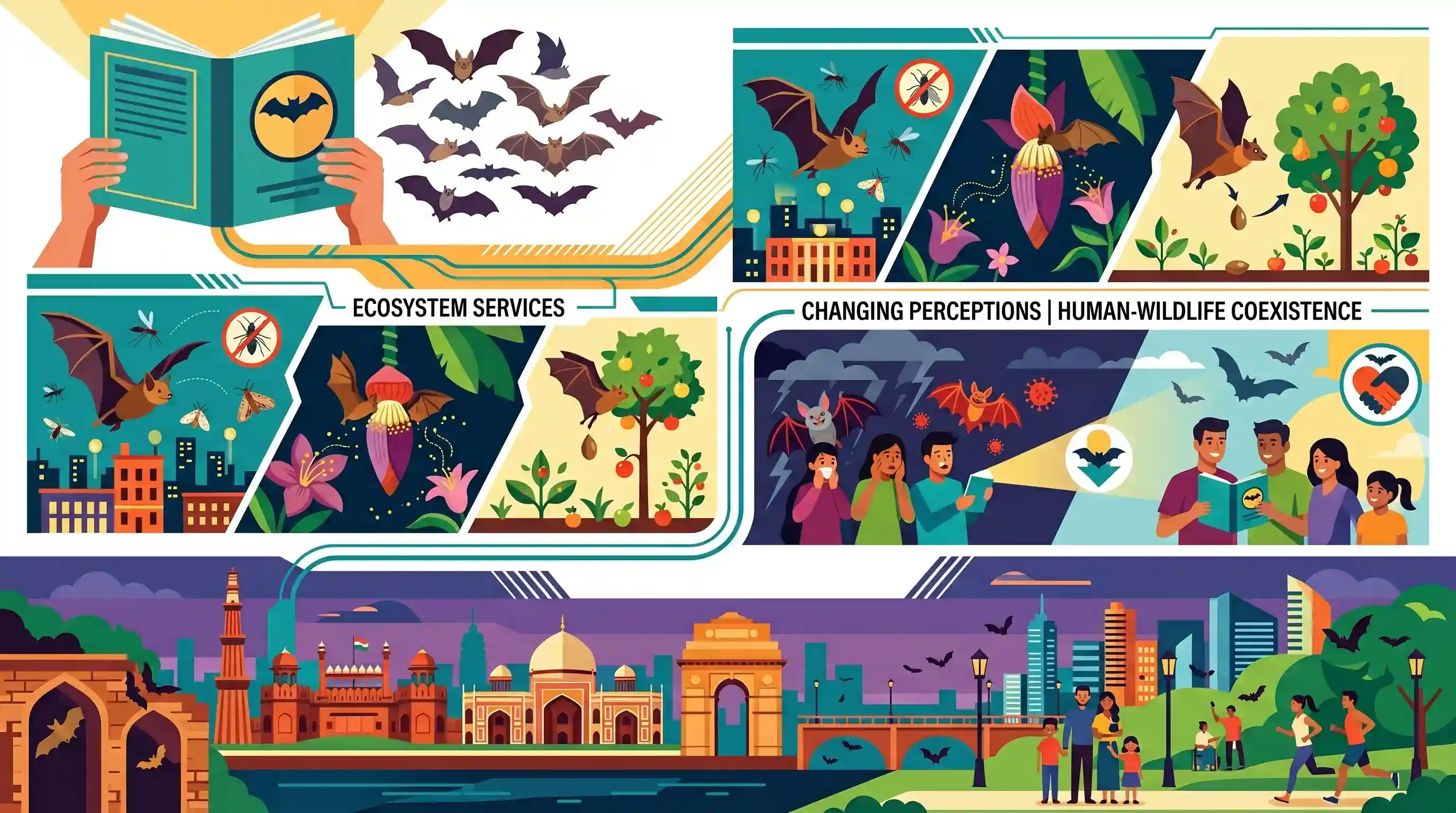
A new field guide titled "Bats of Delhi NCR", published collaboratively by WWF-India and several conservation organizations, highlights the surprising diversity of bats in the region. Documenting 15 species, the publication aims to educate the public about the crucial ecological roles these flying mammals play, including pest control, pollination, and seed dispersal. By detailing their morphology, diets, and habitats—such as Delhi's historical monuments—the guide seeks to bust myths, reduce fear often associated with zoonotic diseases, and encourage harmonious human-wildlife coexistence in urban spaces.
Key Points
- A newly released field guide, "Bats of Delhi NCR", documents 15 species of bats inhabiting the urban and peri-urban landscapes, historical monuments, and biodiversity parks of Delhi.
- The guide aims to dispel prevalent myths and negative public perceptions about bats by highlighting their harmless nature and critical ecological roles.
- Bats serve as essential components of the ecosystem by providing vital services such as pollination, seed dispersal, and natural pest control.
- Researchers emphasize the presence of large urban colonies of insectivorous bats, like mouse-tailed bats, which regulate insect populations and thrive in the cave-like environments of Delhi's heritage monuments.
Important Terms
WWF-India

A leading Indian conservation NGO (established 1969) that works to protect wildlife, restore habitats, and promote sustainable development through science-based research and policy advocacy.
UPSC context
GS III (Environment); relevant for questions on species conservation, major reports, and environmental governance.
Ecosystem Services
The direct and indirect benefits humans derive from healthy ecosystems, including pollination, pest control, and seed dispersal provided by species like bats.
UPSC context
GS III (Environment); fundamental for evaluating the economic and ecological value of biodiversity.
Human-Wildlife Coexistence
A strategy focusing on shared safety and mutual survival between humans and wildlife, shifting from reactive conflict management to building community tolerance.
UPSC context
GS III (Environment); key for discussing urban biodiversity and man-animal conflict mitigation strategies.
Nature Conservation Foundation (NCF)
A prominent Indian NGO dedicated to biological research and conservation, known for extensive field studies on species like bats, hornbills, and snow leopards.
UPSC context
GS III (Environment); relevant for community-based conservation and domestic wildlife research initiatives.
Centre for Wildlife Studies (CWS)
An Indian research body focusing on scientific wildlife conservation, particularly ecological monitoring and developing community-based solutions for human-wildlife conflict.
UPSC context
GS III (Environment); tests knowledge of scientific interventions and ecological research in India.
Zoonotic Diseases
Infectious diseases that jump from animals to humans; bats often act as natural reservoirs for these viruses without falling ill themselves.
UPSC context
GS II/III (Health/Environment); critical for the "One Health" approach and public health safety.
Prelims Trap
"Only insects and birds act as natural pollinators; mammals are not significant pollinating agents."
UPSC has previously tested this. Bats are critical pollinators (chiropterophily) for many tropical night-blooming plants, including bananas, mangoes, and agave.
Static Concepts Connected
What are the key ecosystem services provided by bats?
- Pollination: Essential for pollinating night-blooming tropical plants (e.g., agave, mango, banana) through chiropterophily.
- Seed Dispersal: Frugivorous bats spread seeds across large distances, aiding the natural regeneration of fragmented tropical forests.
- Pest Control: Insectivorous bats consume massive amounts of crop-destroying nocturnal insects, acting as natural bio-pesticides.
How is the Nipah virus transmitted from bats to humans?
- Natural Host: Fruit bats of the Pteropus genus (flying foxes) are the primary natural reservoirs for the virus.
- Spillover Mechanism: Infection occurs by consuming fruits or date palm sap contaminated with infected bat saliva or urine.
- Human Transmission: Once it enters the human population, the virus can spread via close contact with infected body fluids.
Cross-Topic Patterns
Heritage structures as urban wildlife refuges
The use of historical monuments by bat colonies illustrates Ecological Urbanism, blending archaeological preservation with urban biodiversity to foster human-wildlife coexistence in built-up cities.
Habitat fragmentation and zoonotic spillovers
The shift of bats into human habitats directly links to deforestation. This overlap increases the risk of zoonotic spillovers like the Nipah virus.

Expect a multi-statement question combining bats' ecological services (pollination/pest control) with their role as Nipah virus vectors.
Linked PYQs · 2
Linked PYQs · 2
- 2025PrelimsGS1
With reference to monoclonal antibodies, often mentioned in news, consider the following statements : I. They are man-made proteins. II. They stimulate immunological function due to their ability to bind to specific antigens. III. They are used in treating viral infections like that of Nipah virus. Which of the statements given above are correct?
- 2012PrelimsGS1
Consider the following kinds of organisms: 1. Bat 2. Bee 3. Bird Which of the above is/are pollinating agent/agents?
