India and Brazil climate crisis cooperation and South-South strategy
Source:Indian Express ↗
Why It Matters
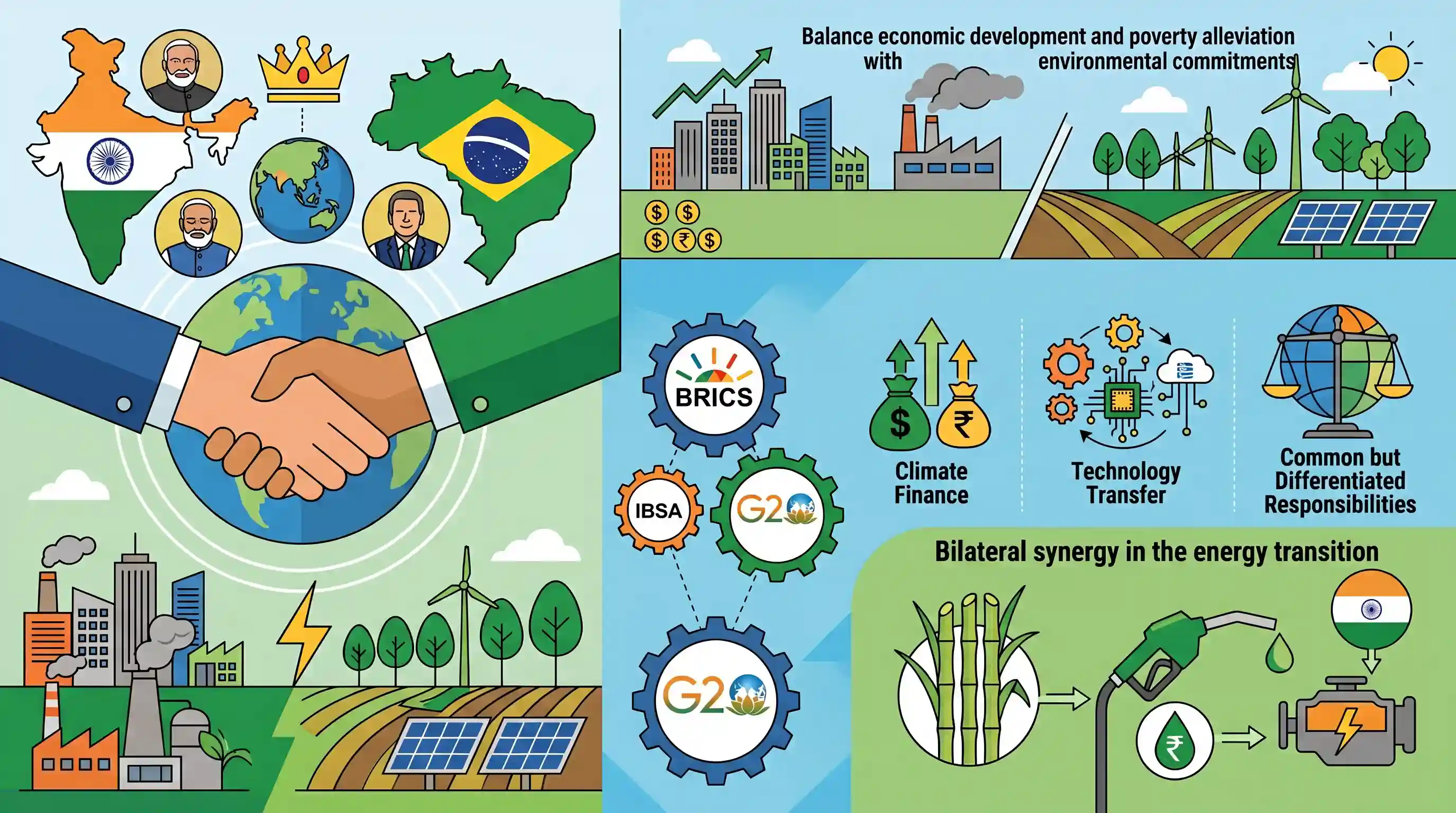
India-Brazil relations represent a critical axis of South-South cooperation. Their collaborative stance shapes the global climate agenda, prevents the imposition of inequitable emission burdens by the Global North, and drives practical green transition solutions like global ethanol blending.
Summary
The article highlights the profound similarities and expanding cooperation between India and Brazil in tackling the global climate crisis. As prominent leaders of the Global South, both nations face the intricate challenge of balancing rapid economic development and poverty alleviation with pressing environmental commitments. Multilaterally, they align within forums like BRICS, IBSA, and the BASIC group to advocate for equitable climate finance, technology transfer, and the principle of Common but Differentiated Responsibilities (CBDR) at UNFCCC negotiations. Bilaterally, their synergy is most evident in the energy transition space, particularly through the Global Biofuels Alliance launched during India's G20 Presidency, where Brazil's extensive expertise in sugarcane-based ethanol is helping India achieve its biofuel blending targets and energy security.
Key Points
- Shared socio-economic context: Both India and Brazil are large developing economies navigating the dual mandate of rapid economic growth and poverty eradication alongside global climate commitments.
- Multilateral advocacy: They collaborate deeply in groupings like BRICS, IBSA, and the G20 Troika to amplify the Global South's voice, advocating for climate justice and equitable climate finance.
- Climate negotiations: Within the UNFCCC framework, both nations anchor the BASIC group to ensure that the principle of Common but Differentiated Responsibilities (CBDR) is respected by the Global North.
- Energy transition and Biofuels: Brazil's vast experience with sugarcane-based ethanol is a key template for India; both countries are founding pillars of the Global Biofuels Alliance (GBA) driving sustainable alternative fuels.
Important Terms
Common but Differentiated Responsibilities (CBDR)

A principle within the UNFCCC acknowledging that while all nations are responsible for the environment, developed countries bear more responsibility due to historical emissions and greater financial/technical capacity.
UPSC context
GS Paper III (Environment). Central to understanding climate justice and India's negotiating stance in global climate summits.
Global Biofuels Alliance (GBA)
An India-led international platform launched at the 2023 G20 Summit to promote biofuel adoption and trade. India, Brazil, and the USA are its founding members and major producers.
UPSC context
GS Paper II/III (Bilateral/Energy). Vital for India’s energy transition, ethanol blending targets, and South-South technical cooperation.
BASIC
A climate negotiation bloc comprising Brazil, South Africa, India, and China. Formed in 2009, it coordinates positions of major emerging economies to ensure equitable outcomes at climate summits.
UPSC context
GS Paper II (International Groupings). Crucial for analyzing the collective bargaining power and unified voice of the Global South.
IBSA
A trilateral forum of India, Brazil, and South Africa focused on promoting South-South cooperation among three major, diverse democracies from different continents across trade, development, and security.
UPSC context
GS Paper II (International Relations). Tests knowledge of democratic South-South partnerships and the strategic significance of this trilateral.
BRICS
An influential grouping of major emerging economies (Brazil, Russia, India, China, South Africa) that advocates for a multipolar world order and reform of global financial institutions like the IMF.
UPSC context
GS Paper II (Global Groupings). Significant for discussions on global governance reform and India's leadership in the Global South.
UNFCCC
The 1992 international treaty aimed at stabilizing greenhouse gas concentrations. It serves as the parent framework for major climate accords like the Kyoto Protocol and the Paris Agreement.
UPSC context
GS Paper III (Environment). Fundamental legal framework for understanding all international climate treaties and annual COP negotiations.
Paris Agreement
A 2015 legally binding international treaty under the UNFCCC. Its goal is to limit global warming to well below 2°C, preferably 1.5°C, compared to pre-industrial levels.
UPSC context
GS Paper III (Environment). Key for questions on Nationally Determined Contributions (NDCs) and global climate mitigation targets.
G20
The premier forum for international economic cooperation. Both India and Brazil have recently held presidencies, using the platform to bridge the gap between developed and developing nations.
UPSC context
GS Paper II (International Forums). Significant for India's multilateral diplomacy and shaping the global development agenda.
Prelims Trap
"The Global Biofuels Alliance (GBA) is an exclusive initiative of Global South countries led by India and Brazil."
Aspirants often assume GBA is a purely developing-world initiative. However, the USA is one of its three primary founding members.
Static Concepts Connected
What is the BASIC group and its role in climate negotiations?
- Origin: Formed in 2009 (Copenhagen Accord) comprising Brazil, South Africa, India, and China.
- Core Objective: To protect the developmental space of emerging economies and push for equitable climate finance and technology transfer.
- Guiding Principle: Strong advocacy for Common but Differentiated Responsibilities (CBDR), ensuring developed nations take the lead in mitigation.
How do biofuel generations differ in source material?
- First Generation (1G): Made from food crops like sugarcane (Brazil's specialty), corn, or vegetable oils. Often criticized for the "food vs fuel" dilemma.
- Second Generation (2G): Derived from non-food biomass and agricultural waste (cellulosic ethanol), avoiding competition with food production.
- Third & Fourth (3G/4G): Extracted from algae (3G) or genetically engineered crops/microbes designed for high yields and carbon capture (4G).
Cross-Topic Patterns
Biofuels, ethanol blending & sugarcane pricing
Brazil's ethanol template aligns with India's push for E20 blending, linking directly to India's FRP (Fair and Remunerative Price) for sugarcane and WTO disputes over Indian sugar subsidies.
BASIC vs Global North Climate Clubs
As the G7 proposes exclusive "Climate Clubs" with carbon border taxes (like EU's CBAM), the BASIC group's role becomes critical to counter non-tariff trade barriers disguised as climate action.

Global Biofuels Alliance's founding members (India, Brazil, USA) and CBDR principles will likely form a composite 2026 Prelims question.
Linked PYQs · 4
Linked PYQs · 4
- 2012MainsGS2
Compare the significance of IBSA and BRICS in the context of India's multilateral diplomacy.
- 2021MainsGS3
Describe the major outcomes of the 26th session of the Conference of the Parties (COP) to the United Nations Framework Convention on Climate Change (UNFCCC). What are the commitments made by India in this conference?
- 2025PrelimsGS1
Consider the following statements : Statement I: Of the two major ethanol producers in the world, i.e., Brazil and the United States of America, the former produces more ethanol than the latter. Statement II: Unlike in the United States of America where corn is the principal feedstock for ethanol production, sugarcane is the principal feedstock for ethanol production in Brazil. Which one of the following is correct in respect of the above statements?
- 2009PrelimsGS1
In the context of alternative sources of energy, ethanol as a viable bio-fuel can be obtained from
