Economic Survey macro vulnerability assessment and fiscal federalism
Source:The Hindu ↗
Why It Matters
Provides an authoritative overview of India's current macroeconomic challenges, directly aligning with GS3 syllabus topics on growth, development, employment, and inclusive growth. The critique of state-level fiscal populism and trade-offs in ethanol blending are high-probability themes for Mains questions.
Summary
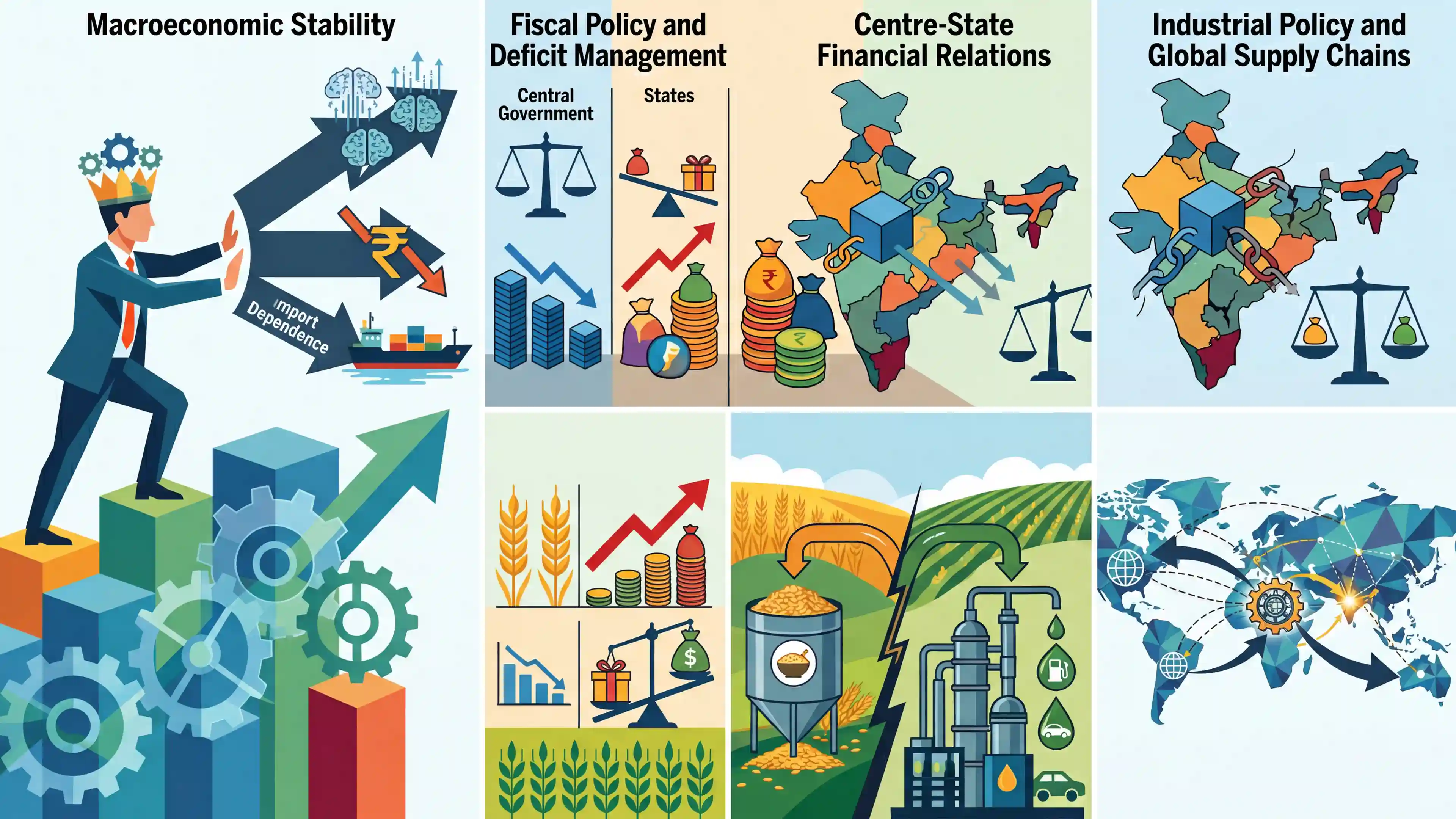
The editorial reviews the Economic Survey 2025-26, praising its objective and critical assessment of India's macroeconomic landscape over the usual self-congratulatory tone. It highlights the Chief Economic Adviser's call for an "entrepreneurial state" to tackle structural weaknesses like currency depreciation, import dependence, and capital flight to advanced AI hubs. The Survey emphasizes the need for India to achieve "strategic indispensability" in global supply chains. Furthermore, it sharply critiques the fiscal populism and rising revenue deficits in States, contrasting it with the Centre's fiscal prudence. The Survey also brings attention to novel socio-economic and environmental challenges, including the conflict between ethanol blending and food security, the real costs of the renewable energy transition, and the negative productivity impacts of smartphone addiction.
Key Points
- The Survey envisions an agile "entrepreneurial state" capable of risk-taking and experimentation to navigate economic uncertainties.
- Highlights macroeconomic vulnerabilities, including a depreciating rupee, high import reliance, and capital flight to advanced economies driven by AI development.
- Urges a shift from merely participating in global supply chains to achieving "strategic indispensability."
- Contrasts the Centre's successful fiscal consolidation with the growing revenue deficits of States driven by unconditional cash transfers and fiscal populism.
- Flags emerging inter-sectoral challenges, such as the trade-off between ethanol production and food security, the hidden costs of renewable energy, and the socio-economic impact of smartphone addiction.
Important Terms
Economic Survey 2025-26

The Ministry of Finance’s flagship annual document reviewing the Indian economy’s performance. The 2025-26 edition shifts focus from "resilience" to "strategic indispensability" and advocates for an "entrepreneurial state."
UPSC context
GS Paper III: Macroeconomics. Tests ability to analyze official economic data and the government's strategic policy roadmap for future growth.
Strategic Indispensability
A position where an economy becomes a non-substitutable, essential node in global value chains. It ensures deep integration in strategic sectors (like semiconductors) to gain leverage and prevent external coercion.
UPSC context
GS Paper III: Industrial Policy & Global Trade. Tests understanding of India’s evolving role in the fragmented global economic order.
Entrepreneurial State
A governance model where the state acts as a proactive risk-taker and enabler rather than a mere regulator. It focuses on building long-term capabilities and coordinating innovation to tackle structural bottlenecks.
UPSC context
GS Paper II/III: Governance and Industrial Growth. Evaluates the state's shifting role from 'Ruler’s Raj' to a facilitator of economic dynamism.
Fiscal Populism
Economic policies prioritizing short-term public appeal, such as unconditional cash transfers, often at the expense of long-term fiscal health and growth-enhancing capital expenditure.
UPSC context
GS Paper III: Fiscal Policy. Tests understanding of the trade-off between social welfare spending and sustainable capital formation.
Revenue Deficit
A situation where the government's revenue expenditure exceeds its revenue receipts. The Survey highlights rising revenue deficits in States as a threat to overall national fiscal credibility.
UPSC context
GS Paper III: Public Finance. Critical for analyzing the quality of government spending and Centre-State financial relations.
Digital Addiction
Compulsive engagement with digital platforms leading to mental health challenges and functional impairment. The Survey identifies it as a "digital externality" that could diminish long-term national productivity.
UPSC context
GS Paper II/III: Social Issues & Productivity. Tests awareness of modern socio-economic challenges impacting human capital and the workforce.
Energy-Food Nexus
The structural tension between using agricultural land for biofuel feedstock (maize) versus food crops. The Survey warns this could increase edible oil imports and threaten food price stability.
UPSC context
GS Paper III: Food Security & Environment. Tests ability to analyze complex policy trade-offs between renewable energy goals and nutritional security.
Prelims Trap
The 'Entrepreneurial State' implies minimizing state intervention and transferring all risk to the private sector.
It means the opposite: a proactive government that actively invests in innovation, manages uncertainty, and continuously adapts policy, rather than rolling back state presence.
Static Concepts Connected
How does Revenue Deficit differ from Fiscal Deficit under the FRBM framework?
- Revenue Deficit: The gap between revenue expenditure (day-to-day, non-asset creating) and revenue receipts. It indicates the government is borrowing for consumption.
- Fiscal Deficit: The total borrowing requirement of the government (total expenditure minus total non-debt creating receipts). This includes borrowing for capital expenditure.
- FRBM Target: The FRBM Act originally aimed to eliminate the revenue deficit entirely, ensuring that all government borrowings go towards productive capital formation.
What are the generations of biofuels and their implications for food security?
- First Generation: Made from food crops like sugar, corn, or starch. This generation directly competes with food security and agricultural land use.
- Second Generation: Made from non-food biomass, agricultural residue (like stubble), or wood. It avoids the food-versus-fuel debate.
- Third/Fourth Generation: Derived from algae or engineered organisms. These are highly efficient, require less land, and can be carbon-negative.
Cross-Topic Patterns
Ethanol Blending vs. Food Inflation Trade-off
Incentivizing maize and sugarcane for the Ethanol Blended Petrol Programme risks crowding out acreage for pulses and oilseeds, directly linking energy transition policies to agricultural cropping patterns and food inflation.
Fiscal Populism and Article 293
The Survey's critique of States' revenue deficits ties into the ongoing debate over Article 293, which requires the Centre's consent for State borrowing if prior central loans are outstanding.
Strategic Indispensability vs. PLI Schemes
Moving beyond the PLI scheme's import-substitution focus, "strategic indispensability" emphasizes deep integration into Global Value Chains (GVCs) to become an irreplaceable global node in critical sectors like semiconductors.

The food security vs. ethanol blending trade-off and the states' rising revenue deficits are prime targets for GS-3 analytical questions.
Linked PYQs · 5
Linked PYQs · 5
- 2018MainsGS3
How would the recent phenomena of protectionism and currency manipulations in world trade affect macroeconomic stability of India?
- 2019MainsGS3
The public expenditure management is a challenge to the Government of India in the context of budget making during the post-liberalization period. Clarify it.
- 2025MainsGS3
Explain how the Fiscal Health Index (FHI) can be used as a tool for assessing the fiscal performance of states in India. In what way would it encourage the states to adopt prudent and sustainable fiscal policies?
- 2023MainsGS3
Discuss several ways in which microorganisms can help in meeting the current fuel shortage.
- 2021MainsGS3
Distinguish between Capital Budget and Revenue Budget. Explain the components of both these Budgets.
