Study Predicts Increase in Hourly Heat Extremes Due to Emissions
Source:The Hindu ↗
Why It Matters
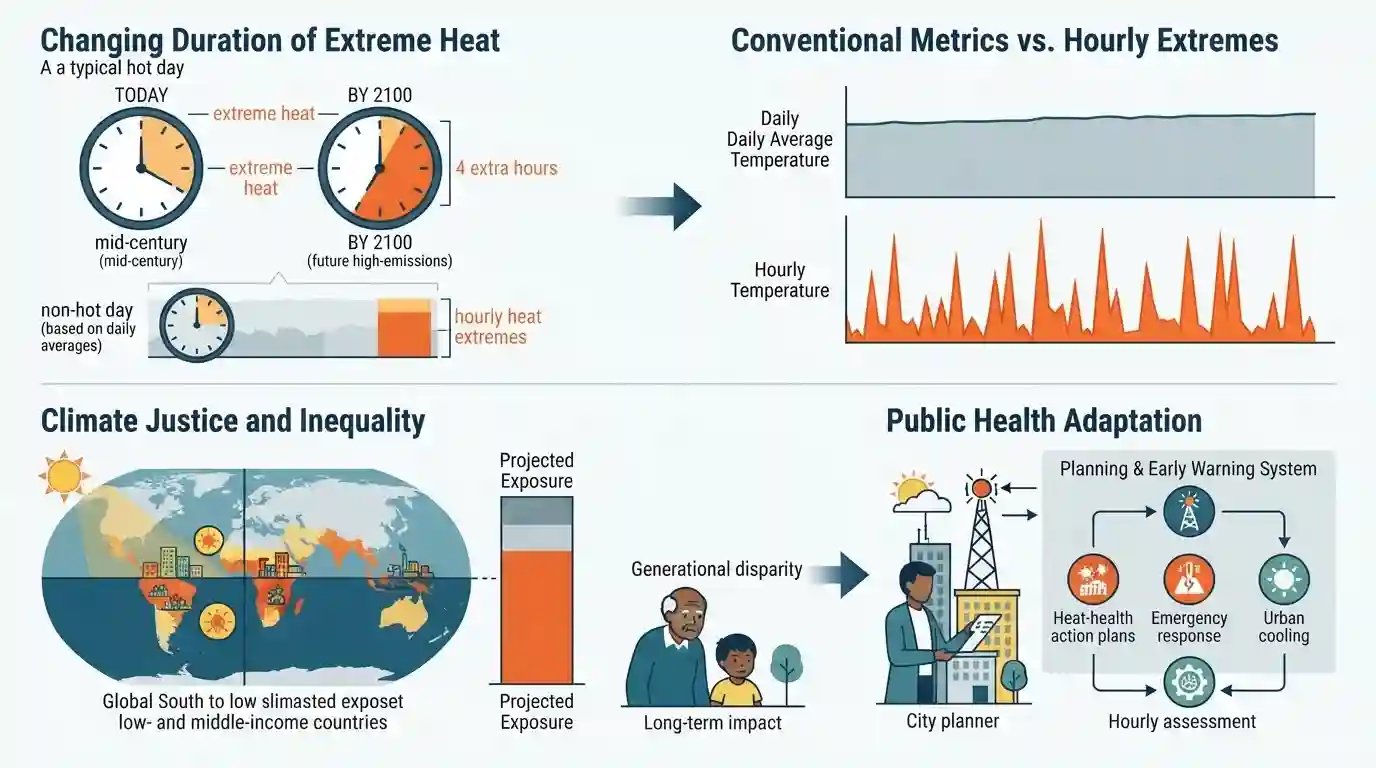
This study introduces a vital paradigm shift from daily-average temperature metrics to hourly heat extremes (HHEs). Daily metrics often underreport acute heat exposure, which is critical for a tropical and developing nation like India. The finding that low- and middle-income countries bear over three-quarters of the global heat burden directly feeds into mains-level arguments on climate justice, public health vulnerability, and the necessity of upgrading India's Heat Action Plans (HAPs) from daily triggers to hourly early warning systems.
Summary
A modelling study published in Nature Climate Change warns that under a high-emissions scenario, a typical hot day by 2100 could have an extra four hours of extreme heat. Additionally, days not categorized as 'hot' by daily averages will gain three hours of extreme heat. The researchers emphasize that conventional daily temperature metrics overlook short-term 'hourly heat extremes' (HHEs) or flash heat events. Low- and middle-income countries are projected to suffer disproportionately, accounting for over 75% of current and future exposure, showcasing deep regional and generational climate disparities. Shifting to hourly assessments is crucial for designing robust public health planning and precise early warning systems.
Key Points
- Traditional climate and vulnerability assessments utilize daily mean, maximum, or minimum temperatures, which overlook shorter but highly intense periods of hourly heat extremes (HHEs), such as heat bursts or flash heat events.
- Hourly analysis reveals that global land areas currently experience an average of 269 hours of extreme heat each summer, with land areas gaining 62 additional hours of extreme heat per decade between 1981 and 2023.
- Approximately 28% of recorded hourly heat extremes between 1981 and 2023 occurred on days that were otherwise classified as 'non-hot' by conventional daily metrics.
- By 2100, under a high-emissions scenario, a hot day is projected to gain an extra four hours of extreme heat, with an additional three hot hours spilling onto non-hot days. This equates to a fourfold rise in HHE events and a sixfold increase in human exposure.
- Low- and middle-income countries (LMICs) bear the brunt of this climate hazard, accounting for more than 75% of both current and projected exposure, creating stark regional and generational climate inequalities.
- Shifting to global hourly temperature data is critical for accurate heat risk management, improving early warning systems, preparing public health infrastructure, and tailoring localized Heat Action Plans (HAPs).
Important Terms
Climate Justice

An ethical framework framing global warming as a political and social issue, emphasizing how its burdens and mitigation policies disproportionately impact vulnerable, historically low-emitting populations.
UPSC context
GS Paper III (Environment); tests understanding of global equity, environmental ethics, and climate negotiations.
Hourly Heat Extremes (HHEs)
A localized climate metric defined as temperatures exceeding 90% of historical hourly baselines, capturing short-term heatwaves and flash heat events overlooked by daily average metrics.
UPSC context
GS Paper III (Disaster Management); tests knowledge of precise heatwave early warning systems and public health planning.
Nature Climate Change (Journal)
A prestigious, peer-reviewed scientific journal publishing high-impact research on the physical, social, and economic aspects of global climate change and its policy implications.
UPSC context
GS Paper III (Environment); serves as an authoritative scientific source for referencing contemporary climate trends.
Sun Yat-sen University
A premier comprehensive public research university in Guangdong, China, widely recognized for its contributions to global environmental modelling, marine science, and atmospheric research.
UPSC context
GS Paper III (Science & Technology); represents key academic institutions collaborating on global environmental research.
Southern Marine Science and Engineering Guangdong Laboratory
A Chinese provincial-level research institute operated by Sun Yat-sen University, focusing on marine safety, disaster mitigation, and ecological engineering in the South China Sea.
UPSC context
GS Paper III (Disaster Management); relevant for international disaster mitigation frameworks and marine climate modeling.
Prelims Trap
"Heatwaves are local disasters restricting states to utilize only up to 10% of their SDRF allocation for response."
In August 2026, the MHA officially notified heatwaves as a natural calamity, removing the 10% spending cap previously applied when they were just 'local disasters'.
Static Concepts Connected
What are the IMD criteria for declaring a heatwave in India?
- Plains: Maximum temperature must reach at least 40°C.
- Hilly regions: Maximum temperature must reach at least 30°C.
- Coastal areas: Maximum temperature must reach at least 37°C.
- Departure criteria: A heatwave is declared if the departure from normal temperature is 4.5°C to 6.4°C. Severe heatwave if >6.4°C.
How is the State Disaster Response Fund (SDRF) financed and governed?
- Statutory basis: Constituted under Section 48 (1) (a) of the Disaster Management Act, 2005.
- Funding split: Center contributes 75% for general category states and 90% for special category (hilly/NE) states.
- Mitigation allowance: States can use 20% of their disaster allocations via the State Disaster Mitigation Fund (SDMF) for proactive adaptation measures like cool roofs.
Cross-Topic Patterns
Urban Heat Islands & Hourly Extremes
Urban concretization directly amplifies short-burst hourly heat extremes (HHEs). This connects physical geography micro-climates to the disproportionate public health vulnerability of urban poor.
Fiscal Federalism in Disaster Finance
The 16th Finance Commission elevating heatwaves to a notified calamity highlights evolving fiscal federalism, allowing states flexible funding for climate adaptation rather than just post-disaster relief.

Expect a 2026 multi-statement question combining IMD heatwave criteria, the newly removed 10% SDRF cap, and 'Hourly Heat Extremes' (HHEs).
Linked PYQs · 3
Linked PYQs · 3
- 2022MainsGS3
Discuss global warming and mention its effects on the global climate. Explain the control measures to bring down the level of greenhouse gases which cause global warming, in the light of the Kyoto Protocol, 1997.
- 2017MainsGS3
'Climate change' is a global problem. How India will be affected by climate change? How Himalayan and coastal states of India will be affected by climate change?
- 2023MainsGS1
Discuss the consequences of climate change on the food security in tropical countries.
