Proposal for Health Tax on High Fat Sugar and Salt Foods to Curb NCDs
Source:The Hindu ↗
কেন এটি গুরুত্বপূর্ণ
The rising incidence of non-communicable diseases (NCDs) and the double burden of malnutrition are critical public health challenges. Potential government interventions, such as front-of-pack labelling (handled by FSSAI) and health taxes (junk food tax), are highly relevant for GS2 Health and Governance, as well as GS3 Economy (taxation). Past Prelims questions have tested knowledge of FSSAI labelling rules, while Mains often focuses on strategies to address malnutrition.
সারসংক্ষেপ
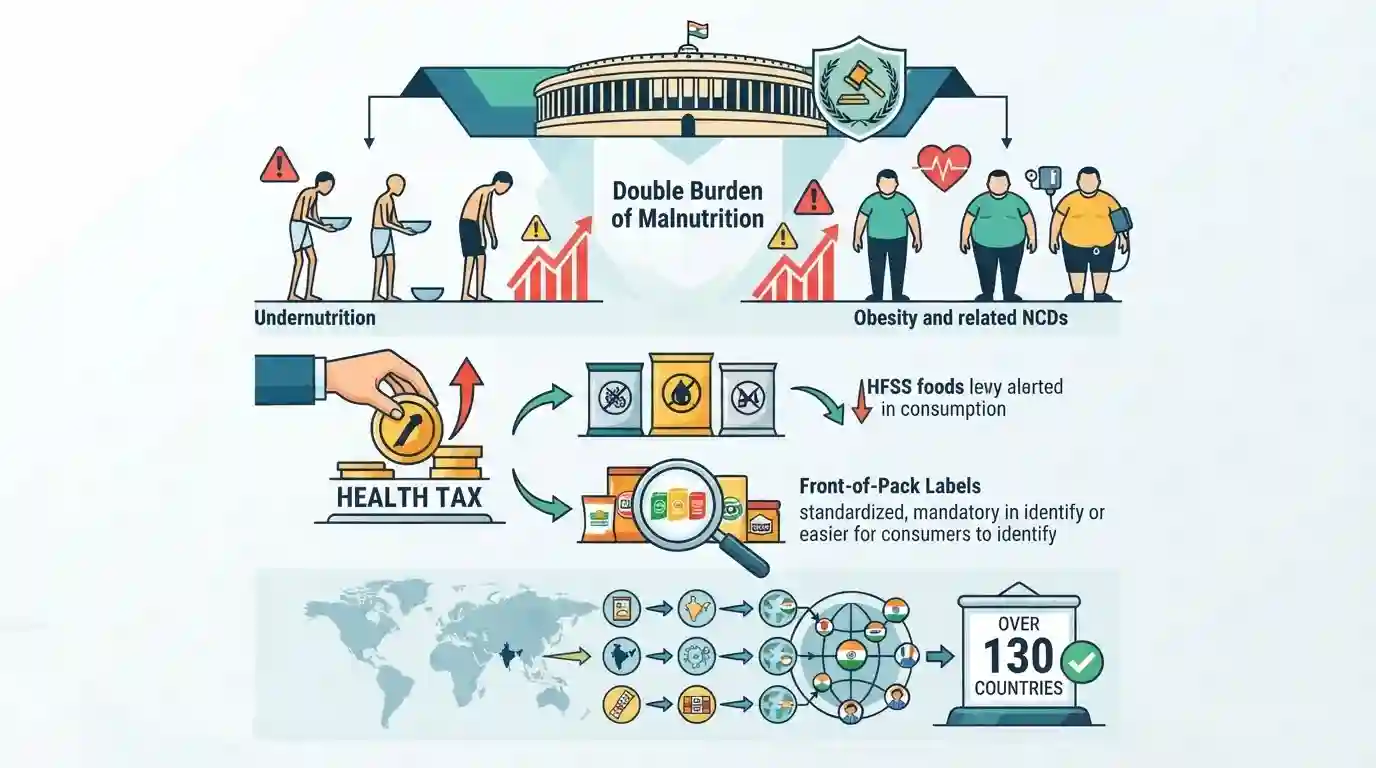
The article discusses the pressing need for India to adopt strict regulatory measures, such as a health tax on foods high in fat, sugar, and salt (HFSS), to combat the rising tide of obesity and non-communicable diseases. Confronting a double burden of malnutrition, India has seen recent recommendations for mandatory front-of-pack nutrition labelling and health taxes from parliamentary panels and health bodies like ICMR-NIN. The piece highlights that implementing such a tax would align India with global best practices, as over 130 countries have already introduced similar levies to curb the consumption of unhealthy diets.
মূল বিষয়
- India is currently grappling with a double burden of malnutrition, characterised by the coexistence of undernutrition and a rapid rise in diet-related non-communicable diseases and obesity.
- A Parliamentary Standing Committee has recommended mandatory front-of-pack nutrition labelling for foods high in sugar and clear indication of sugar content on baby foods.
- A national consortium led by ICMR-NIN has proposed levying a 'health tax' on foods high in fat, sugar, and salt (HFSS), alongside stricter advertising regulations.
- According to the WHO, over 133 countries have implemented some form of health tax since 2017 to discourage consumption of unhealthy foods and beverages.
- The ICMR-NIN report projects that the number of overweight/obese children and adolescents in India could rise from 17 million currently to 27 million by 2030, emphasizing the urgent need for regulatory interventions.
গুরুত্বপূর্ণ শব্দ
Let's Fix Our Food (LFOF) Consortium

A multi-institutional initiative led by ICMR-NIN, alongside partners like WHO and FSSAI, aiming to drive evidence-based policies—such as HFSS food taxation and front-of-pack labelling—to improve food environments for Indian youth.
UPSC context
GS-2 (Health/Governance). A key example of multi-sectoral collaboration to address childhood obesity and non-communicable diseases.
Front-of-Pack Nutrition Labelling (FOPNL)
An FSSAI-proposed regulatory framework that uses simplified, visual indicators (like traffic light colors or star ratings) on the front of packaged foods to warn consumers about high fat, sugar, and salt content.
UPSC context
GS-2 (Governance). Essential for consumer rights, FSSAI regulations, and preventive healthcare strategies to combat diet-related diseases.
Double burden of malnutrition
A public health crisis defined by the WHO as the simultaneous coexistence of undernutrition (stunting, wasting) alongside overnutrition (obesity and diet-related non-communicable diseases) within the same population or household.
UPSC context
GS-2 (Social Justice/Health). A core concept for analyzing India's evolving nutritional challenges and formulating effective food security interventions.
Health Tax (HFSS Tax)
A targeted fiscal policy that levies higher taxes on foods High in Fat, Sugar, and Salt (HFSS) to increase their prices, disincentivize unhealthy consumption, and raise revenue for public health initiatives.
UPSC context
GS-2 (Health) & GS-3 (Economy). Highlights the intersection of taxation mechanisms, market interventions, and public health management.
ICMR-National Institute of Nutrition (ICMR-NIN)
India's premier autonomous institution for nutrition research under the Ministry of Health. It formulates national dietary guidelines, conducts nutritional surveys, and provides the scientific backing for India's public health interventions.
UPSC context
GS-2 (Health). Highly relevant for questions on health governance and evidence-based policymaking by autonomous government bodies.
Parliamentary Standing Committee
Permanent legislative panels of Members of Parliament that oversee government departments, scrutinize proposed bills, and hold the executive accountable—such as the recent panel demanding FSSAI fast-track its food labelling standards.
UPSC context
GS-2 (Polity). Central to understanding legislative oversight, policy scrutiny, and the functioning of the Indian Parliament.
প্রিলিমস ফাঁদ
Double burden of malnutrition means the coexistence of protein-energy malnutrition and micronutrient deficiencies (hidden hunger).
The 'double burden' specifically denotes the simultaneous coexistence of undernutrition (stunting/wasting) AND overnutrition (obesity/NCDs), not just dual forms of deficiencies.
সংযুক্ত স্থির ধারণা
What is the statutory backing and nodal ministry of the FSSAI?
- Statutory basis: Established under the Food Safety and Standards Act, 2006, which consolidated older acts like the Prevention of Food Adulteration Act.
- Nodal Ministry: Operates under the Ministry of Health & Family Welfare (MoHFW), not the Ministry of Consumer Affairs or Food Processing.
- Core Mandate: Regulates the manufacture, storage, distribution, sale, and import of food to ensure safe and wholesome consumption.
How does a 'Health Tax' function as a Pigouvian Tax?
- Pigouvian nature: A tax levied on goods that generate negative externalities (e.g., public healthcare costs from obesity) to correct market failures.
- Dual purpose: Aims to reduce consumption through price elasticity while generating revenue specifically earmarked for public health initiatives.
- GST equivalent: In India's current GST structure, a compensation cess is levied on specific 'demerit goods' like tobacco and caffeinated beverages.
আন্তঃবিষয় প্যাটার্ন
GST Council + Demerit Goods Tax
Levying an HFSS 'health tax' requires GST Council consensus to alter the cess structure on processed foods, linking public health policy directly with federal fiscal mechanics and the GST regime.
Consumer Nutrition + Article 21
The Supreme Court linking Front-of-Package Labelling (FOPL) to Article 21 elevates nutritional awareness from a mere statutory consumer right to a fundamental constitutional protection under the Right to Health.

Expect a 2026 Prelims multi-statement question combining FOPL mechanisms, Pigouvian taxes, and the 'Double Burden of Malnutrition'.
সংযুক্ত PYQ · 3
সংযুক্ত PYQ · 3
- 2024MainsGS2
Poverty and malnutrition create a vicious cycle, adversely affecting human capital formation. What steps can be taken to break the cycle ?
- 2018PrelimsGS1
Consider the following statements: 1. The Food Safety and Standards Act, 2006 replaced the Prevention of Food Adulteration Act, 1954. 2. The Food Safety and Standards Authority of India (FSSAI) is under the charge of Director General of Health Services in the Union Ministry of Health and Family Welfare. Which of the statements given above is/are correct?
- 2016PrelimsGS1
With reference to pre-packaged items in India, it is mandatory to the manufacturer to put which of the following information on the main label, as per the Food Safety and Standards (Packaging and Labelling) Regulations, 2011? 1. List of ingredients including additives 2. Nutrition information 3. Recommendations, if any, made by the medical profession about the possibility of any allergic reactions 4. Vegetarian/non-vegetarian Select the correct answer using the code given below.
