Research and Development Deficit in Indian Higher Education
Source:The Hindu ↗
Why It Matters
Research and innovation are foundational to India's economic growth and technological self-reliance. Understanding the structural deficits in R&D funding, the role of institutions like ANRF, and the need for private sector participation is crucial for answering GS3 questions on Science & Technology policy, as well as GS2 questions on higher education and human resource development.
Summary
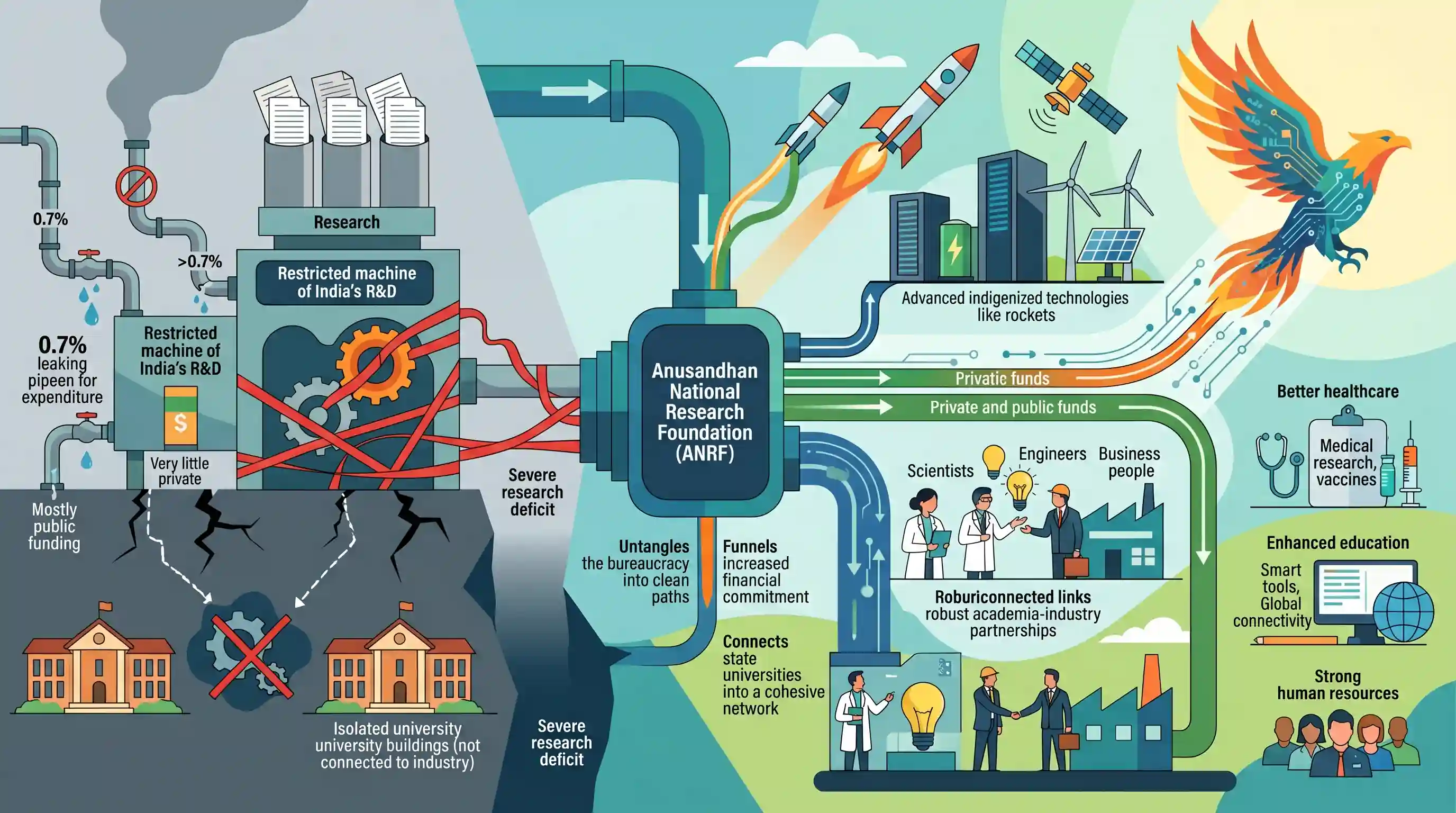
The article critically examines India's research and development (R&D) ecosystem, contrasting the ambitious vision of 'Viksit Bharat 2047' with the ground reality of a severe research deficit. It highlights that India's R&D expenditure is stagnant at under 0.7% of GDP, with an over-reliance on public funding and negligible participation from the private sector. The piece discusses the role of the newly established Anusandhan National Research Foundation (ANRF) in addressing institutional weaknesses, particularly in state universities. It argues that without structural reforms, increased financial commitment, reduced bureaucratic red tape, and robust academia-industry partnerships, India will struggle to build the innovation-driven knowledge economy necessary for its long-term socio-economic goals.
Key Points
- India's Gross Expenditure on R&D (GERD) remains low at around 0.65% of GDP, falling significantly behind global innovators like the US, China, and South Korea.
- Unlike developed economies where the private sector drives research, India's R&D expenditure is heavily skewed towards government funding.
- The Anusandhan National Research Foundation (ANRF) was established to democratize and expand research funding, particularly targeting state universities and colleges.
- To achieve the 'Viksit Bharat 2047' vision, India must overcome structural deficits, reduce bureaucratic hurdles in research funding, and stimulate private sector investment in innovation.
- Stronger academia-industry linkages are essential for translating fundamental scientific research into commercial applications and retaining top scientific talent.
Important Terms
Viksit Bharat 2047

The Government of India's vision to transform the nation into a developed country by 2047, the centenary of its independence, targeting a $30 trillion economy and high per capita income.
UPSC context
GS Paper II (Governance) and GS III (Economy); tests understanding of long-term national development goals and strategic planning.
Anusandhan National Research Foundation (ANRF)
The apex statutory body established in 2023 to provide high-level strategic direction for scientific research, innovation, and entrepreneurship across India's universities, colleges, and research institutions.
UPSC context
GS Paper III (Science & Technology); critical for questions on India's R&D ecosystem and institutional reforms in science.
Anusandhan National Research Foundation Act, 2023
The legislative framework that created the ANRF, replacing the Science and Engineering Research Board (SERB) to centralize and democratize research funding while encouraging private sector participation.
UPSC context
GS Paper III (Science & Technology); focuses on legislative measures to promote indigenization and technological development.
Gross Expenditure on Research and Development (GERD)
The total expenditure (public and private) on research and development activities within a country; India's GERD currently stands at approximately 0.64-0.66% of its GDP.
UPSC context
GS Paper III (Economy/S&T); essential for analyzing India's research deficit and comparing innovation capacity globally.
Department of Science and Technology (DST)
A nodal department under the Ministry of Science and Technology that promotes new areas of S&T and plays a central role in organizing and funding scientific research.
UPSC context
GS Paper III (Science & Technology); relevant for institutional roles in India's scientific advancements.
Knowledge Economy
An economic system in which growth is driven by the production, distribution, and use of knowledge and information rather than traditional physical resources or low-skilled labor.
UPSC context
GS Paper III (Economy); relates to human resource development and the transition to high-value innovation sectors.
Prelims Trap
"The private sector accounts for the majority of India's R&D expenditure."
In India, the government contributes over 60% of R&D funding. This is the opposite of advanced economies (US, China), where the private sector drives 60-70% of R&D.
Static Concepts Connected
What is the Anusandhan National Research Foundation (ANRF)?
- Statutory body: Established via the ANRF Act 2023, subsuming the legacy Science and Engineering Research Board (SERB).
- Funding mandate: Allocated ₹50,000 crore over 5 years, but uniquely expects ~72% (₹36,000 crore) to come from private and philanthropic sources.
- Leadership: The Prime Minister acts as the ex-officio President of its Governing Board.
What are the key indicators of India's structural research deficit?
- GERD stagnation: Gross Domestic Expenditure on R&D remains stuck at ~0.65% of GDP for a decade, far below the global average of 1.8%.
- Low researcher density: India suffers from an exceptionally low number of full-time equivalent (FTE) researchers per million population compared to global peers.
- Poor industry linkage: Weak translation of fundamental academic research into commercial applications ('Lab-to-Market' gap), hurting sunrise sectors like AI.
Cross-Topic Patterns
R&D deficit + Patent filings
Stagnant R&D funding directly limits domestic patent generation, linking this S&T issue to Economy questions on India's IPR regime and performance in WIPO's Global Innovation Index.
ANRF + NEP 2020 Higher Education Hubs
ANRF's mandate to boost research in state universities operationalizes the National Education Policy (NEP) 2020 objective of transforming teaching-heavy higher education institutions into research hubs.

ANRF's funding model (private vs public split) and India's stagnant GERD trends are highly likely to form a 2026 Prelims question.
Linked PYQs · 3
Linked PYQs · 3
- 2015MainsGS2
The quality of higher education in India requires major improvements to make it internationally competitive. Do you think that the entry of foreign educational institutions would help improve the quality of higher and technical education in the country? Discuss.
- 2025MainsGS3
India aims to become a semiconductor manufacturing hub. What are the challenges faced by the semiconductor industry in India? Mention the salient features of the India Semiconductor Mission.
- 2024MainsGS3
Examine the pattern and trend of public expenditure on social services in the post-reforms period in India. To what extent this has been in consonance with achieving the objective of inclusive growth?
