UP Recruitment Delays and Unemployment Crisis Impacting Youth
Source:The Hindu ↗
Why It Matters
The issue is highly relevant for GS-2 (Governance and Role of Civil Services) and GS-3 (Employment and Demographic Dividend). It sheds light on systemic inefficiencies in state recruitment agencies and their socio-economic impact on the youth, making it crucial for answering questions on public administration reforms and human resource management.
Summary
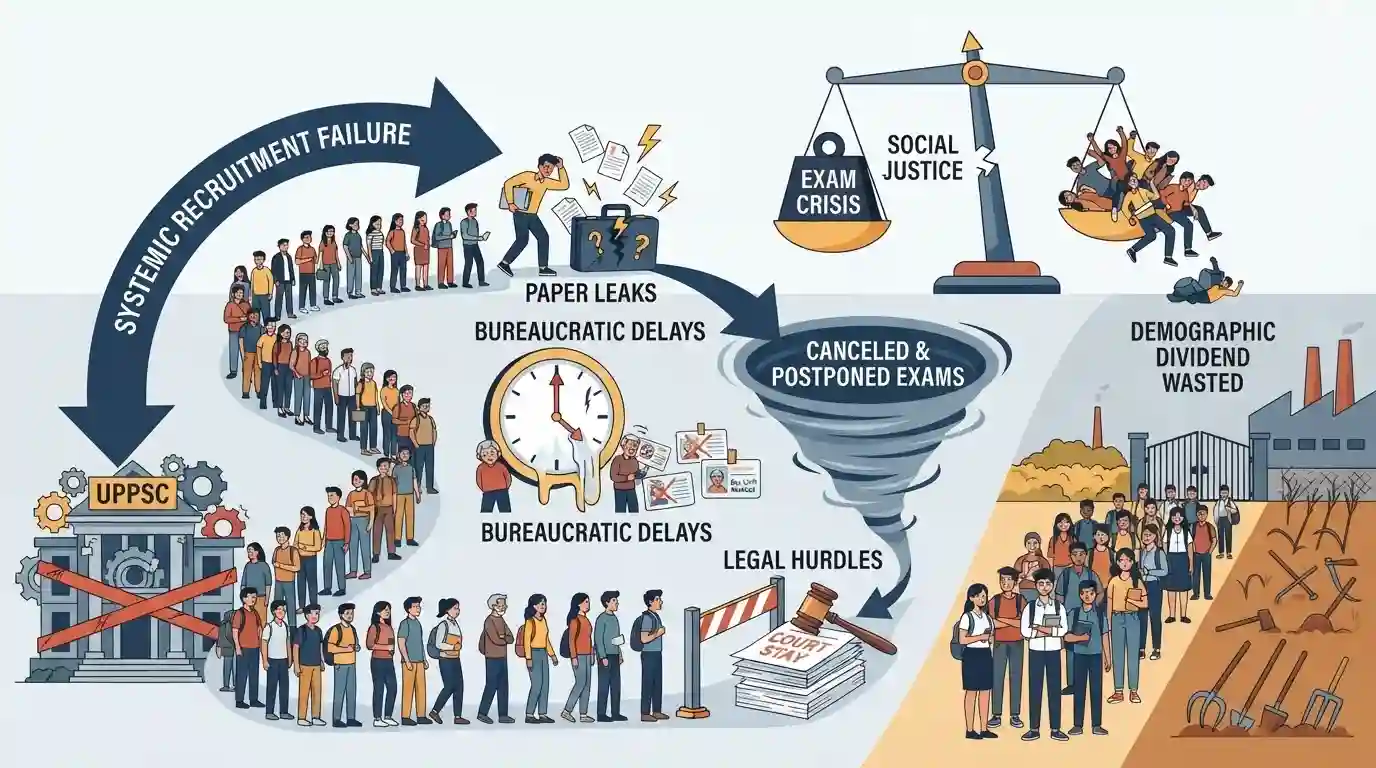
The article highlights the systemic failure of government recruitment processes in Uttar Pradesh, where millions of job aspirants are losing their prime years waiting for exams to conclude. Issues like paper leaks, bureaucratic delays, and legal hurdles have led to canceled or postponed exams, causing many to cross the eligible age limit. This ongoing crisis not only fuels widespread youth unrest but also threatens to squander the state's demographic dividend, underscoring the urgent need for reforms in bodies like the UPPSC to ensure timely and transparent recruitment.
Key Points
- Millions of government job aspirants in Uttar Pradesh are losing their prime productive years due to severely delayed recruitment processes, prolonged litigations, and canceled exams.
- Frequent instances of paper leaks (such as in UP Police Constable and RO/ARO exams) have compounded the frustration, leading to massive youth protests and demands for structural reforms.
- The continuous delay often pushes candidates past the maximum age limit for eligibility, effectively ending their chances of securing public sector employment.
- The crisis threatens to convert India's much-touted demographic dividend into a demographic disaster, emphasizing an urgent need for governance and administrative efficiency in exam-conducting bodies.
Important Terms
Uttar Pradesh Public Service Commission (UPPSC)

A constitutional body established under Article 315 of the Indian Constitution, responsible for conducting competitive examinations and advising the state government on recruitment, promotions, and disciplinary matters for various public services in Uttar Pradesh.
UPSC context
GS Paper II: Constitutional Bodies; covers state-level public service recruitment, administrative integrity, and constitutional provisions like Articles 315 to 323.
Uttar Pradesh Police Recruitment and Promotion Board (UPPRPB)
A specialized state-level body in Uttar Pradesh responsible for the recruitment, promotion, and direct appointment of police personnel, recently tasked with deploying AI-driven monitoring following major paper leaks.
UPSC context
GS Paper II/III: Governance and internal security; focuses on police reforms, recruitment transparency, and administrative measures to curb corruption.
Demographic Dividend
The economic growth potential resulting from shifts in a population’s age structure, specifically when the share of the working-age population (15 to 64) is larger than the non-working-age share.
UPSC context
GS Paper I/III: Social issues, human resources, and economy; tests challenges of jobless growth, skill development, and youth employment.
Public Examinations (Prevention of Unfair Means) Act, 2024
A central legislation enacted to curb paper leaks, digital impersonation, and organized cheating in national examinations, prescribing stringent punishments such as imprisonment up to ten years and fines up to one crore rupees.
UPSC context
GS Paper II/III: Government policies and governance; tests legislative mechanisms to ensure transparency in competitive recruitments and prevent organized fraud.
State Public Service Commission (SPSC)
A constitutional body established under Article 315 for each state, mandated to conduct examinations for recruitment to state services and advise the Governor on civil services appointments, promotions, and disciplinary procedures.
UPSC context
GS Paper II: Constitutional Bodies; assesses understanding of personnel administration, federal public services, and constitutional provisions safeguarding civil servants.
Prelims Trap
The Governor has the constitutional power to remove the Chairperson or any member of a State Public Service Commission.
Under Article 317, while the Governor appoints them, only the President can remove SPSC members following a mandatory Supreme Court reference and inquiry.
Static Concepts Connected
What constitutional rules govern SPSC member appointment, tenure, and removal?
- Appointment: Appointed by the Governor of the state, ensuring state-level executive oversight.
- Tenure: Hold office for 6 years or until they reach 62 years of age, whichever is earlier.
- Removal: Can only be removed by the President (not the Governor) on grounds of misbehaviour after a Supreme Court inquiry.
- Post-retirement restriction: Ineligible for reappointment to the same post; can only join UPSC or another SPSC.
How can SPSC functions be extended beyond state civil services?
- Legislative mandate: Requires an Act of the State Legislature, not an executive notification.
- Applicable bodies: Can be extended to cover local authorities, corporate bodies, or public institutions.
- Constitutional basis: Governed strictly under Article 321 of the Constitution.
Cross-Topic Patterns
Demographic dividend and internal security
Unproductive waiting years and canceled exams risk converting India's youth bulge into a source of widespread civil unrest, direct law-and-order challenges, and regional instability.
Federalism and public exam laws
The clash between central anti-cheating bills and state-specific penal laws highlights growing friction over legislative competence in concurrent jurisdictions like administrative police reforms.

SPSC constitutional provisions (Articles 316-321) combined with federal anti-leak legislation likely to be tested in 2026 Prelims.
Linked PYQs · 2
Linked PYQs · 2
- 2022UPPSC_PRELIMSGS1
The demographic dividend is
- 2021UPPSC_PRELIMSGS1
The functions of the State Public Service Commission of Uttar Pradesh can be extended by
