Drone Strike Causes Fire Outside Nuclear Plant in Abu Dhabi
Source:The Hindu ↗
Why It Matters
The event illustrates the growing intersection of asymmetric warfare (drones) and critical infrastructure vulnerability. It holds direct relevance to UPSC's focus on International Relations and internal/external security paradigms, specifically touching on Middle Eastern geopolitics, global energy supply chain stability via chokepoints like the Strait of Hormuz, and subsequent implications for India's energy security.
Summary
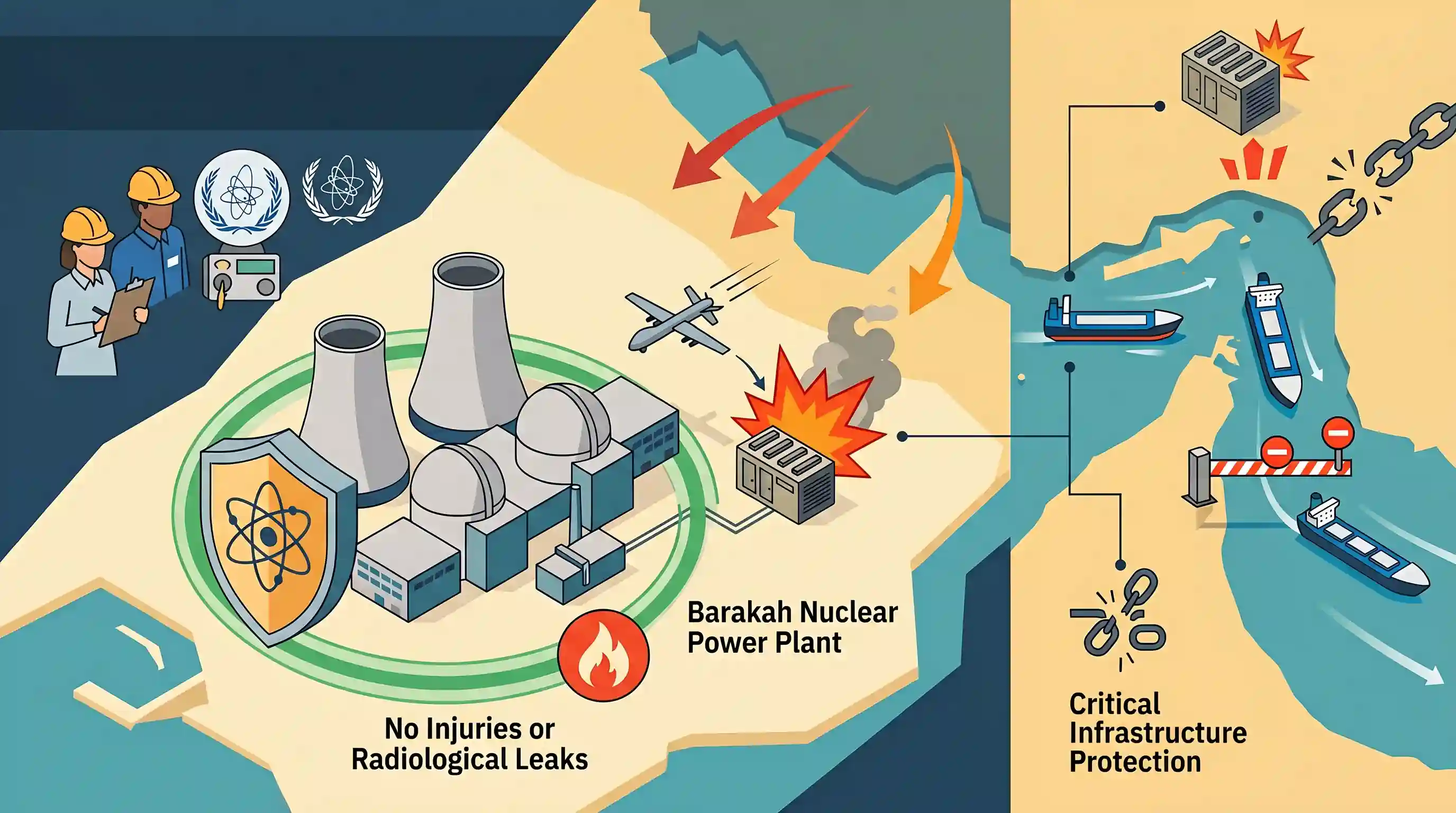
A drone strike resulted in a fire at an external electrical generator near the Barakah Nuclear Power Plant in Abu Dhabi, UAE. While there were no injuries or radiological leaks reported, this represents the first targeting of a nuclear facility on the Arabian Peninsula. The attack took place within the broader geopolitical conflict involving Iran and the Middle East. The incident escalates concerns over the vulnerability of critical infrastructure to asymmetric drone warfare, regional stability, and the security of global energy routes, especially given the plant's proximity to the strategic Strait of Hormuz.
Key Points
- A drone strike caused a fire at an external electrical generator outside the Barakah Nuclear Power Plant in Abu Dhabi, UAE, though no injuries or radiological impacts occurred.
- The $20 billion Barakah plant, built with South Korean collaboration and operational since 2020, is the first and only nuclear power plant on the Arabian Peninsula.
- This marks the first time the plant has been targeted amidst the escalating geopolitical conflict in the Middle East involving Iran and neighboring states.
- The incident highlights the emerging asymmetrical threat of unmanned aerial vehicles (UAVs) to critical infrastructure.
- The attack occurs against the backdrop of tensions over the strategic Strait of Hormuz, raising significant alarms over global energy security and regional stability.
Important Terms
Barakah Nuclear Power Plant

The Arab world’s first nuclear power station, located in Abu Dhabi, UAE. It consists of four reactors providing approximately 25% of the UAE’s electricity and supporting regional energy diversification.
UPSC context
GS-II/III (International Relations/Energy Security). Tests knowledge of strategic infrastructure and energy transitions in the Middle East.
International Atomic Energy Agency (IAEA)
An autonomous international organization (est. 1957) that promotes peaceful nuclear energy use. It acts as a watchdog, verifying that nuclear materials are not diverted for weapons.
UPSC context
GS-II (International Organizations). Crucial for questions on global nuclear governance, non-proliferation, and the UN system.
IAEA Safeguards
Technical measures applied by the IAEA to independently verify that nuclear facilities and materials are used exclusively for peaceful purposes and not for weapons development.
UPSC context
GS-III (Science & Technology/Security). Tests understanding of international verification regimes and nuclear safety protocols.
Strait of Hormuz
A strategic maritime chokepoint between Iran and Oman, connecting the Persian Gulf to the Gulf of Oman; it transits roughly 20% of global oil.
UPSC context
GS-I (Geography) and GS-II (International Relations). Tests knowledge of vital trade routes and West Asian geopolitics.
Asymmetric Warfare
A conflict where belligerents have significantly unequal power, leading the weaker side to use unconventional tactics (e.g., drone strikes, guerrilla warfare) to exploit vulnerabilities.
UPSC context
GS-III (Internal Security). Tests analysis of modern security threats and the impact of technology on traditional military doctrines.
Critical Infrastructure
Essential systems and assets (e.g., power grids, nuclear plants) whose destruction would have a debilitating impact on national security, economy, or public health.
UPSC context
GS-III (Security/Cybersecurity). Tests understanding of national frameworks for protecting vital assets from physical and cyber attacks.
Prelims Trap
"The Barakah plant is the first operational nuclear power plant in the Middle East."
Barakah is the first in the Arab world/Arabian Peninsula, not the Middle East overall. Iran’s Bushehr reactor predates it. UPSC often tweaks regional qualifiers to trick aspirants.
Static Concepts Connected
What is the geographical layout and significance of the Strait of Hormuz?
- Waterways linked: It connects the Persian Gulf to the Gulf of Oman and subsequently to the Arabian Sea.
- Bordering nations: Bounded by Iran to the north and Oman (Musandam Peninsula) and the UAE to the south.
- Strategic value: It is a critical maritime chokepoint handling roughly 20% of global petroleum liquids, vital for India's energy imports.
How do UAVs pose an asymmetric threat to critical national infrastructure?
- Evasion capabilities: Low-flying drones with small radar cross-sections can easily evade and bypass traditional, multi-billion-dollar conventional air and missile defense systems.
- Plausible deniability: Often operated by non-state proxies, making definitive attribution difficult and complicating direct military retaliation under international law.
- High disruption ROI: Cheap commercial drones modified with explosives can cause catastrophic disruptions to vulnerable nodes like power grids or nuclear cooling systems.
Cross-Topic Patterns
Energy Security + Asymmetric Warfare
The shift from targeting oil fields (Saudi Aramco, 2019) to nuclear facilities underscores a growing asymmetric threat to the Middle East's energy infrastructure, directly impacting India's oil and LNG import security.
Nuclear Safety + International Law
Similar to the Zaporizhzhia plant in Ukraine, the Barakah attack tests the IAEA’s framework and international protocols (like the Geneva Conventions) protecting civilian nuclear installations during armed conflict.

Expect a 2026 Prelims map question linking Persian Gulf chokepoints with regional nuclear sites (Barakah, Bushehr) and proxy war zones.
Linked PYQs · 5
Linked PYQs · 5
- 2018PrelimsGS1
In the Indian context, what is the implication of ratifying the 'Additional Protocol' with the 'International Atomic Energy Agency (IAEA)'?
- 2020PrelimsGS1
In India, why are some nuclear reactors kept under "IAEA Safeguards" while others are not?
- 2024PrelimsGS1
Consider the following statements : Statement-I : Sumed pipeline is a strategic route for Persian Gulf oil and natural gas shipments to Europe. Statement-II : Sumed pipeline connects the Red Sea with the Mediterranean Sea. Which one of the following is correct in respect of the above statements?
- 2025MainsGS2
"Energy security constitutes the dominant kingpin of India's foreign policy, and is linked with India's overarching influence in Middle Eastern countries.” How would you integrate energy security with India's foreign policy trajectories in the coming years?
- 2017MainsGS2
The question of India's Energy Security constitutes the most important part of India's economic progress. Analyze India's energy policy cooperation with West Asian countries.
