Legal Liability and Ethical Dilemmas of Autonomous Vehicles
Source:Indian Express ↗
Why It Matters
As artificial intelligence integration expands into public spheres like transportation, understanding the ethical boundaries, liability frameworks, and regulatory challenges becomes crucial for future civil servants formulating technology policies.
Summary
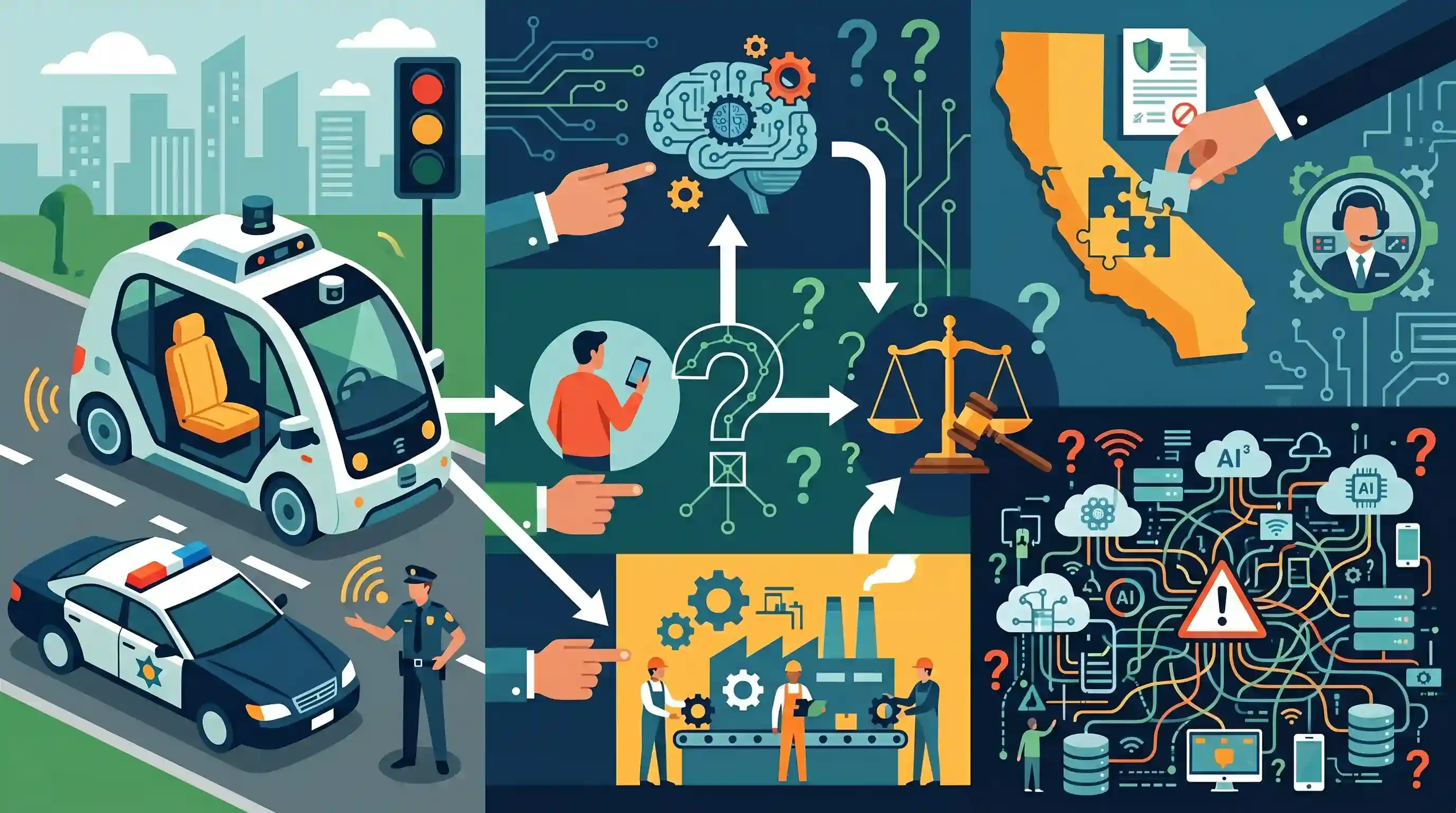
The editorial uses a recent incident of a driverless Waymo robotaxi being stopped by police in California for a traffic violation to explore the legal and ethical dilemmas of AI accountability. It questions who bears responsibility when an autonomous machine breaks the law—the AI, the user, or the manufacturer. While California plans to close current loopholes by holding AV operators legally accountable through 'notices of noncompliance', the piece warns that as AI systems grow more advanced, assigning liability and determining appropriate corrective measures will become significantly more complex.
Key Points
- A driverless Waymo robotaxi was pulled over by San Bruno police for an illegal U-turn, raising the practical issue of penalizing a vehicle with no human driver.
- The incident invokes Isaac Asimov's laws of robotics, prompting ethical discussions on whether the robot, its owner, or the manufacturer holds accountability for an autonomous system's infractions.
- California is introducing a new law next year allowing law enforcement to issue 'notices of noncompliance' directly to companies operating driverless cars for road violations, bridging the current legal gap.
- As AI technology advances toward sapience, the debate around appropriate disciplinary actions for AI—such as reprogramming (reformative) versus decommissioning (retributive)—will become increasingly prominent.
Important Terms
Isaac Asimov's Three Laws of Robotics

Foundational ethical framework for robotics: 1) Never harm humans; 2) Obey orders (unless conflicting with Law 1); 3) Protect self (unless conflicting with Laws 1 or 2).
UPSC context
Relevant for GS Paper IV (Ethics) and GS Paper III (S&T) when discussing machine morality and AI safety.
AI Accountability
The legal and ethical obligation to ensure AI systems are transparent, auditable, and have clear lines of responsibility (developer, deployer, or user) for outcomes.
UPSC context
Critical for GS Paper II (Governance) and GS Paper IV (Ethics) regarding the regulation of emerging technologies.
Algorithmic Liability
A legal framework determining responsibility and damages when an autonomous system or algorithm causes harm, often shifting liability from the 'operator' to the 'manufacturer.'
UPSC context
Tests understanding of legal challenges in GS Paper III (S&T) and Paper II (Legislative issues).
California AV Legislation
Specific laws (notably Assembly Bill 1777) closing regulatory gaps by allowing police to issue 'notices of noncompliance' to manufacturers for driverless traffic violations.
UPSC context
A global case study for GS Paper II (Governance) on how governments adapt laws to disruptive technology.
Waymo
An Alphabet-owned technology company and leader in autonomous ride-hailing services, frequently serving as the primary case study for driverless vehicle regulation.
UPSC context
GS Paper III (S&T); represents the 'commercial deployment' phase of autonomous transport technology.
Prelims Trap
"ADAS (Advanced Driver Assistance Systems) equipped vehicles require no human intervention and make independent driving decisions."
ADAS (e.g., cruise control, lane assist) operates at Level 1-2 autonomy and requires a human driver. Fully autonomous robotaxis operate at Level 4-5 without human oversight.
Static Concepts Connected
What are the core sensors enabling Autonomous Vehicles (AVs)?
- LiDAR: Uses laser pulses to measure distances and create high-resolution 3D maps of the surroundings. Highly accurate but struggles in heavy rain or fog.
- Radar: Uses radio waves to detect the speed and distance of moving objects. Extremely reliable in adverse weather conditions (fog, snow).
- Cameras: Standard optical lenses used to read traffic lights, signs, and lane markings, but reliant on good lighting conditions.
- Sensor Fusion: The AI process of integrating data from LiDAR, Radar, and cameras to create a unified, real-time understanding of the environment.
What is the "Accountability Gap" in AI ethics?
- Liability Dilemma: The legal and moral difficulty in assigning blame when an autonomous system (like an AI driver) causes harm or violates a law.
- Attribution of Blame: Debates on whether responsibility lies with the human user, the software developer, the hardware manufacturer, or the AI itself.
- The Trolley Problem: A classic ethical thought experiment often applied to AVs: how an AI should be programmed to choose between two unavoidable harmful outcomes.
Cross-Topic Patterns
AI Liability & Strict Corporate Liability
Tracing liability to the manufacturer bridges AI ethics and corporate governance, echoing the "strict liability" principles applied in environmental disasters (e.g., the Oleum gas leak case).
Autonomous Transport & Smart City Infrastructure
The deployment of Level 5 AVs relies heavily on advanced urban infrastructure, linking autonomous navigation to 5G rollout, V2X (Vehicle-to-Everything) communication, and Smart City planning.

Expect a GS4 case study on AI ethics (e.g., autonomous vehicle liability) or a GS3 prelims question differentiating LiDAR and Radar tech.
Linked PYQs · 3
Linked PYQs · 3
- 2020PrelimsGS1
With the present state of development, Artificial Intelligence can effectively do which of the following? 1. Bring down electricity consumption in industrial units 2. Create meaningful short stories and songs 3. Disease diagnosis 4. Text-to-Speech Conversion 5. Wireless transmission of electrical energy Select the correct answer using the code given below:
- 2023MainsGS3
Introduce the concept of Artificial Intelligence (AI). How does Al help clinical diagnosis? Do you perceive any threat to privacy of the individual in the use of Al in healthcare?
- 2024MainsGS4
The application of Artificial Intelligence as a dependable source of input for administrative rational decision-making is a debatable issue. Critically examine the statement from the ethical point of view.
