Pacific Ocean Climate Teleconnections and Northern India Rainfall
Source:The Hindu ↗
આ શા માટે મહત્વનું છે
Understanding teleconnections between global ocean-atmosphere phenomena like Pacific climate drivers and the Indian monsoon is crucial for climate resilience, agricultural planning, and water resource management in India.
સારાંશ
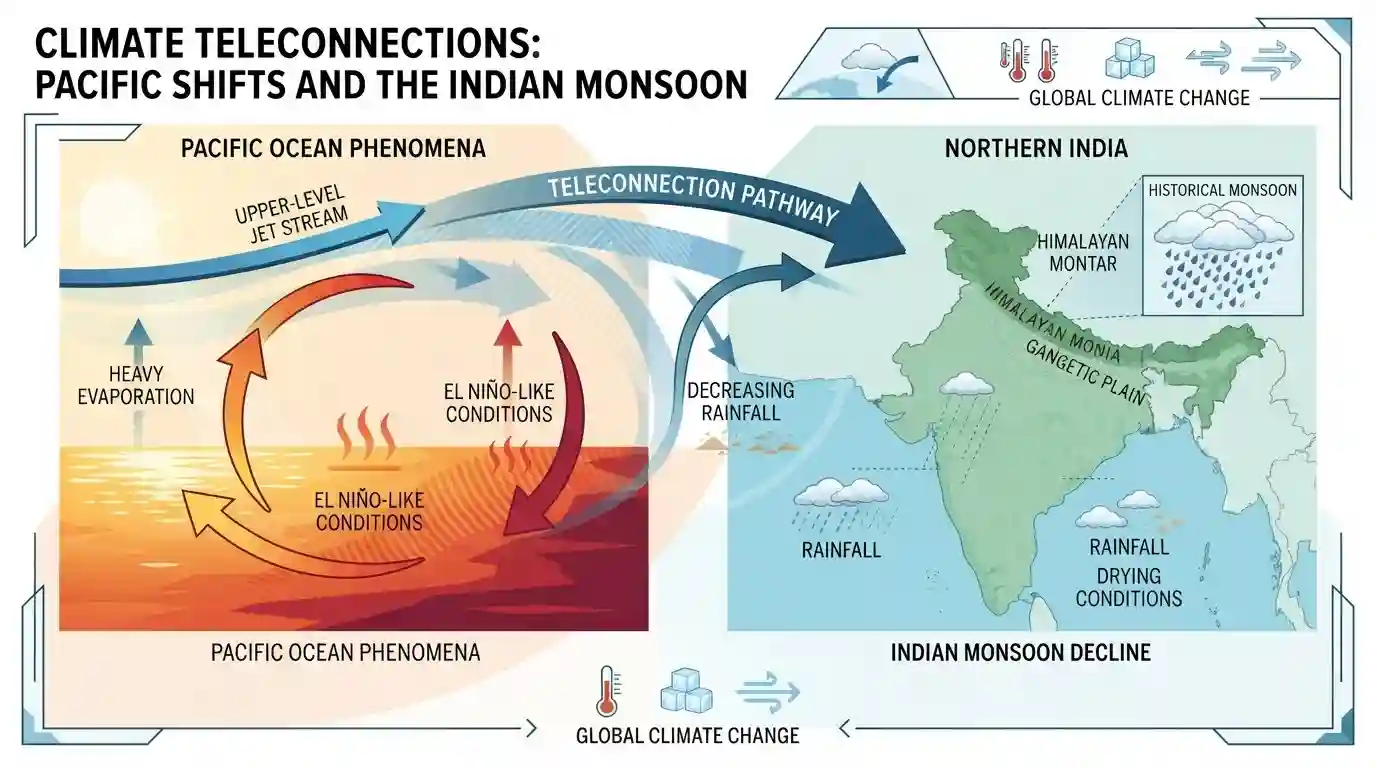
A recent scientific study indicates that climatic shifts and phenomena originating in the distant Pacific Ocean are linked to drying conditions and declining rainfall trends in northern India, highlighting the complex teleconnections affecting the Indian monsoon system.
મુખ્ય મુદ્દા
- A scientific study reveals that a distant Pacific phenomenon is contributing to the drying trends and reduction in rainfall across northern India.
- Teleconnections between Pacific Ocean climate patterns and Indian regional rainfall demonstrate how global climate systems interact.
- Drying in northern India poses severe risks to agriculture, water security, and groundwater levels in the Indo-Gangetic plains.
સંલગ્ન સ્થિર ખ્યાલો
What are the primary oceanic and atmospheric teleconnections influencing the Indian Summer Monsoon?
- ENSO Dynamics: El Niño-Southern Oscillation (ENSO) involves periodic warming and cooling of surface waters in the central and eastern Pacific Ocean, impacting Indian monsoon rainfall.
- Indian Ocean Dipole: Indian Ocean Dipole (IOD) represents the difference in sea surface temperatures between the western and eastern Indian Ocean, modulating monsoon precipitation independently or alongside ENSO.
- Victoria Mode: The Victoria Mode is a North Pacific climate pattern tied to sea surface temperature and atmospheric pressure anomalies that influence moisture transport toward Asian landmasses.
આંતર-વિષય પેટર્ન
Pacific Teleconnections + Indo-Gangetic Water Security
Pacific Ocean variability alters Indo-Gangetic groundwater stress, creating complex policy intersections between international climatology, agricultural irrigation reforms, and transboundary water management.

Expect a statement-based prelims question linking North Pacific climate modes (like the Victoria Mode) to shifts in Indian monsoon teleconnections.
સંલગ્ન PYQ · 3
સંલગ્ન PYQ · 3
- 2020PrelimsGS1
With reference to Ocean Mean Temperature (OMT), which of the following statements is/are correct? 1. OMT is measured up to a depth of 26°C isotherm which is 129 meters in the south-western Indian Ocean during January - March. 2. OMT collected during January - March can be used in assessing whether the amount of rainfall in monsoon will be less or more than a certain long-term mean. Select the correct answer using the code given below:
- 2017PrelimsGS1
With reference to 'Indian Ocean Dipole (IOD)' sometimes mentioned in the news while forecasting Indian monsoon, which of the following statements is/are correct? 1. IOD phenomenon is characterised by a difference in sea surface temperature between tropical Western Indian Ocean and tropical Eastern Pacific Ocean. 2. An IOD phenomenon can influence an El Nino's impact on the monsoon. Select the correct answer using the code given below:
- 2015MainsGS1
How far do you agree that the behaviour of the Indian monsoon has been changing due to humanizing landscapes? Discuss.
