Political Defection Trends in Tamil Nadu Politics
Source:The Hindu ↗
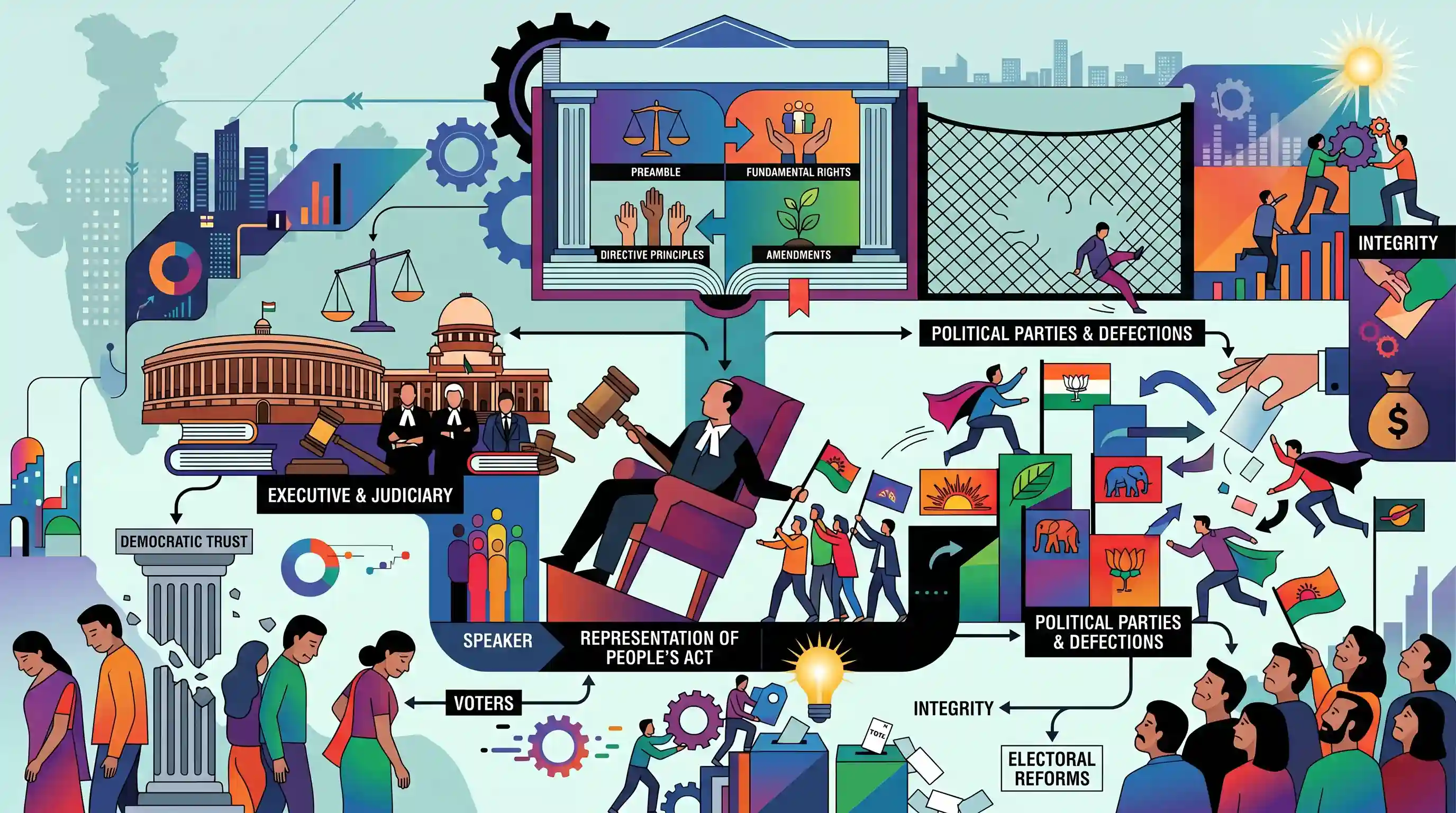
Why It Matters
This topic is a cornerstone of Indian Polity (GS2). Defection waves regularly occur across different states, bringing the constitutional role of the Speaker, the Tenth Schedule, and the balance of power between national and regional political parties under supreme judicial and public scrutiny. Candidates must understand the legal loopholes, landmark judgements (like Kihoto Hollohan and Keisham Meghachandra Singh), and recommendations for reform.
Summary
The article explores the escalating phenomenon of political defections in Tamil Nadu, analyzing the trends of party-hopping among major players like the DMK, AIADMK, and national parties. It raises fundamental concerns regarding the effectiveness of India's Anti-Defection Law (Tenth Schedule), the partisan role played by the Speaker in deciding disqualification cases, and the erosion of voter trust. The commentary stresses the need for structural and constitutional reforms to prevent political opportunism and restore democratic integrity.
Key Points
- The article analyzes the political dynamics of party-switching and defections in Tamil Nadu, where leaders and cadres shift alliances between the regional giants (DMK and AIADMK) and national parties like the BJP.
- It highlights how defections challenge the stability of political alignments and test the boundaries of the Anti-Defection Law (Tenth Schedule).
- The structural loopholes in the Tenth Schedule are scrutinized, especially how collective defections (disguised as mergers under the 2/3rd rule) and engineered resignations of MLAs are used to circumvent disqualification.
- The role of the Speaker as the deciding authority in defection cases is a major point of concern, as partisan delays or quick decisions often reflect political alignment rather than constitutional neutrality.
- The wave of defections raises serious ethical questions about political morality, the betrayal of the voters' mandate, and the dilution of ideological consistency in democratic representation.
- Reforms proposed by various committees—such as vesting the adjudicatory power in the President/Governor acting on the advice of the Election Commission, or limiting the scope of the whip—are emphasized as crucial for safeguarding the spirit of democracy.
Important Terms
Tenth Schedule of the Constitution (Anti-Defection Law)

A constitutional framework designed to penalize individual legislators who switch political parties or defy party whips, thereby deterring opportunistic defections and safeguarding the stability of elected governments.
UPSC context
GS Paper II (Polity). Tests understanding of political stability, legislative accountability, the Speaker’s powers, and related landmark judgements.
52nd Constitutional Amendment Act, 1985
The constitutional amendment that officially added the Tenth Schedule to the Indian Constitution, introducing legal provisions to disqualify legislators who switch party allegiances after being elected.
UPSC context
GS Paper II (Polity). Tests historical knowledge of electoral reforms, background of political instability, and early efforts to check defections.
91st Constitutional Amendment Act, 2003
An amendment that strengthened the anti-defection framework by removing split exemptions, capping the Council of Ministers' size at 15% of the assembly's strength, and barring defectors from holding ministerial positions.
UPSC context
GS Paper II (Polity). Tests understanding of cabinet size limits, executive reforms, and plugging of anti-defection law loopholes.
Representation of the People Act, 1951
The foundational law regulating the conduct of elections in India, detailing qualifications and disqualifications for membership in legislatures, curbing corrupt practices, and resolving electoral disputes.
UPSC context
GS Paper II (Electoral Reforms). Essential for topics concerning candidate eligibility, ethical campaigning, disqualification criteria, and electoral fairness.
Election Commission of India (ECI)
An autonomous constitutional body established under Article 324, charged with administering and ensuring free and fair elections to Parliament, State Legislatures, and top offices.
UPSC context
GS Paper II (Constitutional Bodies). Tests knowledge of independent oversight, the Model Code of Conduct, and democratic institutions.
Supreme Court of India
The highest judicial authority in India and the final interpreter of the Constitution, empowered with original, appellate, advisory, and writ jurisdictions to safeguard fundamental rights and the rule of law.
UPSC context
GS Paper II (Judiciary). Tests understanding of judicial review, checks and balances, separation of powers, and landmark constitutional judgments.
Prelims Trap
A nominated member of Parliament is disqualified from their seat if they join any political party within six months of taking office.
Under the Tenth Schedule, a nominated member is permitted to join a political party within the first six months. They are disqualified only if they join AFTER the expiry of six months. Independent members, however, are disqualified if they join ANY party after election.
Static Concepts Connected
How does the Tenth Schedule distinguish between Independent and Nominated members regarding disqualification?
- Independent Members: Disqualified if they join any political party after their election to the legislature.
- Nominated Members: Allowed to join a political party within six months of taking office; disqualified only if they join after this period.
- Voluntary Relinquishment: The Supreme Court has clarified that 'voluntarily giving up membership' can be inferred from an MP/MLA's conduct, even without formal resignation.
What are the key judicial limits placed on the Speaker's powers under the Tenth Schedule?
- Kihoto Hollohan (1992): Established that the Speaker acts as a quasi-judicial tribunal, making their final decisions subject to judicial review for mala fides, perversity, or jurisdictional error.
- Keisham Meghachandra (2020): Ruled that Speakers must decide disqualification petitions within a reasonable timeframe, outer-limit usually being three months, unless extraordinary circumstances exist.
- Interim Intervention Bar: Courts generally cannot intervene or stay proceedings before the Speaker has made a final determination on the disqualification.
Cross-Topic Patterns
Federalism + partisan presiding officers
The alignment of Speakers and Governors with ruling parties to facilitate defections strains federal relations, converting the Tenth Schedule from a stability tool into a weapon for political dominance.
Electoral mandate + political ethics
Frequent defections subvert the representative mandate of electors, transforming elections from ideological choices into logistical transactions and sparking debates on voter recall mechanisms.

Mains 2026 may ask to evaluate if vesting anti-defection adjudicatory powers in the President/Governor on ECI advice can restore neutrality.
Linked PYQs · 4
Linked PYQs · 4
- 2022PrelimsGS1
With reference to anti-defection law in India, consider the following statements: 1. The law specifies that a nominated legislator cannot join any political party within six months of being appointed to the House. 2. The law does not provide any time-frame within which the presiding officer has to decide a defection case. Which of the statements given above is/are correct?
- 2014PrelimsGS1
Which one of the following Schedules of the Constitution of India contains provisions regarding anti-defection?
- 2020MainsGS2
Once a Speaker, Always a Speaker' ! Do you think this practice should be adopted to impart objectivity to the office of the Speaker of Lok Sabha ? What could be its implications for the robust functioning of parliamentary business in India?
- 2022MainsGS2
“While the national political parties in India favour centralisation, the regional parties are in favour of State autonomy.” Comment.
