Electoral Roll Revision and Democratic Integrity in India
Source:The Hindu ↗
Why It Matters
Electoral integrity is a core theme in the UPSC GS2 syllabus. The cleanliness of electoral rolls directly impacts the democratic mandate and is closely tied to ongoing debates on electoral reforms, the One Nation One Election proposal, and the statutory powers of the ECI.
Summary
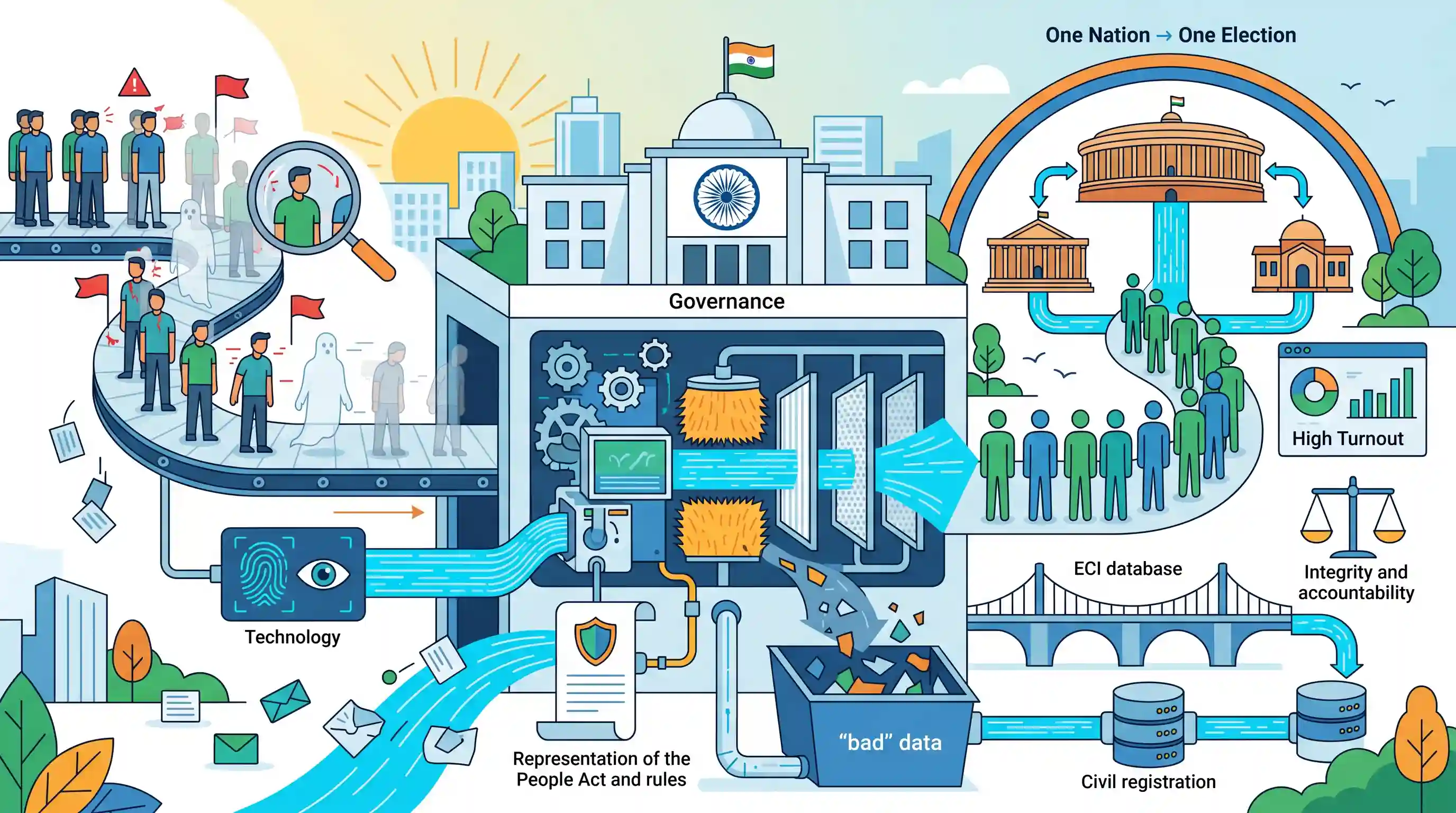
The article highlights the urgent need for a comprehensive 'deep cleaning' of India's electoral rolls to remove inaccuracies like duplicate entries, deceased individuals, and ghost voters. It emphasizes that a flawed voter list compromises the integrity of elections and skews voter turnout data. It touches upon the regulatory framework provided by the Representation of the People Act and explores how technological interventions, such as linking Aadhaar with voter IDs, can aid deduplication. Furthermore, the push for a common electoral roll under the 'One Nation One Election' framework makes the synchronization of the ECI's database with civil registration systems more critical than ever to ensure a robust, inclusive, and transparent democratic process.
Key Points
- The accuracy of electoral rolls is fundamental to democratic integrity; however, India's voter lists often suffer from inaccuracies such as duplicate entries, ghost voters, and unremoved deceased individuals.
- The Representation of the People Act, 1950, provides the statutory framework for the preparation and periodic revision of electoral rolls by the Election Commission of India.
- A deep cleaning of these rolls is critical, especially in light of the proposed 'One Nation One Election' (ONOE) principle, which may necessitate a common electoral roll for local, state, and national elections.
- While linking Aadhaar to Voter IDs has been proposed as a technological solution to weed out duplicates, it necessitates balancing electoral purity with privacy rights and safeguarding against the accidental disenfranchisement of genuine voters.
- Systemic reforms require robust and continuous data synchronization between civil registration systems (like death and migration registries) and the ECI's database to ensure real-time accuracy.
Important Terms
Representation of the People Act, 1950

Legislative framework for seat allocation, delimitation of constituencies, and the preparation of electoral rolls. It defines voter qualifications and establishes the administrative roles responsible for maintaining the voter list.
UPSC context
GS Paper 2 (Electoral Reforms); tests understanding of the legal basis for voter registration and constituency boundaries.
Representation of the People Act, 1951
Governs the actual conduct of elections, qualifications/disqualifications of representatives, corrupt practices, and election disputes. It regulates the registration of political parties and the administrative machinery for polling.
UPSC context
GS Paper 2 (Elections); tests knowledge of election management, candidate accountability, and the administrative framework for fair polls.
Election Commission of India (ECI)
An autonomous constitutional authority established under Article 324 to oversee Union and State elections. It is responsible for voter list purification, polling schedules, and enforcing the Model Code of Conduct.
UPSC context
GS Paper 2 (Constitutional Bodies); core topic regarding the independence and functions of the primary electoral authority.
One Nation One Election
A proposal to synchronize elections for the Lok Sabha, State Legislative Assemblies, and local bodies. It aims to reduce expenditure, administrative burden, and the frequency of Model Code of Conduct enforcement.
UPSC context
GS Paper 2 (Governance/Federalism); evaluates ability to analyze constitutional reforms and their impact on federal structure and state autonomy.
State Election Commissions (SECs)
Constitutional bodies under Articles 243K and 243ZA responsible for conducting elections to Panchayats and Municipalities. They function independently of the ECI and often maintain separate electoral rolls for local bodies.
UPSC context
GS Paper 2 (Local Governance); tests clarity on the dual-authority structure of India's electoral system and democratic decentralization.
Election Laws (Amendment) Act, 2021
Amended the RPA 1950 to allow voluntary linking of Aadhaar with voter IDs to deduplicate rolls. It also introduced four annual qualifying dates for new voter registration instead of one.
UPSC context
GS Paper 2 (Governance/Technology); analyzes the intersection of technological interventions, electoral integrity, and data privacy concerns.
Prelims Trap
The Election Commission of India prepares the common electoral roll for all national, state, and local elections.
State Election Commissions independently prepare rolls for local bodies (Articles 243K/243ZA). Creating a single 'Common Electoral Roll' requires constitutional amendments.
Static Concepts Connected
What is the key difference between RPA 1950 and RPA 1951?
- RPA 1950: Deals with the preparation and revision of electoral rolls, delimitation of constituencies, and qualifications of voters.
- RPA 1951: Governs the actual conduct of elections, qualifications and disqualifications of candidates, and resolution of election disputes.
Which constitutional articles govern the preparation of electoral rolls?
- Article 325: Mandates a single general electoral roll for every territorial constituency without discrimination based on religion, race, caste, or sex.
- Articles 243K & 243ZA: Empowers State Election Commissions (SECs) to prepare separate electoral rolls for Panchayat and Municipal elections respectively.
Cross-Topic Patterns
Aadhaar Linkage & Right to Privacy
Deduplication via Aadhaar invokes the Puttaswamy judgement's proportionality test, balancing the state's interest in electoral purity against citizen privacy and the risk of disenfranchising vulnerable groups.
Common Electoral Roll & Federalism
Implementing a common electoral roll for ONOE requires amending Articles 243K and 243ZA, shifting power from State Election Commissions to the ECI, sparking federalism debates.

Expect a multi-statement question on ONOE focusing specifically on the constitutional amendments (Art 325, 243K) needed for a common roll.
Linked PYQs · 5
Linked PYQs · 5
- 2024MainsGS2
Examine the need for electoral reforms as suggested by various committees with particular reference to "one nation one election" principle.
- 2022MainsGS2
Discuss the procedures to decide the disputes arising out of the election of a Member of the Parliament or State Legislature under The Representation of the People Act, 1951. What are the grounds on which the election of any returned candidate may be declared void ? What remedy is available to the aggrieved party against the decision ? Refer to the case laws.
- 2020MainsGS2
There is a need for simplification of procedure for disqualification of persons found guilty of corrupt practices under the Representation of Peoples Act". Comment.
- 2017PrelimsGS1
For election to the Lok Sabha, a nomination paper can be filed by
- 2017PrelimsGS1
Right to vote and to be elected in India is a
