Bangladesh political transition and implications for Indian diplomacy
Source:The Hindu ↗
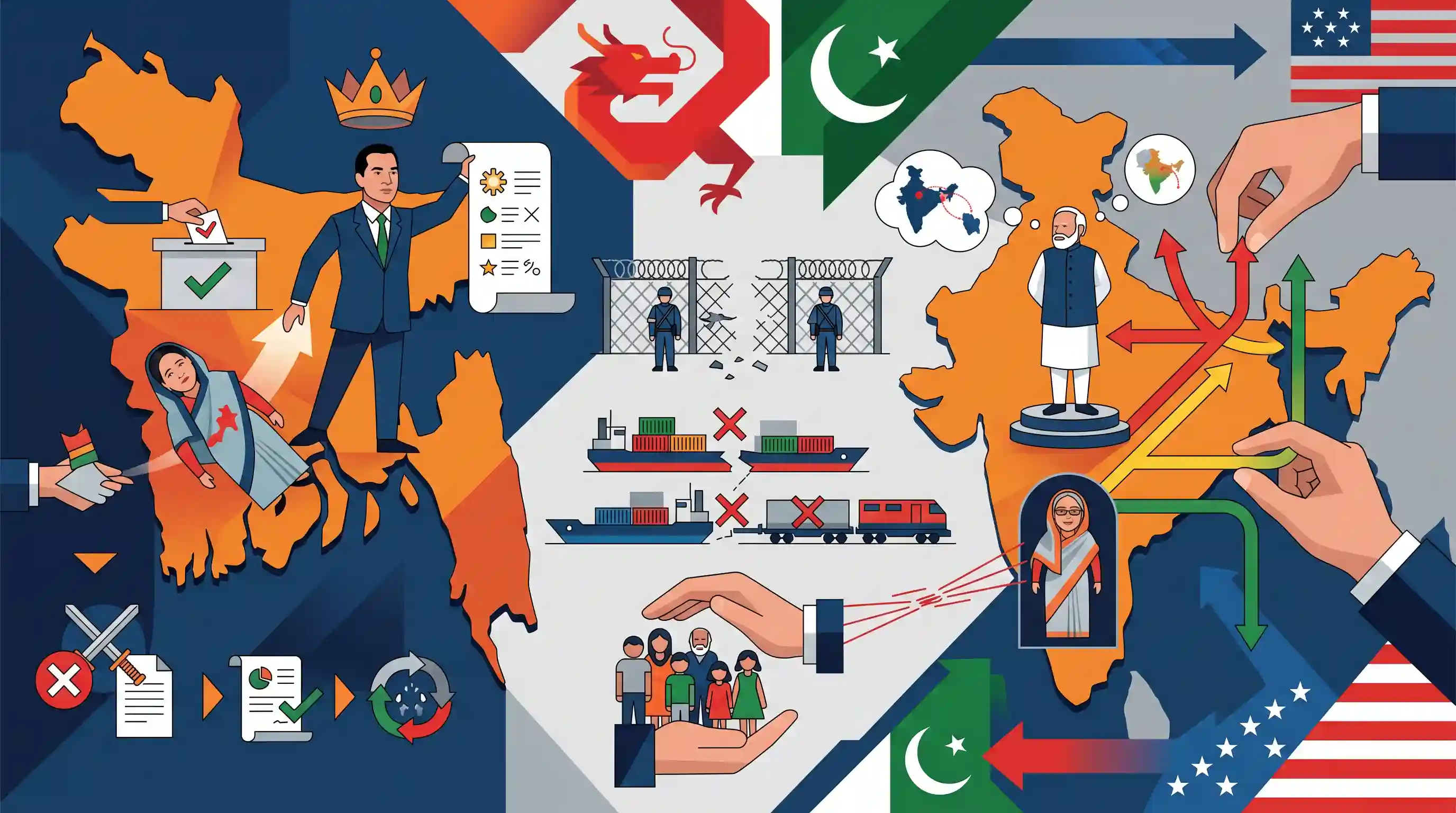
Why It Matters
The regime change in Bangladesh directly impacts India's security, regional connectivity initiatives, and the broader geopolitical stability of South Asia. It serves as a classic case study for adjusting foreign policy in response to domestic political upheavals in neighboring countries.
Summary
The editorial analyzes the decisive electoral mandate for the Bangladesh Nationalist Party (BNP) led by Tarique Rahman, marking a critical shift in Bangladesh's political landscape following the ouster of Sheikh Hasina's Awami League. The new government promises systemic reforms via a 'July Charter'. For India, this regime change necessitates a pragmatic recalibration of its 'Neighbourhood First' policy. New Delhi must engage the BNP leadership to address pressing bilateral issues, including border security, trade disruptions, minority safety, and the diplomatic friction surrounding Sheikh Hasina's exile in India, all while navigating a shifting geopolitical environment involving China, Pakistan, and the US.
Key Points
- The BNP and its allies secured a decisive electoral victory in Bangladesh, marking a clear rejection of the Awami League's legacy.
- Tarique Rahman has assumed the role of Prime Minister, promising systemic democratic reforms through a proposed 'July Charter'.
- India faces the diplomatic challenge of resetting its bilateral relationship with Bangladesh, moving beyond its historical reliance on Sheikh Hasina.
- Urgent bilateral issues to be navigated include the extradition of Sheikh Hasina, border management, trade stability, and the protection of minorities in Bangladesh.
- The regime change introduces new geopolitical dynamics in South Asia, as the new government may recalibrate its ties with China, Pakistan, and the United States.
Important Terms
Bangladesh Nationalist Party (BNP)

Founded in 1978, it is a major center-right party in Bangladesh advocating for 'Bangladeshi nationalism.' Led by Tarique Rahman, it secured a decisive two-thirds mandate in the 2026 general elections.
UPSC context
GS Paper 2 (International Relations) — tests India’s capacity to manage bilateral shifts and security cooperation with non-traditional partners.
Awami League
A center-left secular party in Bangladesh founded by Sheikh Mujibur Rahman. It maintained strong pro-India ties from 2009–2024 under Sheikh Hasina before being ousted by mass protests.
UPSC context
GS Paper 2 (International Relations) — examines the historical trajectory of India-Bangladesh ties and regime change impacts.
July Charter
A 2025 political accord between the interim government and 25+ parties proposing 80+ reforms to establish a 'Second Republic.' It seeks to prevent future authoritarianism via constitutional amendments and term limits.
UPSC context
GS Paper 2 (Governance/IR) — assesses understanding of constitutional transitions and democratic stability in South Asian neighbors.
Jamaat-e-Islami
Bangladesh's largest Islamist party, known for its right-wing ideology. After years of marginalization, it emerged as the main opposition in the 2026 elections, winning nearly 70 seats.
UPSC context
GS Paper 3 (Internal Security) — relevant for tracking cross-border extremism and minority safety in the neighborhood.
Neighbourhood First Policy
An Indian foreign policy framework prioritizing constructive engagement and mutual growth with immediate neighbors. The 2026 transition in Dhaka necessitates a pragmatic recalibration of this policy.
UPSC context
GS Paper 2 (International Relations) — a core theme evaluating India’s regional diplomacy and strategic stability.
Prelims Trap
The India-Bangladesh extradition treaty mandates the sharing of concrete evidence of the crime before an extradition can be processed.
The 2016 amendment to the treaty simplified the process by requiring only an arrest warrant from a competent court, removing the need for concrete evidence.
Static Concepts Connected
What are the key principles governing India's extradition treaties?
- Legal Framework: Regulated by the Extradition Act, 1962, with the Ministry of External Affairs acting as the central nodal authority.
- Dual Criminality: The act for which extradition is requested must be a punishable offence in both the requesting and the requested countries.
- Political Exception: Most treaties allow the requested state to refuse extradition if the crime is deemed a 'political offence' or lacks good faith.
What makes the 4,096 km India-Bangladesh border challenging to secure?
- Complex Geography: The boundary is highly porous, featuring dense mangrove forests, shifting riverine terrains, and densely populated settlements right up to the zero line.
- Transborder Crime: Socio-economic disparities drive organized transborder crimes, including cattle smuggling, human trafficking, and the circulation of Fake Indian Currency Notes (FICN).
- CIBMS Deployment: The Comprehensive Integrated Border Management System (CIBMS) is deployed to electronically secure riverine and vulnerable gaps where physical fencing is impossible.
Cross-Topic Patterns
Neighbourhood First & Northeast Security
Regime changes in Dhaka directly impact India's internal security in the Northeast. Past non-Awami tenures have historically seen increased sanctuary and logistical support for anti-India insurgent groups.
Extradition Law & Bilateral Diplomacy
The legal nuances of the 2016 Extradition Treaty amendment clash with diplomatic realities. India's decision on Sheikh Hasina links international law (extradition exceptions) with neighborhood geopolitics.

Extradition treaty exceptions (political offence), coupled with Bangladesh border management schemes like CIBMS, are high-probability for 2026.
Linked PYQs · 2
Linked PYQs · 2
- 2020MainsGS3
Analyze internal security threats and transborder crimes along Myanmar, Bangladesh and Pakistan borders including Line of Control (LoC). Also discuss the role played by various security forces in this regard.
- 2015MainsGS2
Project 'Mausam' is considered a unique foreign policy initiative of the Indian Government to improve relationship with its neighbours. Does the project have a strategic dimension? Discuss.
