India space observatory AstroSat completes ten years in orbit
Source:The Hindu ↗
Why It Matters
AstroSat represents a major milestone in India's space program, shifting ISRO's focus from Earth-observation/communication to deep-space astronomy. Understanding its payloads and multi-wavelength capabilities is important for Prelims, as directly evidenced by past questions, while its achievements contribute to Mains answers on India's capabilities in space science and technology.
Summary
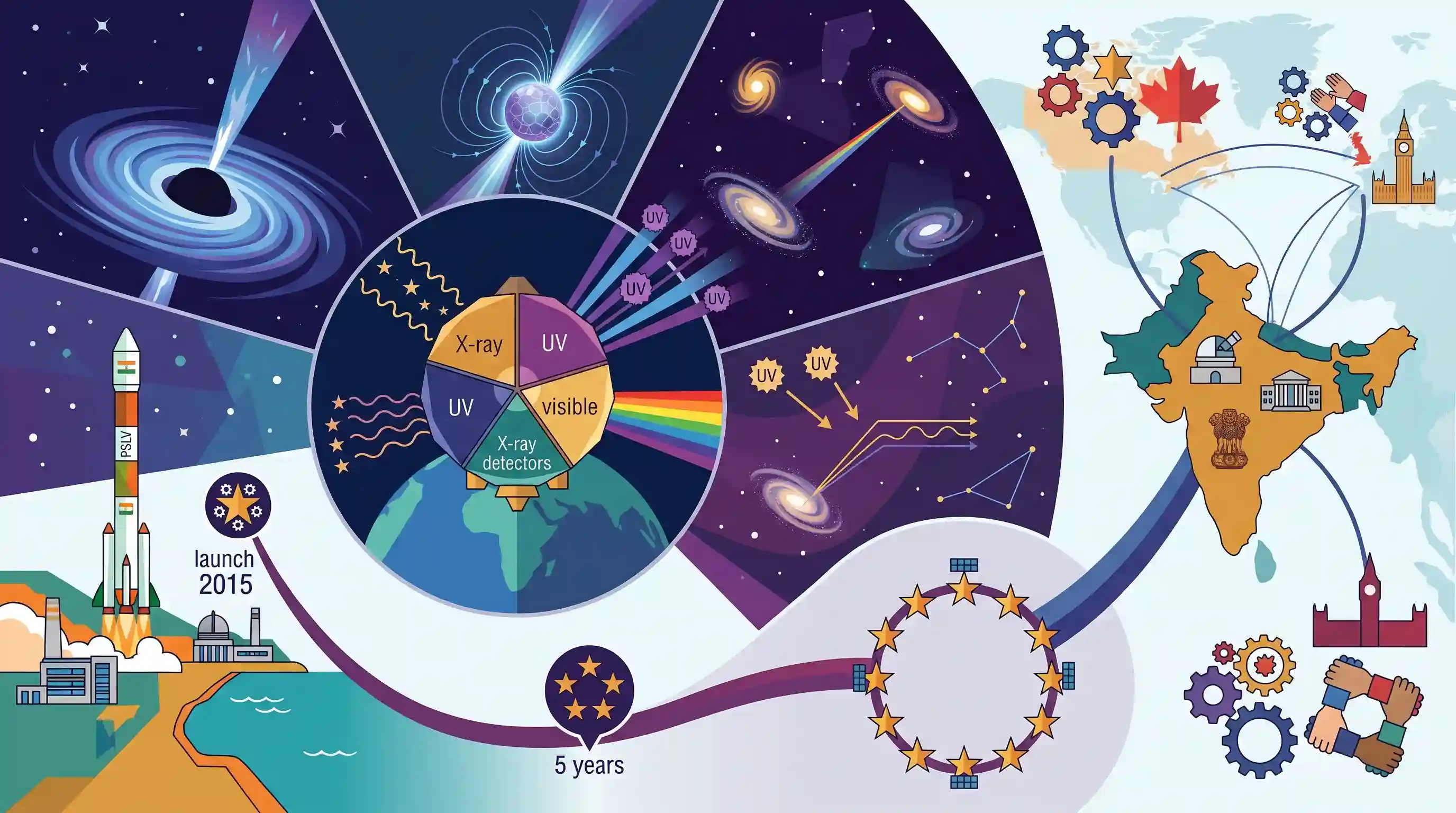
India's first dedicated multi-wavelength space astronomy observatory, AstroSat, has completed a decade in orbit, far surpassing its initial five-year mission life. Launched by ISRO on September 28, 2015, the satellite carries five scientific payloads designed to observe the universe across visible, ultraviolet, and X-ray spectra. Over the last 10 years, AstroSat has facilitated groundbreaking discoveries, including observing black holes, neutron stars, and detecting far-ultraviolet photons from distant galaxies. The mission represents a major collaborative success involving ISRO, premier Indian astronomy institutions such as IUCAA, TIFR, IIAP, and RRI, as well as international partners from Canada and the UK.
Key Points
- AstroSat, India's first dedicated multi-wavelength space astronomy observatory, has successfully completed 10 years of operations, exceeding its designed mission life of 5 years.
- Launched on September 28, 2015, by PSLV-C30, it is equipped with five scientific payloads: UVIT, LAXPC, CZTI, SXT, and SSM.
- The observatory allows simultaneous observations across Visible, Ultraviolet, and low/high energy X-ray regions of the electromagnetic spectrum.
- Major discoveries over the decade include the detection of far-ultraviolet photons from galaxies 9.3 billion light-years away, and extensive observations of black holes and neutron stars.
- The mission involved collaboration between ISRO and key Indian astronomy institutes (IUCAA, TIFR, IIAP, RRI), alongside institutions from Canada and the UK.
Important Terms
AstroSat Mission

India's first dedicated multi-wavelength space observatory launched in 2015. It simultaneously observes celestial sources in optical, ultraviolet, and X-ray bands to study black holes and galaxies.
UPSC context
GS Paper 3 (Science & Tech). Tests understanding of India’s space-based astronomical milestones and multi-wavelength capabilities.
ISRO (Indian Space Research Organisation)
India’s premier national space agency under the Department of Space. It spearheads indigenous technology development, satellite communication, and deep-space exploration missions like Chandrayaan and AstroSat.
UPSC context
GS Paper 3 (Science & Tech). Essential for questions on institutional frameworks and indigenous technological achievements.
IUCAA (Inter-University Centre for Astronomy and Astrophysics)
An autonomous institution in Pune under the University Grants Commission (UGC) established to promote research in astronomy and astrophysics within the Indian university sector.
UPSC context
GS Paper 3 (Science & Tech). Relevant to the role of autonomous research bodies in promoting higher education and research.
Tata Institute of Fundamental Research (TIFR)
A premier research institute in Mumbai under the Department of Atomic Energy. Founded by Homi J. Bhabha, it conducts advanced research in physics, biology, and mathematics.
UPSC context
GS Paper 3 (Science & Tech). Tests knowledge of India’s fundamental research ecosystem and contributions to international science.
Indian Institute of Astrophysics (IIA)
A Bengaluru-based autonomous research institute under the Department of Science and Technology. It specializes in solar and stellar astronomy and led AstroSat’s UVIT instrument development.
UPSC context
GS Paper 3 (Science & Tech). Tests awareness of India’s legacy in astronomy and specialized research institutions.
Raman Research Institute (RRI)
An autonomous research institute in Bengaluru founded by Sir C.V. Raman in 1948. It focuses on basic sciences, including astronomy, astrophysics, and theoretical physics.
UPSC context
GS Paper 3 (Science & Tech). Important for understanding the contribution of private-turned-autonomous labs to national research goals.
Prelims Trap
"AstroSat is designed to observe celestial objects across the entire electromagnetic spectrum."
AstroSat is a multi-wavelength observatory, but it does NOT cover the entire spectrum. It specifically observes only in Visible, Ultraviolet (UV), and X-ray bands, omitting Infrared and Radio waves.
Static Concepts Connected
Why are space-based observatories needed for UV and X-ray astronomy?
- Atmospheric Absorption: Earth's atmosphere absorbs and blocks most high-energy wavelengths, including Ultraviolet, X-rays, and Gamma rays, making accurate ground-based observation impossible.
- Multi-wavelength Advantage: Observing multiple bands (Visible, UV, X-ray) simultaneously allows scientists to study different physical processes of the same celestial event without atmospheric interference.
What are ISRO's major dedicated space observatory missions?
- AstroSat (2015): Multi-wavelength (Visible, UV, X-ray) observatory placed in Low Earth Orbit.
- Aditya-L1 (2023): India's first dedicated solar observatory, placed in a halo orbit around Lagrange point 1 (L1) to continuously study the solar atmosphere.
- XPoSat (2024): India's first dedicated polarimetry mission to study the dynamics of bright astronomical X-ray sources in extreme conditions.
Cross-Topic Patterns
Orbit selection for space observatories
UPSC frequently compares mission orbits. AstroSat sits in a Low Earth Orbit (650 km), contrasting with Aditya-L1 and the James Webb Space Telescope which use gravitationally stable Lagrange points (L1 and L2).
Multi-institutional mega-science projects
Like LIGO-India and INO, AstroSat relies heavily on premier domestic institutes (IUCAA, TIFR) and international partners, reflecting a shift from strictly indigenous ISRO launches to global mega-science collaborative frameworks.

Expect a 2026 Prelims question comparing AstroSat's target spectra and LEO orbit against newer ISRO observatories like XPoSat and Aditya-L1.
Linked PYQs · 2
Linked PYQs · 2
- 2016PrelimsGS1
With reference to 'Astrosat', the astronomical observatory launched by India, which of the following statements is/are correct? 1. Other than USA and Russia, India is the only country to have launched a similar observatory into space. 2. Astrosat is a 2000 kg satellite placed in an orbit at 1650 km above the surface of the Earth. Select the correct answer using the code given below.
- 2023MainsGS3
What is the main task of India's third moon mission which could not be achieved in its earlier mission? List the countries that have achieved this task. Introduce the subsystems in the spacecraft launched and explain the role of the Virtual Launch Control Centre' at the Vikram Sarabhai Space Centre which contributed to the successful launch from Sriharikota.
