Security operations dismantle Maoist strongholds in Chhattisgarh
Source:Indian Express ↗
Why It Matters
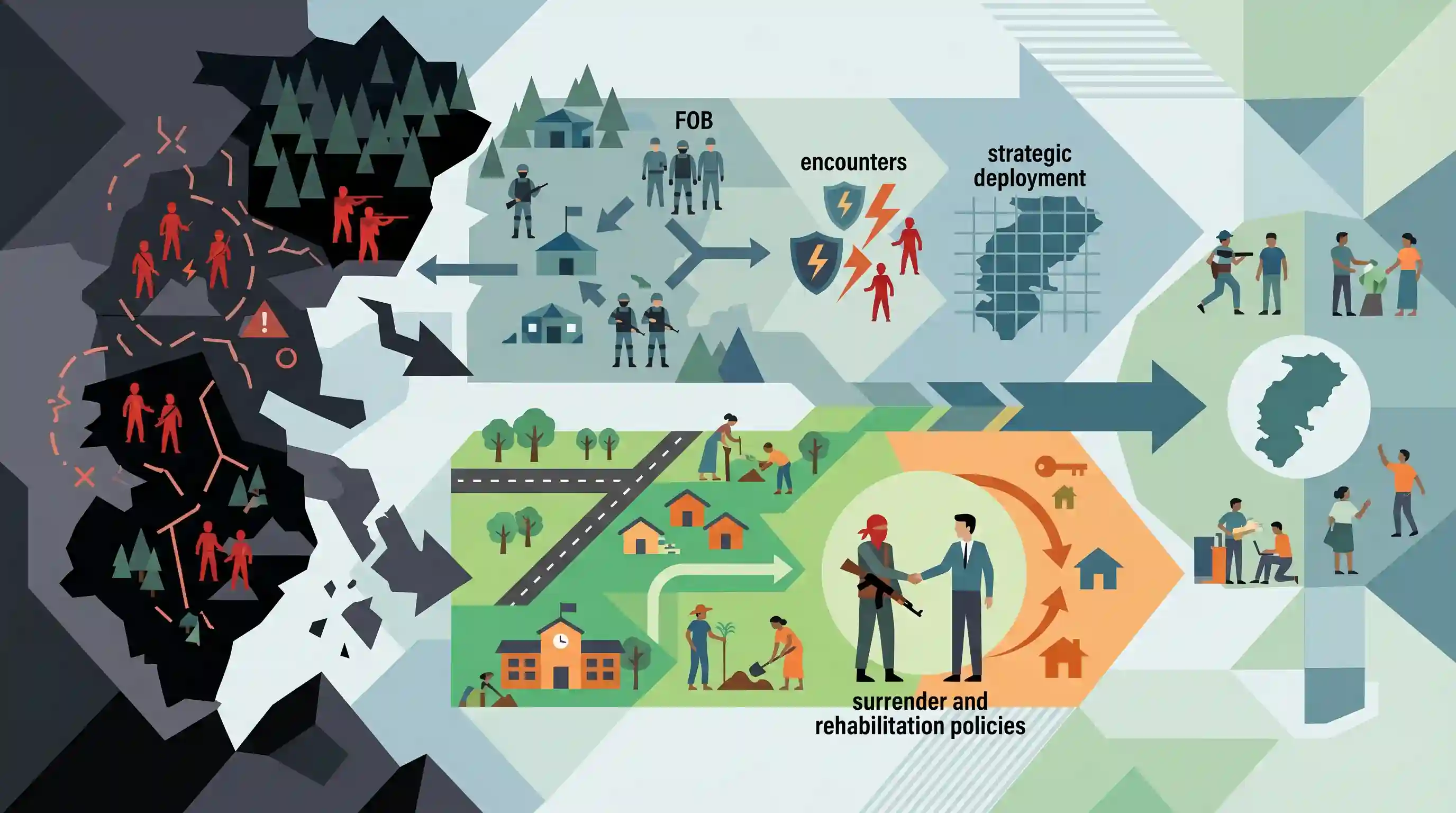
Left-wing extremism is consistently tested in the UPSC Mains GS3 paper. The recent successes in Chhattisgarh serve as a vital case study of the 'security-plus-development' paradigm, demonstrating how infrastructural reach, tactical kinetic operations, and rehabilitation policies work together to dismantle non-state armed actors.
Summary
Over the past two years, aggressive security operations, strategic deployment of Forward Operating Bases (FOBs), and effective surrender policies have effectively dismantled core Maoist strongholds in Chhattisgarh. Driven by a Union Home Ministry deadline to eliminate Left Wing Extremism by March 2026, security forces like the DRG and CRPF have ramped up encounters in remote regions such as Bastar and Abujhmad. Simultaneously, the state has promoted development-oriented rehabilitation and surrender schemes, showcasing a successful multi-pronged approach to neutralizing one of India's major internal security threats.
Key Points
- Significant reduction in Maoist strongholds in Chhattisgarh achieved through a two-year intensive anti-Naxal campaign.
- The Union Government established a firm deadline of March 2026 to completely eradicate Left Wing Extremism (LWE) across India.
- The success relies on a two-pronged strategy: aggressive security encounters by forces like the DRG and CRPF, and the rapid expansion of Forward Operating Bases (FOBs) in previously impenetrable zones.
- Parallel developmental and psychological efforts are driven by robust surrender-cum-rehabilitation schemes, actively incentivizing Maoist cadres to lay down arms and rejoin the mainstream.
Important Terms
Surrender-cum-Rehabilitation Scheme for Left Wing Extremists

A multi-pronged government strategy providing financial aid, vocational training, and immediate grants to Maoist cadres who abjure violence, facilitating their reintegration into mainstream society.
UPSC context
GS Paper III (Internal Security); tests understanding of non-kinetic approaches to conflict resolution and the 'mainstreaming' of insurgents.
SAMADHAN doctrine
A comprehensive counter-insurgency framework (Smart leadership, Aggressive strategy, Motivation, Actionable intelligence, Dashboard-based KPIs, Harnessing technology, Action plans, No financing) launched in 2017 to eliminate Left Wing Extremism.
UPSC context
GS Paper III (Internal Security); essential for answers on government strategies and the multi-dimensional nature of tackling Naxalism.
District Reserve Guard (DRG)
A specialized unit of the Chhattisgarh Police primarily composed of local tribal youth and surrendered Maoists, utilized for their superior knowledge of terrain and local intelligence.
UPSC context
GS Paper III (Internal Security); tests knowledge of state-specific forces and the 'son of the soil' tactical approach in counter-insurgency.
Communist Party of India (Maoist)
A banned far-left militant organization formed in 2004 that seeks to overthrow the Indian state through armed rebellion; it is the primary entity behind the Maoist insurgency.
UPSC context
GS Paper III (Internal Security); basic identification of non-state actors and ideological threats to national security.
Forward Operating Bases (FOBs)
Strategically located security camps established in deep forested Maoist strongholds to restrict insurgent mobility, provide a permanent security presence, and facilitate civilian development projects.
UPSC context
GS Paper III (Internal Security); crucial for explaining the 'Clear, Hold, Build' strategy and tactical area domination in LWE regions.
Central Reserve Police Force (CRPF)
India's largest paramilitary force, serving as the lead agency for anti-Naxal operations with specialized wings like CoBRA (Commando Battalion for Resolute Action) for jungle warfare.
UPSC context
GS Paper III (Internal Security); tests knowledge of the mandate and roles of various Central Armed Police Forces (CAPFs).
Prelims Trap
Anti-Naxal operations and surrender schemes are exclusively funded and implemented by the Union Ministry of Home Affairs.
Police and Public Order are State subjects. The Centre supplements State efforts via CAPF deployments and partial funding through the Security Related Expenditure (SRE) scheme, but states lead operations.
Static Concepts Connected
What are the core pillars of the SAMADHAN doctrine for tackling LWE?
- Smart Leadership: Smart, proactive, and visionary leadership at all levels of security forces.
- Aggressive Strategy: Aggressive operations coupled with motivated and well-trained security personnel.
- Intelligence & Tech: Actionable intelligence sharing, harnessing technology (UAVs, trackers), and choking terror financing networks.
- Metrics & Planning: Dashboard-based Key Performance Indicators (KPIs) and creating specific action plans for different operational theatres.
What is the 'Clear, Hold, and Build' strategy in counter-insurgency?
- Clear: Security forces actively engage and neutralize insurgents to clear a specific territory of their presence.
- Hold: Establishing Forward Operating Bases (FOBs) and fortified camps to prevent insurgents from returning to the cleared zones.
- Build: Initiating rapid developmental works like roads, mobile towers, and administrative services to win local trust and fill the vacuum.
Cross-Topic Patterns
Tribal Rights (PESA/FRA) & Internal Security
The success of LWE eradication relies heavily on implementing PESA and the Forest Rights Act (FRA 2006) to address the core tribal alienation that historically fueled the Maoist movement.
Topography's role in security vacuums
Geography directly dictates security strategy; the 'Clear, Hold, Build' approach via Forward Operating Bases addresses the administrative vacuum historically created by dense, unmapped forests like Abujhmad.

GS-3 Mains: Evaluate 'Clear, Hold, Build' strategy and SAMADHAN doctrine's efficacy in meeting the March 2026 LWE-free target.
Linked PYQs · 4
Linked PYQs · 4
- 2022MainsGS3
Naxalism is a social, economic and developmental issue manifesting as a violent internal security threat. In this context, discuss the emerging issues and suggest a multilayered strategy to tackle the menace of Naxalism.
- 2020MainsGS3
What are the determinants of left-wing extremism in Eastern part of India? What strategy should Government of India, civil administration and security forces adopt to counter the threat in the affected areas?
- 2015MainsGS3
The persisting drives of the Government for development of large industries in backward areas have resulted in isolating the tribal population and the farmers who face multiple displacements. With Malkangiri and Naxalbari foci, discuss the corrective strategies needed to win the Left Wing Extremism (LWE) doctrine affected citizens back into the mainstream of social and economic growth.
- 2021MainsGS3
Analyse the multidimensional challenges posed by external state and non-state actors, to the internal security of India. Also discuss measures required to be taken to combat these threats.
