Himalayan Ecological Fragility and Infrastructure Risks
Source:The Hindu ↗
Why It Matters
The ecological fragility of the Himalayas and the disasters resulting from poorly planned infrastructure are recurring themes in UPSC Mains (both GS1 Geography and GS3 Disaster Management/Environment). The article underscores the importance of 'carrying capacity' and 'hazard zonation'—both of which have been direct PYQ topics.
Summary
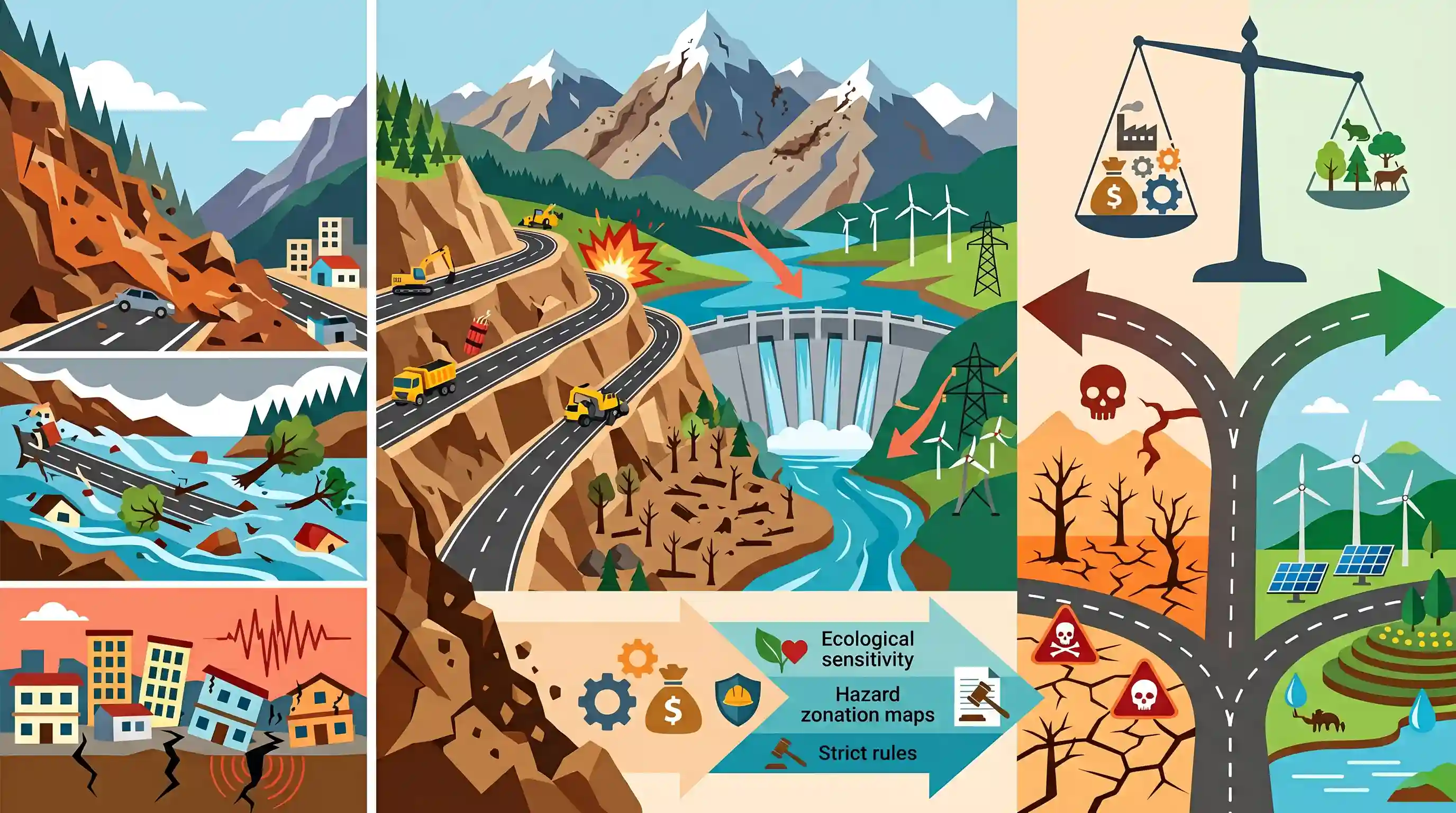
The article discusses the severe ecological and environmental degradation occurring in the Himalayan region due to rapid and unscientific infrastructure development. Projects like extensive road widening (Char Dham Pariyojana) and the construction of hydroelectric dams in this seismically active zone have ignored the region's limited carrying capacity. This anthropogenic pressure is resulting in a high frequency of disasters, including devastating landslides, flash floods, and land subsidence, as seen recently in places like Joshimath. The author warns of an impending 'Himalayan ecocide' and calls for an urgent policy shift that prioritizes ecological sensitivity, strict hazard zonation, and sustainable development over unchecked commercial and infrastructural expansion.
Key Points
- Unchecked infrastructural expansion, including massive road widening and hydroelectric projects, is exacerbating ecological degradation in the fragile Himalayan ecosystem.
- The critical concept of 'carrying capacity' is routinely bypassed by policymakers, leading to the overburdening of seismically active and ecologically sensitive mountainous terrains.
- Anthropogenic interference is directly linked to the increasing frequency of human-made disasters, such as landslides, flash floods, and land subsidence (e.g., in Joshimath).
- Preventing a complete 'ecocide' requires an urgent shift towards sustainable development, strict enforcement of hazard zonation mapping, and the re-evaluation of mega-infrastructure projects.
Important Terms
Ecocide

The widespread or long-term destruction of ecosystems caused by human activity. In the Himalayas, it refers to ecological collapse driven by unscientific infrastructure development and climate change.
UPSC context
GS Paper 3 (Environment/Disaster Management); tests awareness of evolving environmental jurisprudence and threats to fragile ecosystems.
Char Dham Pariyojana
A ~900 km road-widening project connecting four Himalayan shrines in Uttarakhand. It faces scrutiny for bypassing environmental assessments and causing ecological damage despite its strategic and religious importance.
UPSC context
GS Paper 3 (Infrastructure); tests understanding of development vs. conservation trade-offs in sensitive zones.
Environmental Impact Assessment (EIA)
A statutory process evaluating the environmental consequences of proposed projects. For Char Dham, critics allege the project was split into smaller segments to evade mandatory EIA requirements.
UPSC context
GS Paper 3 (Environment); a core syllabus topic for testing regulatory frameworks for sustainable development.
High Powered Committee (HPC)
A Supreme Court-appointed body, such as the Ravi Chopra committee, tasked with studying the cumulative environmental impacts of massive infrastructure projects and recommending mitigation strategies.
UPSC context
GS Paper 2 (Judiciary); examines judicial oversight and executive accountability in environmental governance.
National Green Tribunal (NGT)
A specialized judicial body that provides speedy justice in environmental cases. It monitors unregulated tourism and infrastructure development to ensure compliance with the Environment (Protection) Act.
UPSC context
GS Paper 2 (Statutory Bodies); tests knowledge of institutional mechanisms for environmental justice and protection.
National Landslide Risk Management Strategy
A policy framework for hazard zonation mapping, early warning systems, and capacity building to reduce landslide vulnerability, specifically in India's highly prone Himalayan regions.
UPSC context
GS Paper 3 (Disaster Management); tests strategies for managing geological hazards and mountain-specific vulnerabilities.
Prelims Trap
"Himalayan towns like Joshimath are built on solid tectonic bedrock, making subsidence primarily a result of groundwater extraction."
Joshimath is actually situated on an ancient, unconsolidated landslide moraine (debris and loose rock), not solid bedrock, making it extremely vulnerable to subsidence.
Static Concepts Connected
What is the "Angle of Repose" in the context of Himalayan landslides?
- Definition: The steepest natural angle of descent relative to the horizontal plane at which loose earth or rock material remains stable without slumping.
- Infrastructure impact: Massive road widening involves vertical hill-cutting, which severely violates this natural angle and removes critical base support from the slope.
- Landslide trigger: Once the angle is breached, any additional stress like heavy rainfall, deforestation, or seismic tremors triggers devastating slope failures.
How does "muck dumping" from hydroelectric projects exacerbate Himalayan flash floods?
- Indiscriminate disposal: Excavated debris from dam tunnels and road construction is often indiscriminately disposed of directly into or along mountainous riverbeds.
- Riverbed elevation: The dumped muck artificially elevates the riverbed level, which drastically reduces the natural water-carrying capacity of the river channel.
- Flood amplification: Because the channel capacity is reduced, even moderate seasonal rainfall causes the river to overflow, amplifying artificial flash floods downstream.
Cross-Topic Patterns
Eco-Sensitive Zones: Himalayas vs Western Ghats
UPSC often tests comparative ecology. The Western Ghats have defined protection frameworks (Gadgil/Kasturirangan), whereas the Himalayas still lack comprehensive, legally enforced 'carrying capacity' limits for infrastructure.
EIA Exemptions vs Border Infrastructure
Projects like Char Dham expose the tension between strategic border infrastructure (which often bypasses stringent Environmental Impact Assessments) and the acute vulnerability of high-seismic Himalayan zones.

Expect a GS-3 Mains or Prelims question interlinking carrying capacity, unconsolidated moraines, and hydro-power muck dumping.
Linked PYQs · 5
Linked PYQs · 5
- 2019MainsGS3
Define the concept of carrying capacity of an ecosystem as relevant to an environment. Explain how understanding this concept is vital while planning for sustainable development of a region.
- 2021MainsGS3
Describe the various causes and the effects of landslides. Mention the important components of the National Landslide Risk Management Strategy.
- 2019MainsGS3
Disaster preparedness is the first step in any disaster management process. Explain how hazard zonation mapping will help disaster mitigation in the case of landslides.
- 2021MainsGS1
Differentiate the causes of landslides in the Himalayan region and Western Ghats.
- 2016MainsGS1
The Himalayas are highly prone to landslides. Discuss the causes and suggest suitable measures of mitigation.
