Supreme Court Bench Architecture and Jurisprudential Consistency
Source:The Hindu ↗
આ શા માટે મહત્વનું છે
It addresses a core institutional and structural malaise in India's highest court, directly affecting judicial accountability, legal certainty, and the rule of law.
સારાંશ
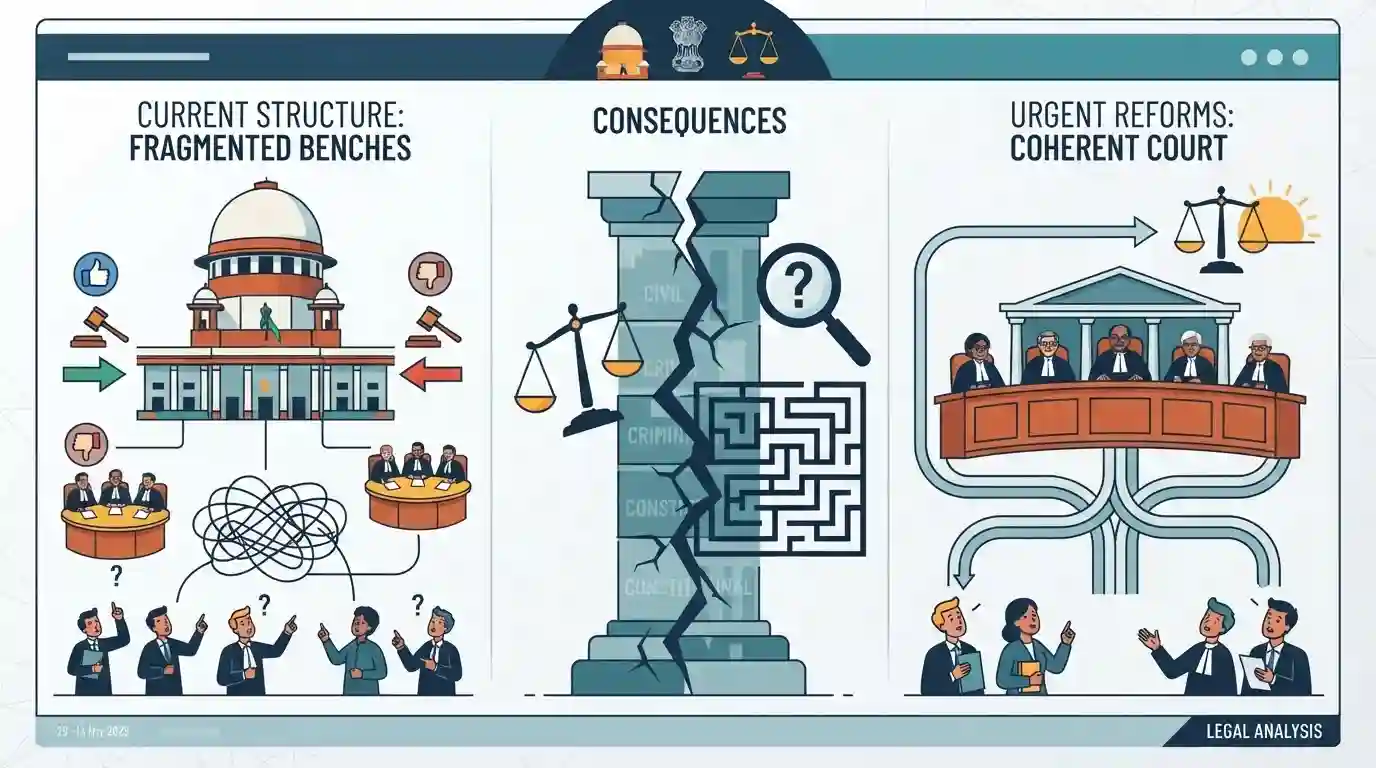
The article examines how the structural architecture of the Supreme Court of India—operating predominantly through small, divided benches—results in jurisprudential inconsistencies and internal contradictions, urging structural reforms to restore institutional coherence.
મુખ્ય મુદ્દા
- The Supreme Court of India faces structural and institutional challenges due to its architecture of sitting in multiple smaller benches (divisional benches) rather than as a unified full court, leading to conflicting judgments and judicial fragmentation.
- The reliance on small benches creates internal contradictions in jurisprudence, undermining legal certainty and predictability for lower courts and citizens.
- Reforming court management, instituting national court of appeal structures, or adopting larger bench configurations for important constitutional questions are proposed to address institutional coherence.
મહત્વપૂર્ણ શબ્દો
Constitution Bench

A mandatory provision under Article 145(3) of the Indian Constitution requiring a minimum of five judges to hear cases involving substantial questions of law regarding constitutional interpretation.
UPSC context
UPSC Prelims/Mains (GS-II): Tests understanding of judicial structures, constitutional interpretation thresholds, and Supreme Court functioning under Article 145.
Law Commission 229th Report
A 2009 recommendation by the Law Commission proposing a dedicated Delhi bench for constitutional matters and regional Cassation Benches for appeals, aiming to resolve backlog and fragmentation.
UPSC context
UPSC Mains (GS-II): Important for structural judicial reforms, tribunal/court restructuring, and recommendations of institutional bodies.
Master of the Roster
The administrative authority of the Chief Justice of India to assign cases and constitute benches, which is currently a focal point for debates on judicial transparency and institutional coherence.
UPSC context
UPSC Mains (GS-II): Core component of Indian Judiciary topics, testing judicial accountability, administrative powers of the CJI, and transparency.
પ્રિલિમ્સ ટ્રેપ
Constitution of India mandates a 13-judge bench for all constitutional amendments.
Aspirants often assume that a 13-judge bench is constitutionally mandated for amending the Constitution, whereas the 13-judge bench in Kesavananda Bharati was convened to test the limits of the amending power under the Basic Structure Doctrine.
સંલગ્ન સ્થિર ખ્યાલો
What are the constitutional provisions governing the constitution of benches and interpretation of the Constitution in the Supreme Court?
- Constitution Bench: Article 145(3) mandates a minimum of five judges for any case involving a substantial question of law as to the interpretation of the Constitution.
- Master of Roster: The Chief Justice of India acts as the Master of the Roster, holding exclusive administrative authority to allocate cases and constitute benches.
- Complete Justice: Article 142 grants the Supreme Court plenary power to pass any decree or order necessary for doing complete justice in any pending cause or matter.
આંતર-વિષય પેટર્ન
Judicial Fragmentation vs. Rule of Law
Judicial fragmentation and conflicting bench rulings directly undermine the Rule of Law and Legal Certainty, core tenets evaluated under General Studies Paper II's governance and judicial oversight themes.

Article 145(3) constitutional bench thresholds + Law Commission recommendations are prime material for a GS-II structural reform question.
સંલગ્ન PYQ · 2
સંલગ્ન PYQ · 2
- 2025MainsGS2
Discuss the evolution of collegium system in India. Critically examine the advantages and disadvantages of the system of appointment of the Judges of the Supreme Court of India and that of the USA.
- 2014PrelimsGS1
The power of the Supreme Court of India to decide disputes between the Centre and the States falls under its
