Historical Confrontation Reshapes Election Commission Autonomy
Source:Indian Express ↗
ఇది ఎందుకు ముఖ్యం
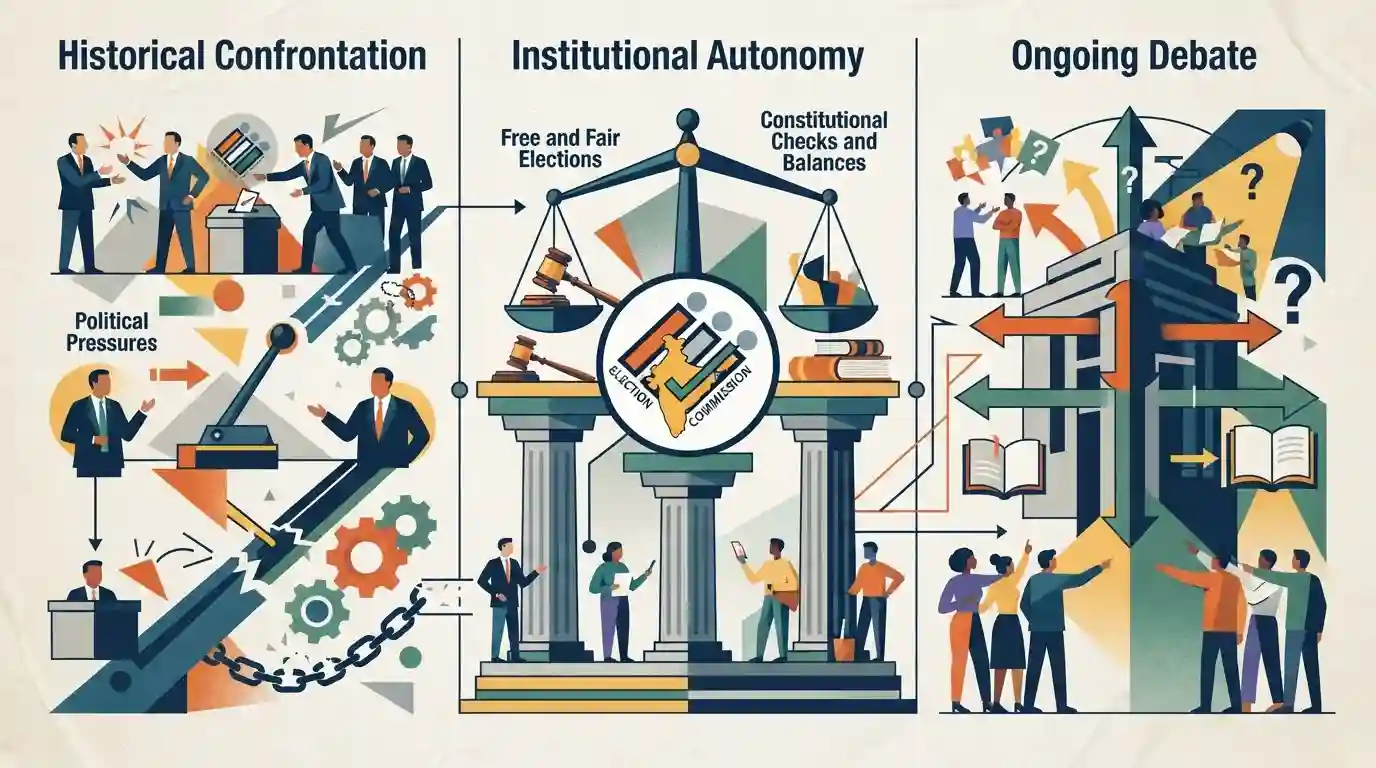
Crucial for understanding the evolution, autonomy, and challenges facing vital constitutional bodies like the Election Commission of India in upholding free and fair elections.
సారాంశం
The article analyses the historical confrontation that reshaped the Election Commission of India, focusing on institutional autonomy, constitutional checks and balances, and the ongoing debate over the independence of election management bodies.
ముఖ్య అంశాలు
- The article discusses the historical confrontation that shaped the institutional evolution and autonomy of the Election Commission of India (ECI).
- It examines the dynamic balance of power between constitutional bodies, institutional integrity, and the independence of election management bodies in India.
- Highlights the significance of judicial oversight and executive-legislative dynamics in preserving democratic institutions.
ముఖ్యమైన పదాలు
Constitution of India

The supreme law of India that establishes the structural framework, fundamental rights, directive principles, and duties of government organs, ensuring constitutional checks and balances across all institutions.
UPSC context
UPSC GS Paper II: Indian Constitution—historical underpinnings, evolution, features, amendments, significant provisions, and basic structure.
Election Commission of India
An autonomous constitutional authority established under Article 324 to ensure free and fair elections to Parliament, State Legislatures, and the offices of the President and Vice-President of India.
UPSC context
UPSC GS Paper II: Structure, organization, and functioning of Constitutional Bodies and issues relating to institutional autonomy.
Supreme Court of India
The apex judicial tribunal and final arbiter of the Constitution of India, tasked with judicial review, protecting fundamental rights, and upholding the separation of powers.
UPSC context
UPSC GS Paper II: Judiciary, judicial review, structure and functioning, and its role in maintaining constitutional checks and balances.
ప్రిలిమ్స్ ఉచ్చు
Other Election Commissioners can be removed by the President on the same grounds and manner as a Supreme Court judge without any precondition.
Aspirants often believe other Election Commissioners can be removed by the President directly on the PM's advice, forgetting the constitutional safeguard requiring the CEC's specific recommendation.
అనుసంధానమైన స్థిర భావనలు
What are the constitutional provisions regarding the composition, tenure, and removal of the Election Commission of India?
- Constitutional Basis: Article 324 provides for an Election Commission consisting of the Chief Election Commissioner and such number of other Commissioners as the President may fix.
- Tenure Details: The CEC and Election Commissioners hold office for a term of 6 years or until they attain the age of 65 years, whichever is earlier.
- Removal Safeguard: CEC can be removed only through impeachment (proved misbehavior or incapacity) like a Supreme Court judge; other Commissioners require the CEC's recommendation.
అంతర-అంశ నమూనాలు
ECI autonomy vs. Judicial Appointments (Collegium)
The debate over Election Commission appointments mirrors broader executive-legislative frictions seen in the appointment of judicial officers via the Collegium system.
Article 324 Plenary Powers & Article 142
Plenary powers under Article 324 parallel the residuary powers of constitutional bodies to step into legislative vacuums under Article 142.

Expect a statement-based question combining Article 324 removal procedures with recent changes to the ECI appointment panel act.
అనుసంధాన PYQలు · 1
అనుసంధాన PYQలు · 1
- 2022MainsGS2
Discuss the role of the Election Commission of India in the light of the evolution of the Model Code of Conduct.
