Constitutional Provisions for Non-Legislator Chief Ministers
Source:Indian Express ↗
Why It Matters
The constitutional provisions governing the appointment of Chief Ministers and Prime Ministers without prior legislative membership are highly tested topics in both UPSC Prelims (Polity) and Mains (GS2 Governance & Constitution). Familiarity with landmark SC rulings prevents candidates from making conceptual errors regarding executive-legislative accountability.
Summary
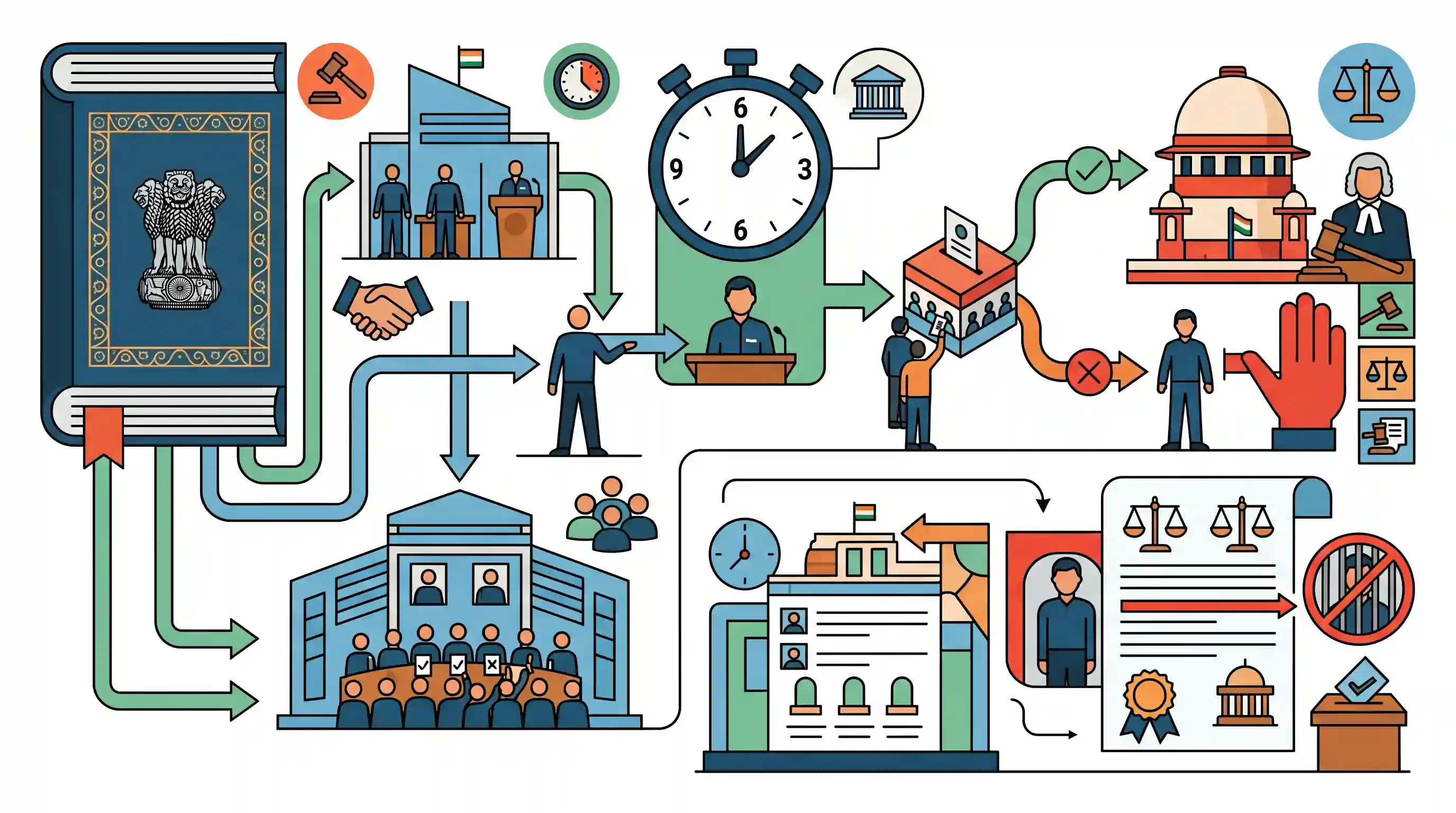
The article explores the legal and constitutional position of appointing a non-legislator as a Chief Minister or Minister. Under Article 164(4) of the Indian Constitution, an individual can hold a ministerial office without being a member of the State Legislature for up to six consecutive months. The Supreme Court of India has consistently upheld this provision, interpreting it as a necessary but temporary democratic exception. Key judgments, including Har Sharan Verma v. Tribhuvan Narain Singh and S.R. Chaudhuri v. State of Punjab, have clarified the boundaries of this provision, stipulating that a minister failing to win an election within six months cannot be consecutively reappointed. Additionally, individuals facing electoral disqualification under the Representation of the People Act, 1951, are barred from utilizing this route to assume power.
Key Points
- Article 164(4) of the Constitution allows a non-legislator to serve as a Chief Minister or state minister for six consecutive months, after which they must secure a legislative seat.
- The Supreme Court upheld the constitutional validity of appointing non-legislators to top executive posts in rulings like Har Sharan Verma v. Tribhuvan Narain Singh and S.P. Anand v. H.D. Deve Gowda.
- In S.R. Chaudhuri v. State of Punjab (2001), the Supreme Court ruled that the six-month grace period cannot be bypassed by resigning and being reappointed without getting elected.
- A person disqualified from contesting elections under the Representation of the People Act, 1951, cannot be appointed as a Chief Minister, as established in the B.R. Kapur v. State of Tamil Nadu case.
Important Terms
Article 164(4)

A constitutional provision allowing an individual to hold a State ministerial office for six consecutive months without being a member of the State Legislature. Membership must be secured within this timeframe.
UPSC context
GS Paper II (Polity); tests knowledge of State Executive appointments and safeguards against misuse of ministerial power.
S.R. Chaudhuri v. State of Punjab
A landmark 2001 Supreme Court ruling that prohibited the consecutive reappointment of a non-legislator as a Minister to bypass the six-month limit, declaring it a 'fraud on the Constitution'.
UPSC context
GS Paper II (Judiciary); tests understanding of judicial checks on executive bypasses of constitutional mandates.
Article 75(5)
The central government equivalent of Article 164(4), permitting a person to serve as a Union Minister for six months without being a Member of Parliament.
UPSC context
GS Paper II (Polity); essential for understanding Union Executive procedures and ministerial accountability to Parliament.
Representation of the People Act, 1951
The primary legislation governing Indian elections. Section 8 disqualifies convicted persons from holding office, preventing them from utilizing constitutional grace periods to assume power if legally barred.
UPSC context
GS Paper II (Elections); crucial for topics on disqualification of representatives and maintaining democratic integrity.
Har Sharan Verma v. Tribhuvan Narain Singh
A 1971 Supreme Court judgment that first upheld the validity of appointing a non-legislator as Chief Minister, provided they join the legislature within six months.
UPSC context
GS Paper II (State Executive); relevant for historical precedents regarding the eligibility and appointment of the Chief Minister.
Prelims Trap
A non-legislator can be re-appointed as a Minister for a second six-month term if they resign before the first term expires.
The SC in S.R. Chaudhuri (2001) expressly forbade this, ruling that the six-month grace period under Article 164(4) cannot be bypassed through consecutive reappointment without winning an election.
Static Concepts Connected
What are the constitutional provisions for non-legislator ministers?
- Union level: Article 75(5) permits a non-MP to be a Union Minister for six consecutive months without a seat.
- State level: Article 164(4) mirrors this for States, allowing a non-MLA/MLC to serve as Minister or Chief Minister for six months.
- Eligibility requirement: A person appointed must be qualified to become a member (e.g., age 25 for Assembly, 30 for Council), not just a registered voter.
How do RPA and Anti-Defection laws restrict ministerial appointments?
- RPA Convictions: Disqualification under RPA 1951 (e.g., criminal conviction >= 2 years) completely bars an individual from being appointed as a Minister/CM (B.R. Kapur case).
- Defection Bar: Under Article 164(1B) added by the 91st Amendment, a legislator disqualified under the Tenth Schedule cannot be appointed as a Minister until re-elected.
Cross-Topic Patterns
Constitutional Appointments + RPA 1951
Links discretionary executive appointments directly to statutory electoral laws, showing that constitutional grace periods (Art 164) are strictly subordinate to RPA 1951 eligibility criteria.
Anti-Defection + Ministerial Posts
Connects the Article 164(4) provision to the Anti-Defection Law (Schedule X), where the 91st Amendment explicitly prevents disqualified defectors from utilizing the non-legislator route to become ministers.

Expect a Prelims question combining Article 164(4) six-month bounds with RPA 1951 disqualifications and the 91st Amendment.
Linked PYQs · 3
Linked PYQs · 3
- 2012PrelimsGS1
The Prime Minister of India, at the time of his/her appointment
- 2020PrelimsGS1
Consider the following statements: 1. According to the Constitution of India, a person who is eligible to vote can be made a minister in a State for six months even if he/she is not a member of the Legislature of that State. 2. According to the Representation of People Act, 1951, a person convicted of a criminal offence and sentenced to imprisonment for five years is permanently disqualified from contesting an election even after his release from prison. Which of the statements given above is/are correct?
- 2022MainsGS2
Discuss the procedures to decide the disputes arising out of the election of a Member of the Parliament or State Legislature under The Representation of the People Act, 1951. What are the grounds on which the election of any returned candidate may be declared void ? What remedy is available to the aggrieved party against the decision ? Refer to the case laws.
