India Economic Stakes in Kimberley Process Reforms
Source:The Hindu ↗
Why It Matters
The Kimberley Process highlights the intersection of international trade, ethics, and domestic economic interests. India's near-monopoly on diamond polishing makes it highly vulnerable to global regulatory changes. Understanding how India can shape multilateral regimes to protect its domestic manufacturing sector while promoting ethical global standards is highly relevant for GS2 (Global Groupings and Agreements) and GS3 (Industrial Policy and Employment).
Summary
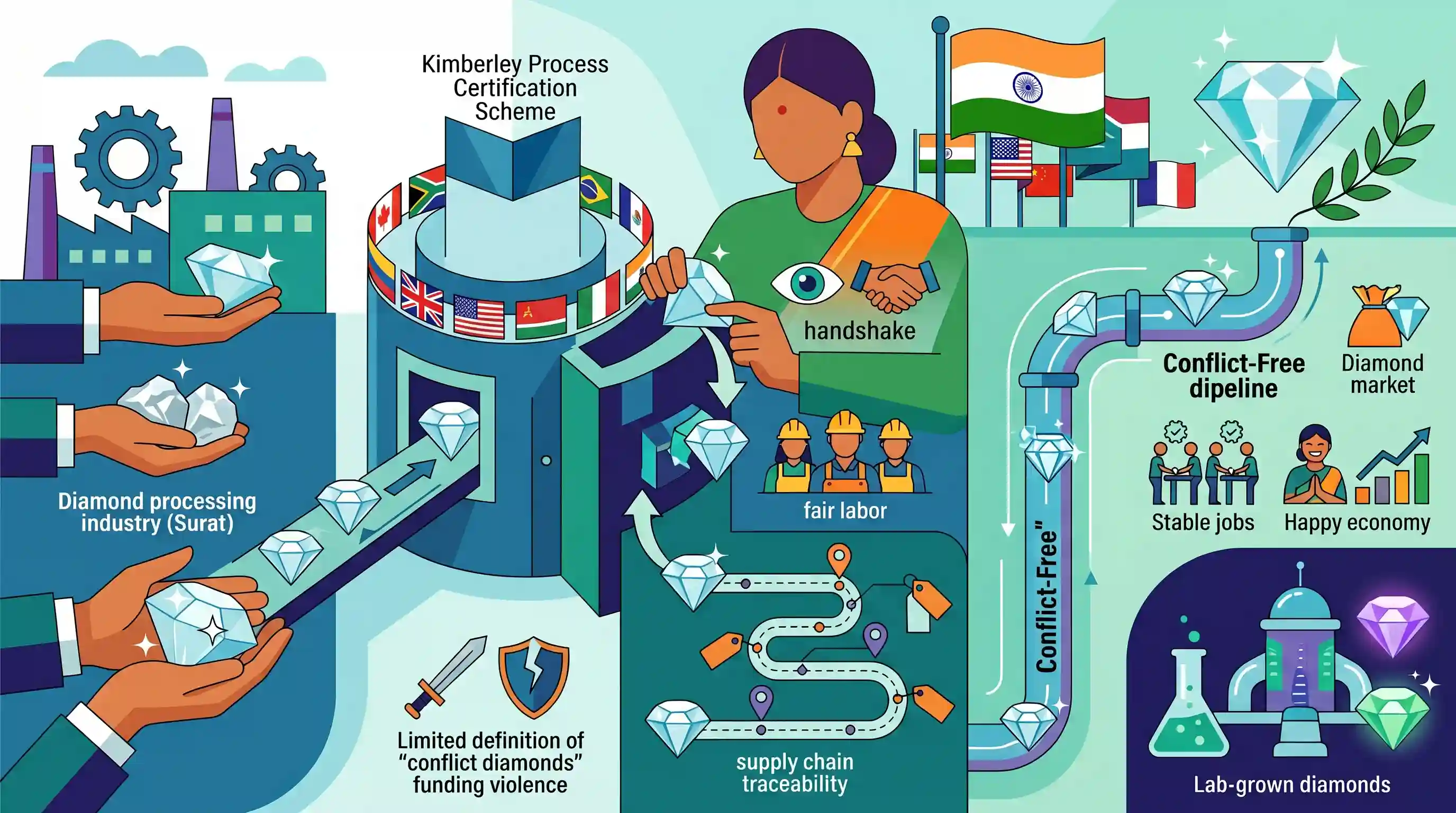
The article examines India's opportunity to lead reforms within the Kimberley Process Certification Scheme (KPCS), the global multilateral regime designed to prevent the trade of conflict diamonds. Given that India processes the vast majority of the world's rough diamonds, its domestic economy and employment—particularly in hubs like Surat—are closely tied to the integrity of the global diamond trade. By advocating for an expanded definition of conflict diamonds that addresses broader human rights abuses, and by improving supply-chain traceability, India can safeguard its diamond industry against reputational risks and the competitive pressure of lab-grown diamonds. Such proactive measures would also bolster India's standing as a responsible leader in international trade governance.
Key Points
- The Kimberley Process Certification Scheme (KPCS) is a multilateral framework established to eliminate the international trade of 'blood diamonds' that are used to finance rebel conflicts.
- As the hub that cuts and polishes over 90% of the world's rough diamonds, India has massive economic stakes in the global diamond supply chain and the integrity of the KPCS.
- India has a strategic opportunity to leverage its leadership role in the Kimberley Process to advocate for crucial reforms, such as expanding the narrow definition of 'conflict diamonds' to include human rights abuses and state-sponsored violence.
- Championing better traceability, ethical sourcing standards, and addressing the integration of lab-grown synthetic diamonds will protect India's domestic diamond manufacturing sector and align with changing global consumer preferences.
- Reforming the KPCS allows India to demonstrate proactive leadership in shaping multilateral trade regimes and global economic governance.
Important Terms
Kimberley Process (KP)

A multilateral trade regime established in 2003 to prevent 'conflict diamonds' from entering the mainstream rough diamond market through a tripartite partnership of governments, industry, and civil society.
UPSC context
Relevant for GS Paper II (International Institutions) and GS Paper III (Economy/Supply Chain), testing knowledge of global trade governance and ethical sourcing.
Kimberley Process Certification Scheme (KPCS)
The operational mechanism of the Kimberley Process requiring every shipment of rough diamonds to be accompanied by a government-validated certificate guaranteeing the stones are conflict-free.
UPSC context
Key for GS Paper III (Industrial Policy and External Sector), focusing on regulatory frameworks and India's compliance in the diamond value chain.
Conflict Diamonds
Rough diamonds used by rebel movements or their allies to finance armed conflicts aimed at undermining legitimate governments, specifically defined by the UN to exclude state-led human rights abuses.
UPSC context
Tested in GS Paper II (International Relations) and GS Paper IV (Ethics), regarding the definition's limitations and humanitarian impacts of global trade.
World Diamond Council (WDC)
A non-profit trade association representing the global diamond industry; it holds 'Observer' status in the Kimberley Process and provides technical expertise for the certification scheme.
UPSC context
Relevant for GS Paper II (Global Governance), highlighting the role of non-state actors and industry bodies in multilateral regimes.
Lab-Grown Diamonds (LGDs)
Diamonds produced in laboratories using advanced technology that mimic the physical and chemical properties of natural diamonds, posing a competitive challenge to the traditional mining industry.
UPSC context
Important for GS Paper III (Science & Technology and Economy), focusing on industrial innovation and shifting market dynamics in India's export sector.
Gem & Jewellery Export Promotion Council (GJEPC)
The apex body in India, under the Ministry of Commerce and Industry, responsible for promoting exports and serving as the nodal agency for Kimberley Process certification.
UPSC context
Critical for GS Paper III (Indian Economy), specifically regarding export promotion and institutional support for the gemstone sector.
Prelims Trap
The Kimberley Process explicitly bans the trade of diamonds mined using forced labor or state-sponsored violence.
KPCS strictly defines conflict diamonds only as those used by rebel movements against legitimate governments. It currently excludes state-sponsored violence or broader human rights abuses.
Static Concepts Connected
What factors drive the location of India's diamond cutting industry in Surat?
- Skilled Labor: Cheap, highly skilled generational artisan labor is the primary driver, allowing the industry to thrive despite the absence of domestic raw materials.
- Footloose Industry: Diamonds are low-volume, high-value goods. Transport costs are negligible, making the cutting industry a classic footloose sector unbound by mining locations.
- Policy Support: Duty-free import regimes for rough diamonds and robust export-oriented infrastructure facilitate frictionless integration into global supply chains.
How are Lab-Grown Diamonds (LGDs) produced and how do they differ from simulants?
- Production Methods: Created in labs via Chemical Vapour Deposition (CVD) or High-Pressure High Temperature (HPHT) using a natural diamond seed.
- Chemical Identity: Unlike simulants like cubic zirconia, LGDs are composed of pure carbon and are chemically and optically identical to mined diamonds.
Cross-Topic Patterns
Multilateral mandate expansion
India's push to redefine 'conflict diamonds' in KPCS mirrors its WTO and ISA negotiation strategies: leveraging market scale to reform outdated multilateral definitions.
CVD technology beyond diamonds
The Chemical Vapour Deposition (CVD) process used for lab-grown diamonds is also a foundational thin-film technology required for semiconductor and solar panel manufacturing.

Expect a 2026 Prelims question mixing KPCS's narrow 'rebel' mandate with the CVD/HPHT scientific methods of Lab-Grown Diamonds.
Linked PYQs · 2
Linked PYQs · 2
- 2025PrelimsGS1
Consider the following pairs : Country Resource-rich in I. Botswana : Diamond II. Chile : Lithium III. Indonesia : Nickel In how many of the above rows is the given information correctly matched?
- 2019MainsGS2
‘The long-sustained image of India as a leader of the oppressed and marginalised nations has disappeared on account of its new found role in the emerging global order.’ Elaborate.
