Centenary of Trade Unions Act and Modern Labour Protections
Source:The Hindu ↗
Why It Matters
The 100-year anniversary of the Trade Unions Act provides critical context for evaluating current labor market reforms, particularly the four new Labour Codes. It bridges historical labor movements (a frequent Prelims topic) with modern economic challenges like informalization and the gig economy (key themes in GS3).
Summary
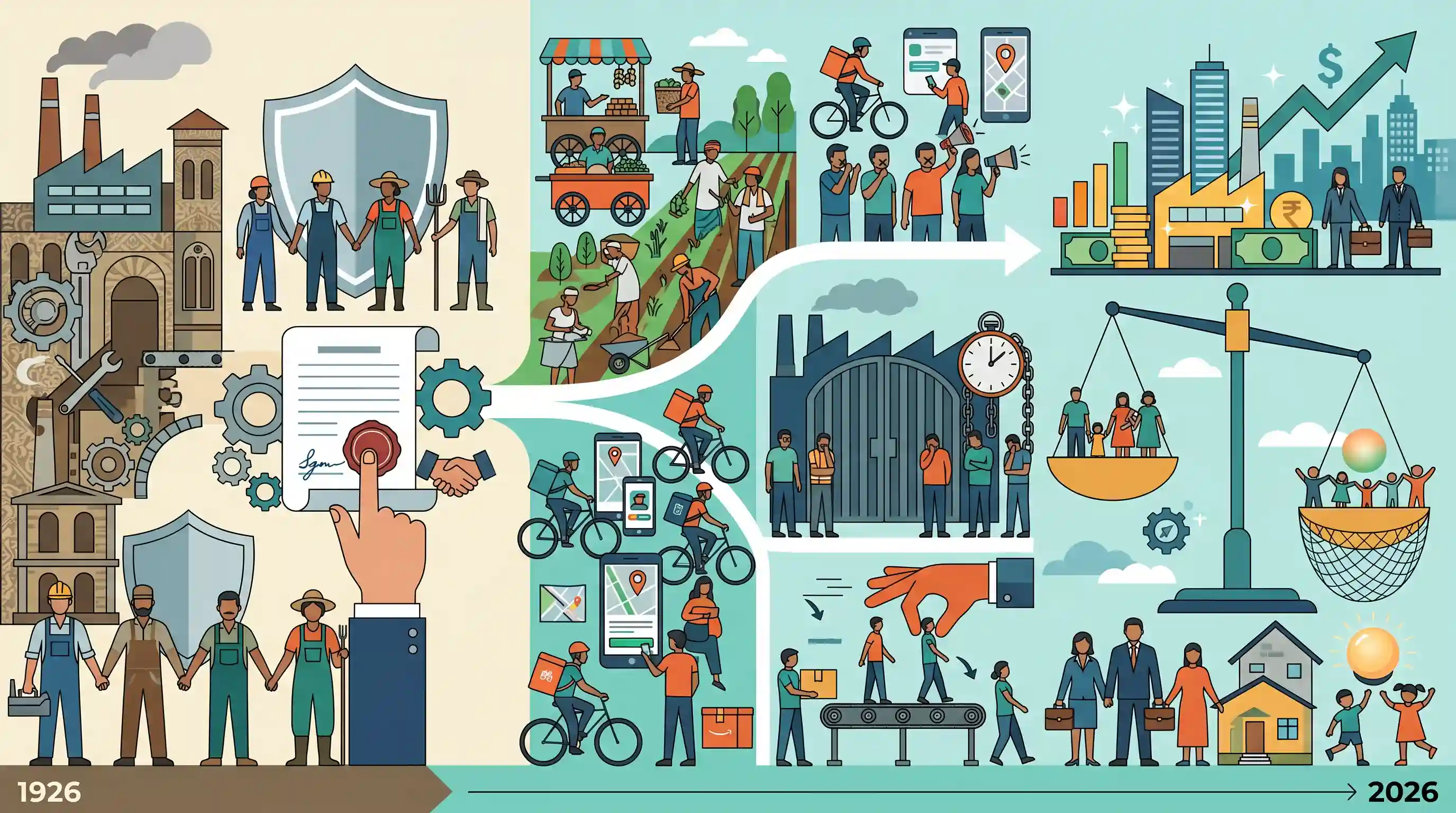
The year 2026 marks the centenary of the Trade Unions Act of 1926, a foundational law that granted legal recognition and immunity to labor unions in India. Despite this historic legislative milestone, the article argues that real protection for workers continues to be elusive. The modern labor landscape is characterized by deep vulnerabilities, driven by the persistent dominance of the unorganized sector and the explosive growth of the gig and platform economy. Furthermore, the transition to the four new Labour Codes has sparked concerns among trade unions about the dilution of collective bargaining rights, harder conditions for legal strikes, and easier hiring-and-firing norms. Ultimately, the piece highlights the ongoing tension between pursuing economic growth and safeguarding equitable, secure conditions for India's workforce.
Key Points
- The Trade Unions Act of 1926 was a historic milestone that gave legal recognition and immunity to trade unions, facilitating collective bargaining in India.
- A century later, genuine worker protection remains weak due to the high informalization of the workforce, with over 90% of workers in the unorganized sector lacking social security and formal contracts.
- The consolidation of 29 central labor laws into four new Labour Codes (such as the Industrial Relations Code) has faced criticism for allegedly making strikes harder and easing retrenchment, potentially eroding union power.
- The rise of the platform and gig economy has created new categories of workers who fall outside traditional employer-employee relationships, leaving them highly vulnerable.
- Effective enforcement mechanisms and an update to labor rights are urgently needed to ensure that the drive for 'ease of doing business' does not compromise fundamental labor standards.
Important Terms
Trade Unions Act, 1926

A foundational law providing legal status, registration, and immunity from civil and criminal liability to labor unions for bona fide activities, facilitating collective bargaining in colonial India.
UPSC context
GS1 Modern History (Labour movements); GS2/GS3 (Industrial relations and labor laws).
Industrial Relations Code, 2020
A modern code consolidating laws on trade unions, industrial disputes, and standing orders. It introduces stricter strike notice periods and higher thresholds for layoffs to enhance business flexibility.
UPSC context
GS2 Government Policies; GS3 Indian Economy (Labour reforms and ease of doing business).
Code on Social Security, 2020
A major reform consolidating nine social security laws and extending statutory benefits like insurance and pensions to unorganized, gig, and platform workers for the first time.
UPSC context
GS2 Social Justice; GS3 Inclusive Growth (Gig economy and social safety nets).
Trade Disputes Act, 1929
A repressive colonial law that restricted strikes and union activities, famously protested by Bhagat Singh and B.K. Dutt with a 1929 bomb in the Central Legislative Assembly.
UPSC context
GS1 Modern History (Revolutionary activities and nationalist struggle).
International Labour Organization (ILO)
A specialized UN agency (est. 1919) that sets international labor standards and promotes social justice through tripartite dialogue between governments, employers, and worker representatives.
UPSC context
GS2 International Institutions; GS3 Global labor rights and employment.
Central Trade Unions (CTUs)
National-level labor federations recognized by the Ministry of Labour for tripartite consultations, typically requiring a verified membership of 500,000+ workers across multiple states and industries.
UPSC context
GS2 Pressure Groups; GS3 Industrial relations and labor welfare.
Prelims Trap
"The Trade Unions Act of 1926 makes the registration of trade unions mandatory for collective bargaining."
Registration is optional, aligning with Article 19(1)(c). Unregistered unions exist, but only registered unions gain statutory immunity from civil suits and criminal conspiracy.
Static Concepts Connected
Who were the pioneers of the early Indian trade union movement?
- N.M. Lokhande: Formed the Bombay Mill Hands Association (1890), widely considered the precursor to organized labor movements in India.
- B.P. Wadia: Founded the Madras Labour Union in 1918, recognized as India's first formal, modern trade union.
- Lala Lajpat Rai: Served as the first president of the All India Trade Union Congress (AITUC), established in 1920.
How do the 2020 Labour Codes alter worker protections and industrial relations?
- Retrenchment flexibility: The Industrial Relations Code increases the threshold for requiring government permission to lay off or retrench workers from 100 to 300 employees.
- Strike restrictions: The Code makes legal strikes harder by mandating a minimum 60-day prior notice period across all industrial establishments.
- Platform worker recognition: The Code on Social Security provides first-time statutory recognition to gig workers, requiring aggregators to contribute 1-2% of turnover to a welfare fund.
Cross-Topic Patterns
Gig economy + Federalism dynamics
As central Labour Codes await full implementation, states like Rajasthan are passing standalone Gig Workers Acts, testing the concurrent list dynamics of labour welfare.
Article 19(1)(c) + Economic Reforms
The ongoing tension between the fundamental right to form associations under Article 19(1)(c) and the state's push for 'Ease of Doing Business' via relaxed industrial relations.

The 1926 Act's centenary makes a multi-statement Prelims question mixing AITUC/Wadia history with 2020 Labour Codes highly likely in 2026.
Linked PYQs · 4
Linked PYQs · 4
- 2024MainsGS3
Discuss the merits and demerits of the four 'Labour Codes' in the context of labour market reforms in India. What has been the progress so far in this regard?
- 2016MainsGS3
How globalization has led to the reduction of employment in the formal sector of the Indian economy? Is increased informalization detrimental to the development of the country?
- 2017PrelimsGS1
Consider the following statements: 1. The Factories Act, 1881 was passed with a view to fix the wages of industrial workers and to allow the workers to form trade unions. 2. N.M. Lokhande was a pioneer in organizing the labour movement in British India. Which of the above statements is/are correct?
- 2017PrelimsGS1
The Trade Disputes Act of 1929 provided for
